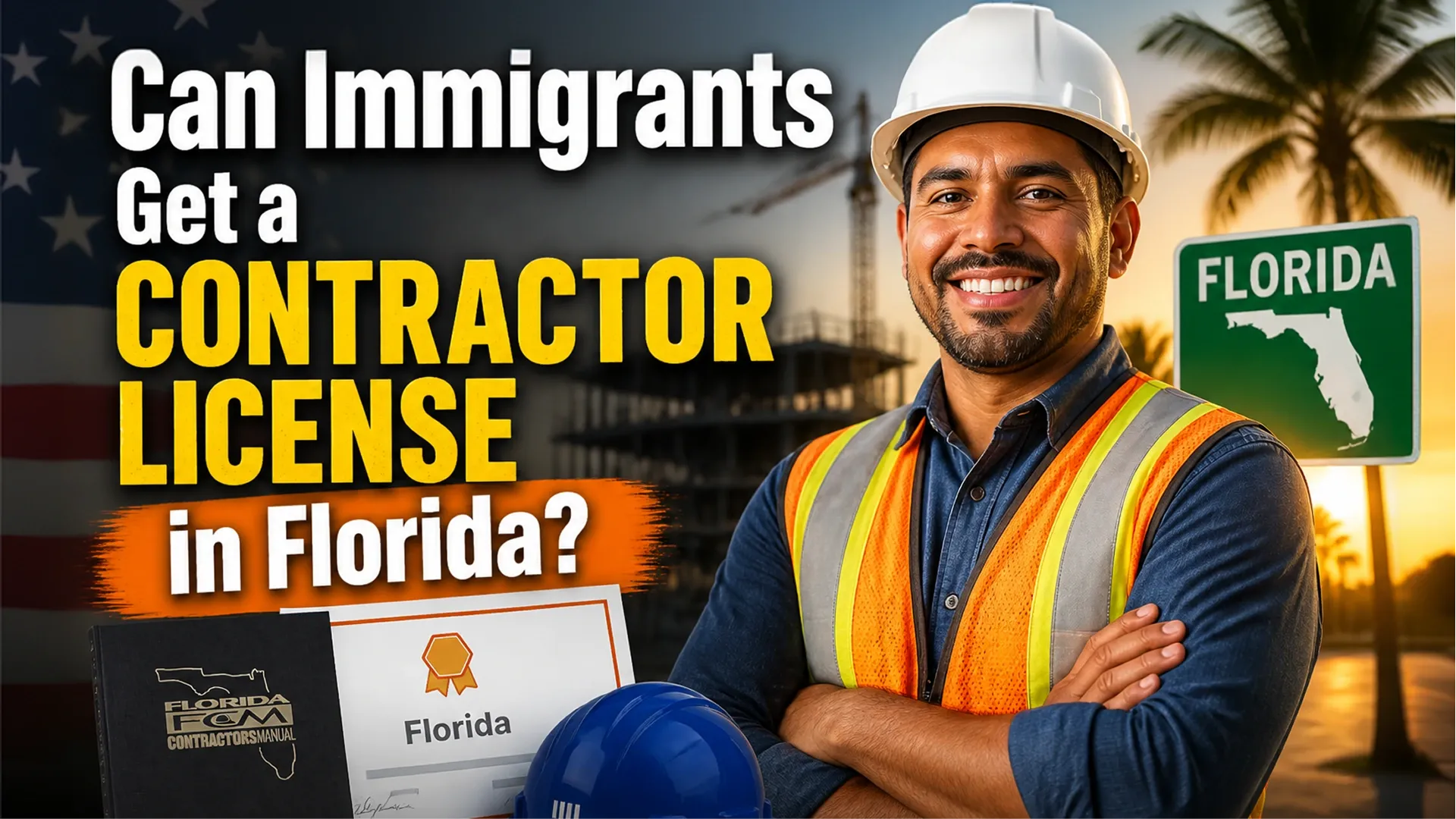
Can Immigrants Get a Contractor License in Florida?
You don't need to be a citizen to get a contractor license in Florida. Learn what immigrants really need to qualify and pass the exam.

Adrian Coastal Roofing
You've been building in Florida for years. You know how to read a blueprint, manage a crew, and deliver a project on time. But when it comes to getting your contractor license for immigrants, there's always that one question holding you back: Can someone like me actually get licensed here?
The short answer is yes. Florida law does not require citizenship or a green card to get a contractor license for immigrants. What it requires is experience, character, insurance and passing an exam you can absolutely prepare for.
This article is for every Hispanic, Brazilian, Caribbean and immigrant contractor who has been doing the work without the license. It's time to change that.
Florida Law Doesn't Ask Where You're From
When you apply for a contractor license for immigrants in Florida, the DBPR, the Department of Business and Professional Regulation, reviews your application based on the following:
- You are at least 18 years old
- You are of good moral character
- You have the required work experience or education
- You carry the required insurance
- You pass the state exam
Citizenship status is not on that list. Immigration status is not on that list. Florida's contractor licensing laws focus on your ability to do the work, not on your passport.
That doesn't mean everyone knows this. Many immigrant contractors in Florida have spent years believing that a license was out of reach, either because someone told them so or because the process looked too complicated in English. Neither of those is a good enough reason to keep working without legal protection.
The Real Requirements for a Contractor License for Immigrants
For a certified contractor license in Florida, you need to meet one of these experience paths:
- A 4-year college degree in engineering, architecture, or construction, plus 1 year of verified hands-on experience in your category.
- 4 years of active experience as a skilled tradesperson, with at least 1 year working as a foreman.
- A combination of college credits and field experience totaling 4 years, including at least 1 year as a foreman.
The experience doesn't have to have been in the U.S. but it does need to be documented. Letters from licensed contractors you've worked under, project records, affidavits from supervisors, these are all ways to prove your background to the CILB.
If you have years of construction experience from Brazil, Mexico, Puerto Rico, or anywhere else, that experience can count. The key is documenting it properly.
What About the Exam? Do I Need Perfect English?
This is one of the biggest worries among Hispanic and immigrant contractors in Florida and the honest answer is: no, you don't need perfect English to pass the Florida contractor exam.
Here's why:
The exam is open book. You bring approved reference materials into the room. You can use those books to find answers. You are not writing essays or being graded on your English, you are selecting answers on a multiple-choice test, using the same books the question was written from.
Approved translation dictionaries are allowed. Florida law permits the use of strict translation dictionaries in the exam room. This means you can bring a bilingual dictionary to help you understand terminology.
An oral exam option exists. Under Florida Administrative Code, applicants can petition the CILB for an oral examination in certain cases. In an oral exam, someone reads the questions aloud to you, and you get twice as much time to complete it. It's not available for general and building contractor categories, but it is available for many specialty licenses.
Many contractors working as a Hispanic contractor in Florida today passed the exam without perfect English, because with the right preparation, the exam becomes about finding the answer in your books, not about your fluency.
How Contractor School Florida Can Help You Prepare
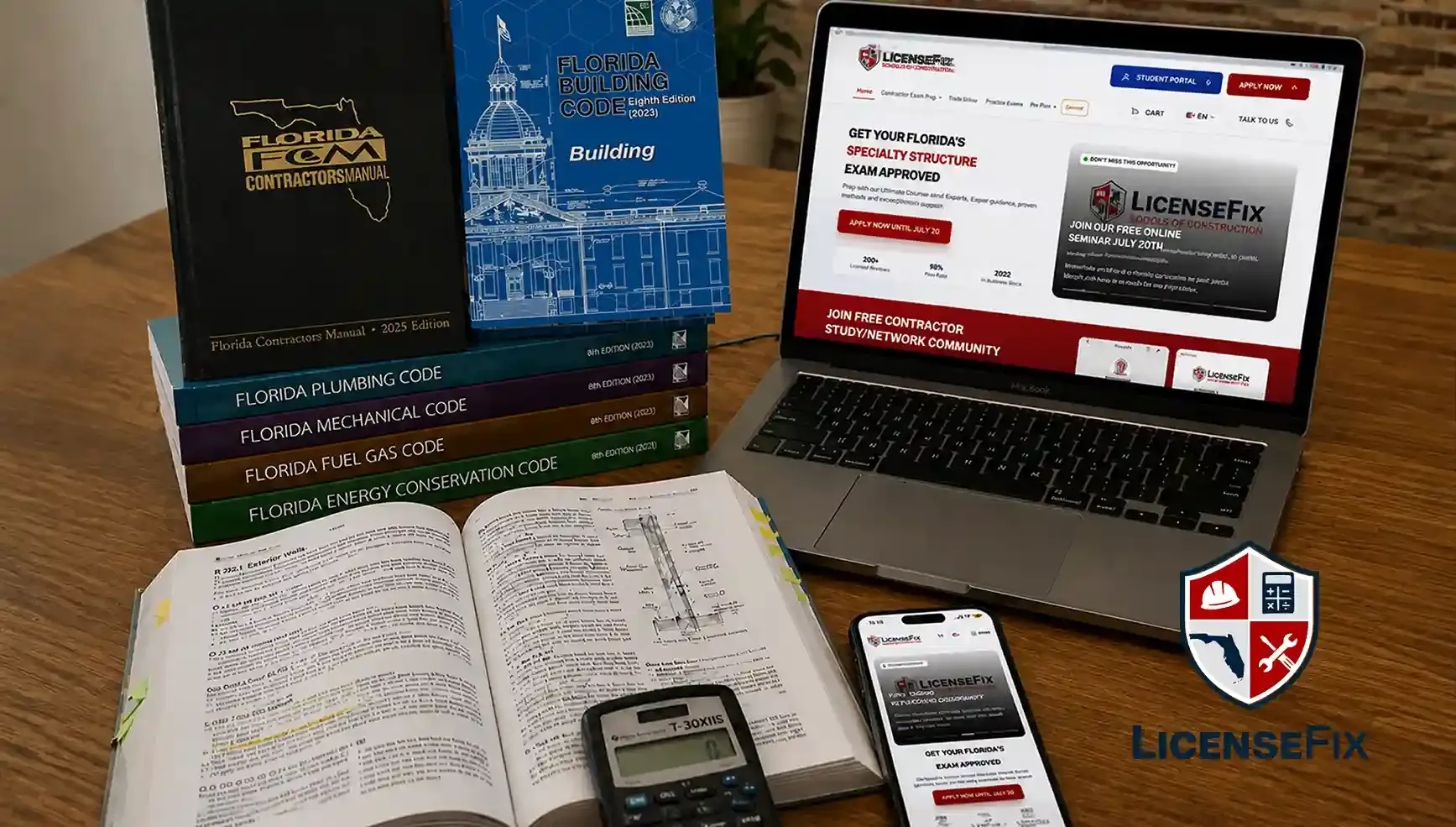
Knowing the rules is one thing. Walking into the exam room ready to pass is another. This is exactly what a good contractor school in Florida does, it prepares you for the format of the exam, not just the content.
A quality contractor school in Florida will:
- Teach you how to use your reference books quickly, under timed conditions
- Explain the business and finance section in plain language (this is where many fail)
- Help you understand Florida-specific laws like lien law, workers' comp requirements, and Chapter 489
- Offer support in multiple languages, so you're not learning in a language that slows you down
At LicenseFix School, we work with contractors in English and Spanish. We know that the contractor license for immigrants is not just a piece of paper, it's a career milestone that changes what's possible for you and your family.
What Immigrant Contractors in Florida Often Get Wrong
There are a few patterns we see again and again among immigrant contractors who delay getting their license:
Believing you need a green card or citizenship. You don't. The DBPR doesn't ask for immigration status to process a contractor license application.
Thinking the exam is impossible without strong English. It's not. With the right reference materials, a translation dictionary, and good preparation, the open-book format levels the field.
Not documenting experience properly. This is the most common delay. If you've worked under licensed contractors, get affidavit letters from them before you apply. The CILB needs proof, and "I've been doing this for 10 years" isn't proof on its own.
Waiting for the "right moment." The only cost of waiting is more time without the license, more money going to someone else who signs your permits, more jobs you can't bid on directly.
Frequently Asked Questions
Do I need a Social Security Number to get a contractor license in Florida?
The DBPR application does ask for identification. While many immigrants use an ITIN (Individual Taxpayer Identification Number) or other forms of government-issued ID, the specific requirements can vary. LicenseFix School can walk you through exactly what's accepted in your situation.
Can I count experience I got in my home country?
Yes, if it's documented. The CILB looks at experience gained under a licensed contractor. If you worked under someone with the equivalent of a contractor license in your country, you'll need letters or records proving that experience. It's not automatic, but it is possible.
Is the Florida contractor exam available in Spanish?
The exam itself is administered in English. However, you can bring a bilingual dictionary, and LicenseFix School offers exam preparation in Spanish so you understand the material well before test day.
What is the passing score on the Florida contractor exam?
You need to score 70% or higher on each part of the exam. If you fail one part and pass another, you only retake the part you failed, your passing scores stay valid for up to 4 years.
The License Is Within Reach — Start Now
Thousands of immigrant contractors are licensed in Florida today. Some of them came from Brazil. Some from Honduras. Some from Colombia and Mexico and Haiti and the Dominican Republic. They figured out the process, documented their experience, and passed the exam.
You can do the same.
Get support in English or Spanish: talk to LicenseFix School today at (888) 538-1225. We'll help you understand exactly where you stand and what steps come next for your contractor license for immigrants in Florida.

About Adrian Coastal Roofing
Adrian is the CEO of Coastal Roofing, a company specializing in roof installation in Florida, recognized for its quality, reliability, and excellence in residential and commercial projects. With years of experience in the construction industry and Florida roofing, Adrian has built his reputation by delivering durable solutions that withstand the state’s extreme weather. Under his leadership, Coastal Roofing has become a leader in roof installation in Florida, offering modern systems such as TPO, PVC, metal roofing, and other efficient solutions to reduce costs and extend the lifespan of roofs.