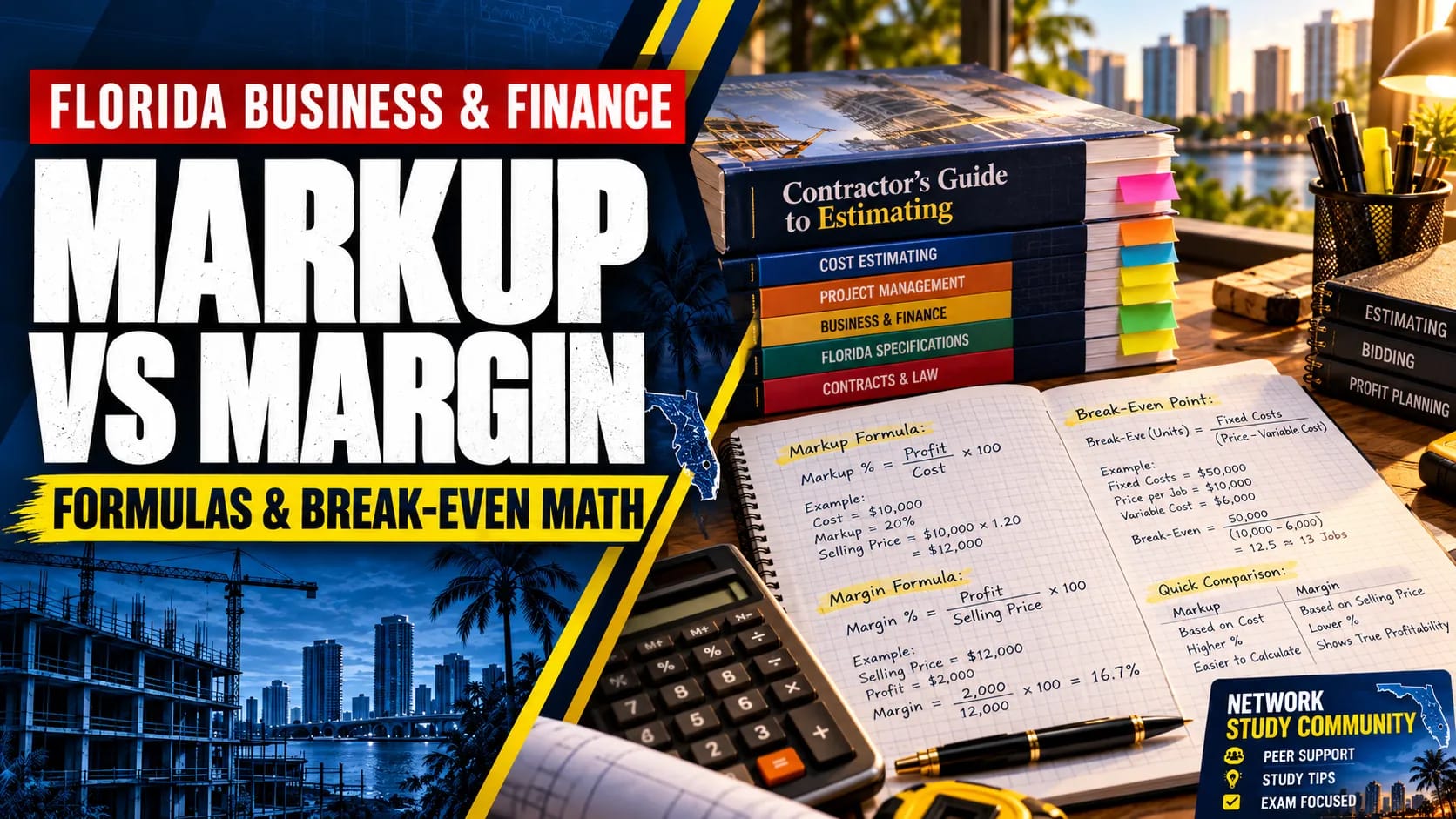
Markup vs. Margin and Overhead Math: Cracking Chapter 3 of the Florida Contractors Manual
Never confuse markup with margin on the Florida Business and Finance exam. Master Chapter 3 formulas, break-even math, and bids with License Fix.

If there is one math error that derails skilled builders on the Florida Construction Industry Licensing Board (CILB) Business and Finance exam, it is confusing markup with margin.
In casual field conversation, contractors often treat markup and gross margin as interchangeable terms. On the Pearson VUE examination, confusing the two will guarantee the wrong answer every single time. Pearson VUE exam writers intentionally design multiple-choice distractors using the markup percentage where the margin percentage belongs, and vice versa.
Combined with questions on general overhead distribution, break-even analysis, and net profit calculations, Chapter 3 of the Florida Contractors Manual accounts for a heavy slice of the quantitative scoring on your test. In this guide, License Fix School breaks down the exact formulas, step-by-step conversion techniques, and math shortcuts you need to ace these questions on test day.
1. The Fundamental Difference: Markup vs. Margin
To never miss a pricing question on the exam, remember the denominator:
- Markup is the percentage added to the Cost of the project to determine the selling price.
$$\text{Markup} = \frac{\text{Gross Profit}}{\text{Cost}}$$ - Margin (Gross Profit Margin) is the percentage of the Selling Price that represents gross profit.
$$\text{Margin} = \frac{\text{Gross Profit}}{\text{Selling Price}}$$
The Golden Relationship:
Gross Profit is identical in dollar terms:
$$\text{Gross Profit} = \text{Selling Price} - \text{Direct Costs}$$
However, because Selling Price is always larger than Cost (on a profitable job), Markup percentage is ALWAYS higher than Margin percentage.
| Desired Margin | Required Markup |
|---|---|
| 10% | 11.1% |
| 15% | 17.6% |
| 20% | 25.0% |
| 25% | 33.3% |
| 30% | 42.9% |
| 33.3% | 50.0% |
| 50% | 100.0% |
2. The Conversion Formulas You Must Memorize
You will frequently encounter exam questions that state: "A contractor's direct costs for a commercial renovation are $120,000. If the contractor desires a 20% gross profit margin, what should the contract bid price be?"
The Deadly Mistake:
The most common mistake is taking 20% of $120,000 ($24,000) and adding it to get $144,000. That is applying a 20% markup, not a 20% margin!
If you sell the job for $144,000:
$$\text{Margin} = \frac{$144,000 - $120,000}{$144,000} = \frac{$24,000}{$144,000} = 16.67%$$
You underpriced your job and failed the question!
The Correct Formula: Selling Price From Cost & Desired Margin
$$\text{Selling Price} = \frac{\text{Direct Cost}}{1 - \text{Desired Margin}}$$
Applying the correct formula:
$$\text{Selling Price} = \frac{$120,000}{1 - 0.20} = \frac{$120,000}{0.80} = \mathbf{$150,000}$$
Proof:
$$\text{Gross Profit} = $150,000 - $120,000 = $30,000$$
$$\text{Margin} = \frac{$30,000}{$150,000} = \mathbf{20%}$$
3. Distributing General Overhead to Job Bids
In construction accounting, costs fall into two buckets:
- Direct Costs (Cost of Goods Sold / Job Costs): Labor, materials, subcontractors, and equipment dedicated to a specific job.
- Indirect Costs (General & Administrative Overhead): Office rent, administrative salaries, legal fees, advertising, insurance, and utilities that exist regardless of whether a job is active.
On the exam, you will be asked to determine how much overhead must be allocated to a project to ensure the company remains profitable.
Overhead as a Percentage of Direct Costs
If a contractor's annual budget projects:
- Total Direct Job Costs: $800,000
- Total Operating Overhead: $160,000
- Target Net Profit: $80,000
The Overhead Rate based on direct cost is:
$$\text{Overhead Rate} = \frac{$160,000}{$800,000} = 20%$$
The Profit Rate based on direct cost is:
$$\text{Profit Rate} = \frac{$80,000}{$800,000} = 10%$$
Total Markup on Direct Costs = $20% + 10% = \mathbf{30%}$.
For an upcoming project with $45,000 in estimated direct costs, the contractor must bid:
$$\text{Bid Price} = $45,000 \times 1.30 = \mathbf{$58,500}$$
4. Break-Even Point Calculations
Another standard Chapter 3 exam problem tests break-even volume -- the dollar volume of sales required to cover all fixed and variable expenses with zero net profit and zero loss.
The Break-Even Formula:
$$\text{Break-Even Sales Volume} = \frac{\text{Total Fixed Overhead Expenses}}{\text{Gross Margin Percentage}}$$
Sample Exam Question:
A roofing contractor has fixed annual overhead expenses of $180,000. If the company operates at an average gross margin of 25% on all projects, what annual sales volume is necessary for the company to break even?
Solution:
$$\text{Break-Even Sales} = \frac{$180,000}{0.25} = \mathbf{$720,000}$$
If the question asked how much sales volume is required to achieve a $60,000 net profit, simply add the desired profit to the fixed overhead:
$$\text{Required Sales} = \frac{$180,000 + $60,000}{0.25} = \frac{$240,000}{0.25} = \mathbf{$960,000}$$
5. Top Test-Day Tips for Math Questions
- Write Down the Given Values First: When you read a word problem, write down on your scratch paper: Cost = X, Margin = Y, Overhead = Z. Label them clearly so you don't plug a margin into a markup formula.
- Work Backwards From Multiple Choice Options: If you forget an algebraic formula during testing fatigue, use the four multiple-choice options! Take Option A, subtract direct costs, divide by the option itself, and see if it yields the desired margin percentage in the question.
- Use the Memory Feature on Your Approved Calculator: Pearson VUE allows specific basic scientific or standard calculators. Practice using the percentage and memory keys (M+, MR) before test day so you don't waste time retyping 7-digit numbers.
Practical Worked Example: Job Costing and Overhead Allocation
Let us walk through a comprehensive estimating problem that combines direct costs, operating overhead, and targeted profit margins:
Problem Scenario:
A commercial general contractor is preparing a bid for an interior buildout. Direct job costs are estimated as follows:
- Direct Materials: $62,000
- Direct Labor: $44,000
- Subcontractors: $58,000
- Equipment Rental: $16,000
The contractor's historical financial statements show that annual General & Administrative (G&A) overhead equals 15% of total direct job costs. The company's business plan establishes a required net profit margin of 12% on the total contract price. What is the minimum bid price the contractor should submit?
Step-by-Step Solution:
-
Calculate Total Direct Costs:
Total Direct Costs = $62,000 + $44,000 + $58,000 + $16,000 = $180,000 -
Calculate Allocated Overhead:
Overhead = $180,000 x 0.15 = $27,000 -
Calculate Total Cost Before Profit:
Total Cost = $180,000 + $27,000 = $207,000 -
Apply the Profit Margin Formula (Selling Price with 12% Margin):
Remember, do NOT multiply $207,000 by 1.12 (that would be markup, not margin)!
Bid Price = Total Cost / (1 - Desired Margin)
Bid Price = $207,000 / (1 - 0.12)
Bid Price = $207,000 / 0.88 = $235,227.27
Verification:
- Gross Profit = $235,227.27 - $207,000 = $28,227.27
- Margin = $28,227.27 / $235,227.27 = 12.0%
This systematic calculation ensures that both operating overhead and targeted profit are fully recovered in every bid you submit.
Pass the Florida Contractor Exam With License Fix School
Contractor math doesn't have to be intimidating. With the right formulas, clear examples, and proven test-day strategies, you can turn Business and Finance calculations into guaranteed points.
At License Fix School, our specialized exam prep courses deliver:
- Comprehensive math workshops focusing specifically on Chapter 3 accounting problems.
- Tabbed, highlighted reference guides for the Florida Contractors Manual.
- High-volume question banks mirroring real Pearson VUE test items.
- Full support from experienced contractor licensing instructors who guide you every step of the way.
Take the guesswork out of your contractor exam prep. Contact License Fix School today and get licensed on your first attempt.

About Pascual, Contractor Licensing Instructor
Pascual is a Florida contractor licensing exam prep specialist, with a focus on the Business & Finance and General Contractor exams. He has helped numerous candidates prepare for and pass their state exams, combining technical knowledge of Florida's regulations with practical study strategies. His approach is straightforward and grounded in real experience with the exam format, helping future contractors understand not just the content, but also how to avoid the most common mistakes that trip up candidates.
More from Pascual, Contractor Licensing Instructor