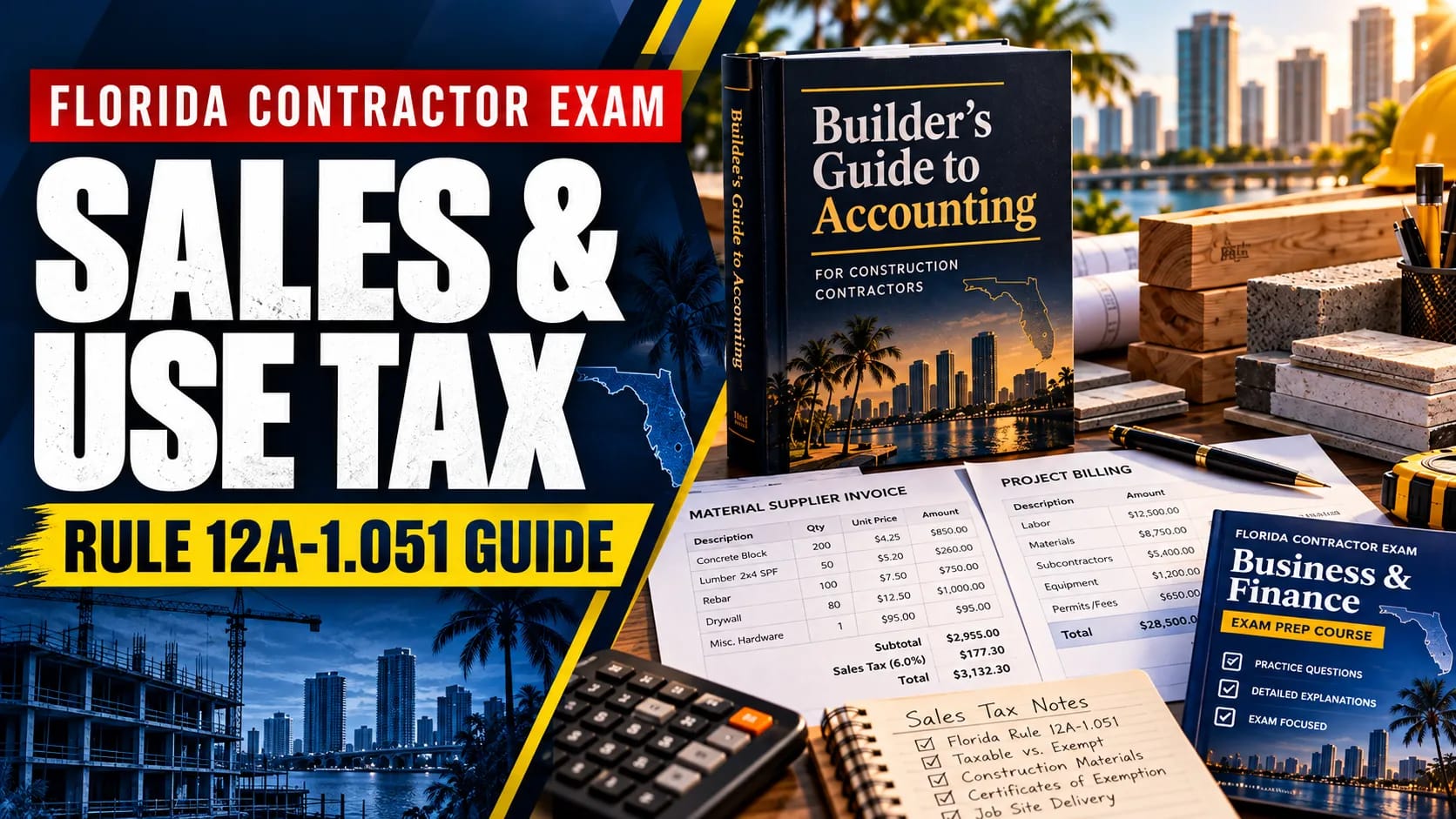
Florida Contractor Sales and Use Tax: How Rule 12A-1.051 Is Tested on the B&F Exam
Understand Florida Rule 12A-1.051 sales and use tax for the contractor Business & Finance exam. Contract types, exemptions, and surtax by License Fix.

Few topics on the Florida Construction Industry Licensing Board (CILB) Business & Finance exam cause more confusion than sales and use tax. Most contractors understand retail sales tax: a store sells an item, adds 6% plus county discretionary surtax, and remits it to the state. But in the construction world, contractors rarely act as retail sellers. Instead, they improve real property.
Under Florida Administrative Code (F.A.C.) Rule 12A-1.051 (Sales to or by Contractors Who Repair, Alter, Improve, or Construct Real Property), the tax treatment of materials changes completely depending on how your construction contract is structured.
If you don't know the difference between a lump-sum contract and a retail sale plus installation contract on test day, you will get tripped up on multiple questions pulled from the Florida Department of Revenue guidelines in the Florida Contractors Manual. In this article, License Fix School breaks down the critical sales and use tax rules tested on the exam.
1. The Core Principle: Contractors as Ultimate Consumers
The cornerstone concept of Florida construction tax law is that a contractor who purchases materials to alter, improve, or repair real property is generally considered the ultimate consumer of those materials.
- The General Rule: When you buy lumber, concrete, electrical wire, or roofing shingles from a building supply store, you must pay sales tax to the vendor at the time of purchase.
- No Sales Tax Billed to the Property Owner: Because you already paid sales tax on the materials as the ultimate consumer, you do NOT bill sales tax to the property owner on your lump-sum invoice. The cost of materials (including the sales tax you paid) is simply buried inside your overall contract price.
2. The Five Types of Construction Contracts Under Rule 12A-1.051
The CILB Business and Finance exam tests your ability to classify construction contracts and determine who owes sales tax, when it is due, and how it must be invoiced. Rule 12A-1.051 identifies five distinct contractual structures:
1. Lump-Sum Contracts
- Definition: The contractor agrees to complete a defined scope of work for a single fixed price.
- Tax Rule: The contractor is the ultimate consumer. The contractor pays sales tax on materials to the supplier at the time of purchase. The contractor does not charge sales tax to the customer.
2. Cost-Plus or Fixed-Fee Contracts
- Definition: The contractor agrees to complete the project for the actual cost of labor and materials, plus an agreed percentage or fixed management fee.
- Tax Rule: Exactly the same as a lump-sum contract. Even though costs are itemized for billing verification, the contractor remains the ultimate consumer and pays tax to the material supplier. The contractor does not charge sales tax on the final customer invoice.
3. Guaranteed Maximum Price (GMP) Contracts
- Definition: Cost of the project is reimbursed up to a specified ceiling, with cost savings often shared.
- Tax Rule: Same as lump-sum and cost-plus. The contractor pays tax upon purchasing materials.
4. Time and Materials (T&M) Contracts
- Definition: Labor is billed at set hourly rates, and materials are billed at agreed rates.
- Tax Rule: Unless the contract qualifies as a 'retail sale plus installation' agreement (described below), the contractor is still considered the ultimate consumer and must pay sales tax to the supplier when buying materials.
5. Retail Sale Plus Installation Contracts (The Critical Exception)
- Definition: A contract where the agreement explicitly states two separate figures:
- An agreed retail sales price for the materials, AND
- A separate agreed charge for the installation labor.
- Tax Rule (THE EXCEPTION): The contractor acts as a registered retail dealer.
- The contractor purchases materials from the supplier tax-free using a Florida Annual Resale Certificate for Sales Tax (Form DR-13).
- The contractor charges sales tax to the customer on the material portion of the invoice.
- The installation labor remains non-taxable, provided it is broken out separately on the contract and invoice.
3. Real Property Improvements vs. Tangible Personal Property (TPP)
Another favorite trick on the exam is distinguishing between an improvement to real property versus the sale of tangible personal property:
- Real Property Improvement: Once materials are installed, they become permanent fixtures attached to the land or building (e.g., roofs, poured concrete slabs, central HVAC systems, underground plumbing, structural framing). The contractor pays tax as the consumer.
- Tangible Personal Property (TPP): Items that do not become permanent parts of the realty and can be easily unplugged or removed without structural damage (e.g., freestanding kitchen refrigerators, washing machines, window blinds, office furniture).
- When a contractor sells and installs TPP, they must collect sales tax from the customer on the full sales price unless specifically exempt.
4. Government and Non-Profit Exemptions: The Direct Purchase Rule
In Florida, state and local government agencies, public school boards, and 501(c)(3) religious/charitable organizations hold Consumer's Certificate of Exemption (Form DR-14) and are exempt from paying sales tax.
However, exam questions love to test the Direct Purchase / Owner Direct Purchase (ODP) protocol:
- The Trap: A contractor building a school or municipal park cannot simply flash the school district's tax-exempt certificate at the lumber yard. If the contractor buys the materials in the contractor's name, the purchase is 100% taxable, even if the materials will be installed on an exempt building!
- How to Qualify for the Exemption: To legally avoid sales tax on public/exempt projects:
- The exempt entity must issue the purchase order directly to the material supplier.
- The supplier must invoice the exempt entity directly.
- The exempt entity must pay the supplier directly from public/exempt funds.
- The exempt entity must take title and assume risk of loss for the materials upon delivery to the jobsite.
If these four conditions are not met, the transaction is taxable.
5. Discretionary Sales Surtax and County Rates
Florida levies a statewide sales tax rate of 6.0%. However, individual Florida counties impose discretionary sales surtaxes (typically 0.5% to 1.5%), bringing total sales tax rates to 6.5%, 7.0%, 7.5%, or higher.
Key Exam Rules for Surtax:
- The $5,000 Limitation: The local county surtax applies only to the first $5,000 of a single transaction of tangible personal property. The state 6.0% rate applies to the entire amount, but the county surtax stops after $5,000.
- Jobsite Location Governs: When materials are delivered into a county, the surtax rate of the county where the materials are delivered and installed governs, not the county where the supplier's warehouse is located.
Master Florida Sales Tax Rules With License Fix School
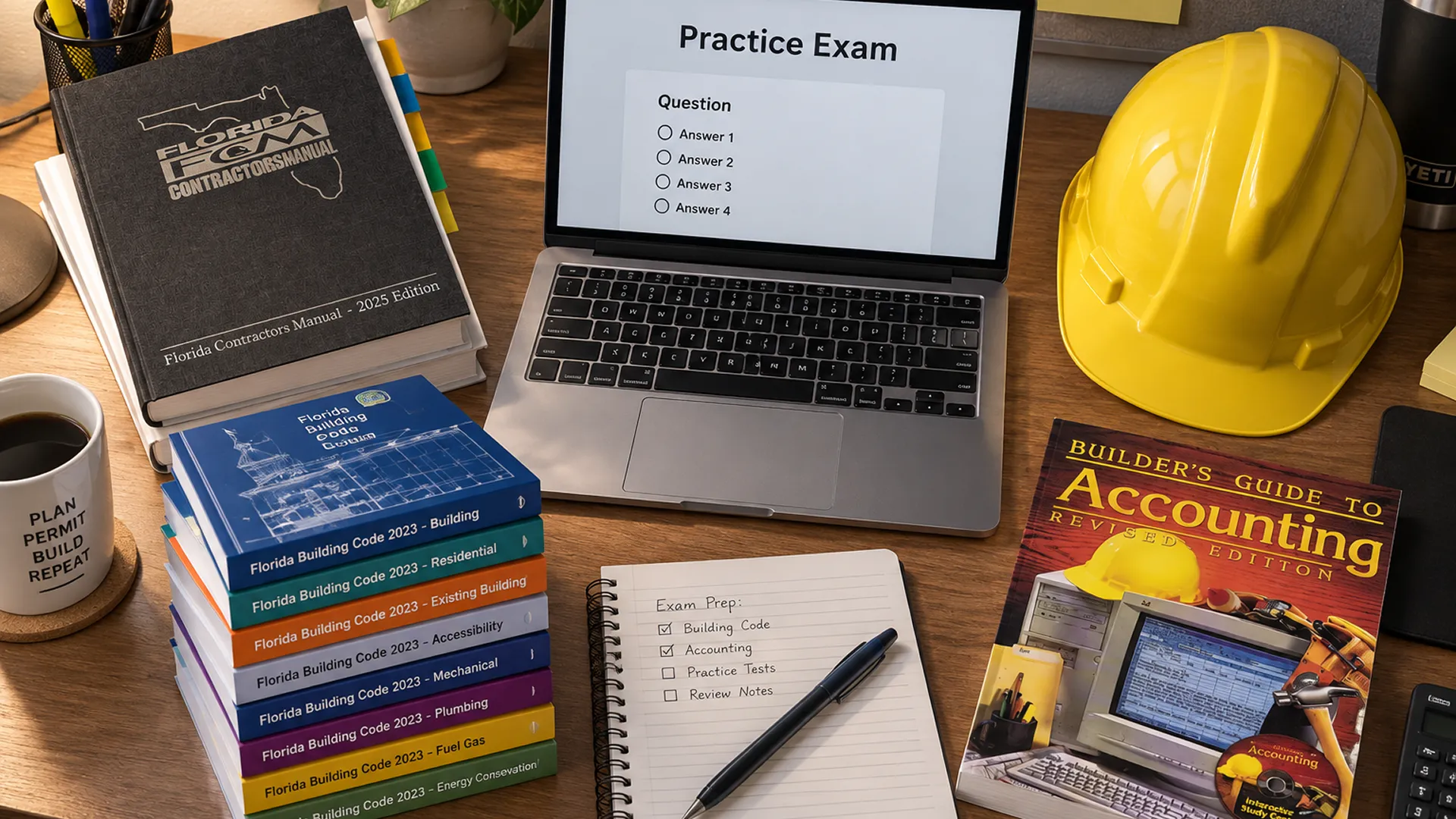
You don't need an accounting degree to master Florida contractor sales tax rules. You just need to know the core principles of Rule 12A-1.051 and have your Florida Contractors Manual tabbed and highlighted in all the right places.
At License Fix School, our proven exam prep system gives you:
- Exact page tabs for Chapter 3 and Rule 12A-1.051 in the Florida Contractors Manual.
- High-yield cheat sheets highlighting contract types and tax liabilities.
- Practice question banks that simulate the exact Pearson VUE testing format.
Don't let sales tax questions steal your passing score. Enroll with License Fix School today and secure your Florida contractor license on your first attempt.

About Pascual, Contractor Licensing Instructor
Pascual is a Florida contractor licensing exam prep specialist, with a focus on the Business & Finance and General Contractor exams. He has helped numerous candidates prepare for and pass their state exams, combining technical knowledge of Florida's regulations with practical study strategies. His approach is straightforward and grounded in real experience with the exam format, helping future contractors understand not just the content, but also how to avoid the most common mistakes that trip up candidates.
More from Pascual, Contractor Licensing Instructor