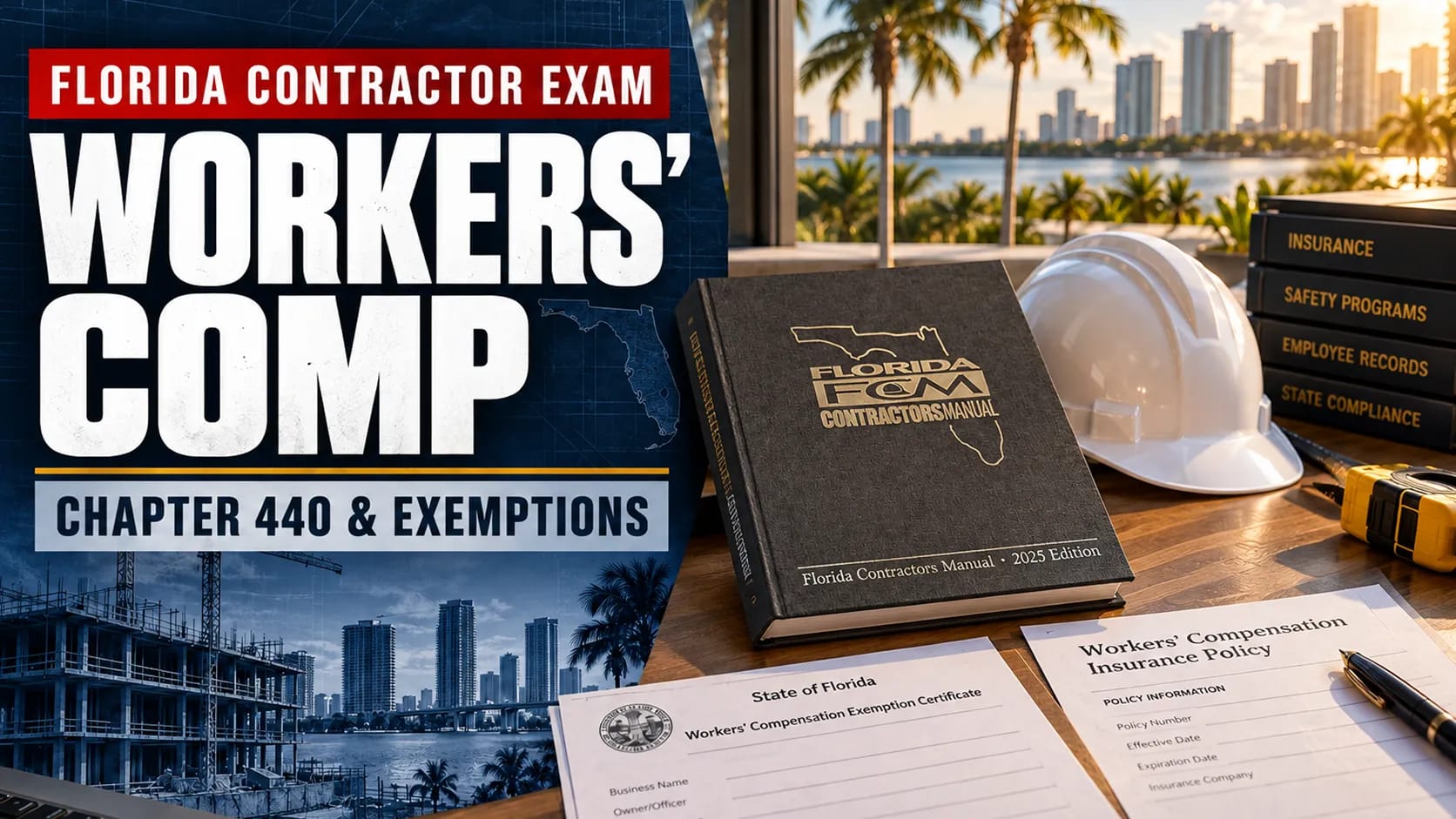
Florida Workers' Compensation for the B&F Exam: Chapter 440, Exemptions, and Penalties
Pass Florida Workers Comp questions on the Business and Finance exam. Learn Chapter 440 officer exemptions, stop-work fines, and rules with License Fix.

Among all administrative statutes tested on the Florida Construction Industry Licensing Board (CILB) Business & Finance exam, Florida Statutes Chapter 440 (Workers' Compensation) ranks among the most heavily weighted. The State of Florida enforces some of the strictest workers' compensation mandates for the construction industry anywhere in the country.
On test day, Pearson VUE will test you on employee threshold counts, corporate officer exemption rules, subcontractor liability flow-downs, and the brutal financial penalties levied by the Division of Workers' Compensation for non-compliance.
If you don't know the exact difference between an agricultural employer and a construction employer, or how to calculate a Stop-Work Order penalty, you can easily drop 4 to 6 critical points on your examination. Here is the complete breakdown of what you must know about Chapter 440 for the Florida Business and Finance exam.
1. The Construction Industry Threshold: Rule of One
The general rule in non-construction Florida businesses is that employers must carry workers' compensation once they employ 4 or more workers.
In the construction industry, this threshold does NOT apply.
- The Construction Mandate: Under F.S. 440.02, any construction business employing one or more employees (including the contractor, sole proprietor, or corporate officers who have not filed valid certificates of election to be exempt) is legally required to carry workers' compensation coverage.
- Corporate Officers Count as Employees: By default, every corporate officer or LLC member is classified as an employee unless they formally obtain an exemption certificate from the state.
2. Corporate Officer Exemptions: Limits, Ownership, and Rules
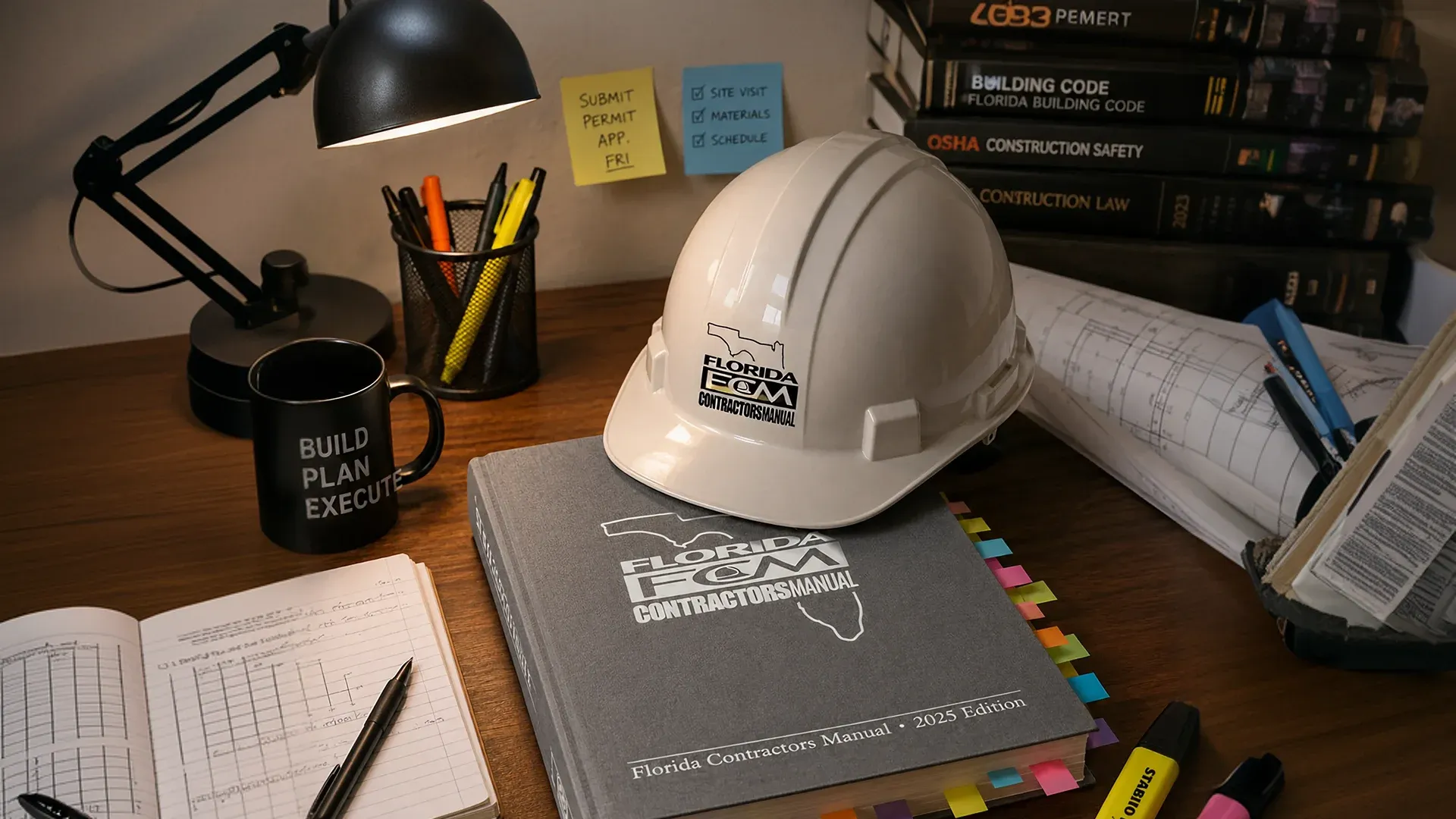
One of the most heavily tested areas on the Business and Finance exam is the exemption mechanism administered by the Florida Division of Workers' Compensation.
Key Exemption Requirements for Construction Officers:
- Ownership Percentage Threshold: To qualify for an exemption in the construction industry, a corporate officer or LLC managing member must own at least 10% of the business entity as registered with the Florida Department of State, Division of Corporations (Sunbiz).
- Maximum Exemptions Per Company: A construction entity can have a maximum of three (3) officers exempt at any given time.
- Application Fee: An officer exemption in construction requires a $50 application fee (valid for 2 years).
- Who Cannot Be Exempt: Independent contractors without business entities, non-officer employees, family members who own less than 10% equity, and sole proprietors/partners in construction cannot simply exempt themselves; they must be covered or meet strict legal criteria.
Exam Trap Alert:
If an exam question asks: "A Florida construction corporation has 5 shareholders, each owning 20% of the stock. All 5 are listed as officers. How many officers may legally exempt themselves from workers' compensation coverage under Chapter 440?"
The answer is 3. Even though all 5 own more than 10%, Florida law strictly limits construction exemptions to three officers per corporate entity.
3. Contractor Liability for Subcontractors (The Upward Liability Trap)
Under F.S. 440.10, the statutory employer doctrine dictates that a general contractor or prime contractor is ultimately responsible for ensuring that all downstream subcontractors carry valid workers' compensation coverage or valid exemptions.
- Certificate of Insurance Verification: Before letting any subcontractor perform work on a jobsite, the contractor must verify that the subcontractor's workers' comp policy is in active status on the state's coverage database (DWC Coverage Verification system).
- If a Subcontractor Has No Insurance: If an uninsured sub or an uninsured employee of a sub is injured on the project, the primary contractor's insurance carrier is legally forced to cover the claim.
- Audit Premium Backcharges: At the annual insurance audit, the prime contractor's carrier will demand certificates for every dollar paid to subcontractors. Any 1099 subcontractor who cannot produce a valid certificate of insurance or valid officer exemption will be reclassified as an employee, and the prime contractor will be billed backdated premiums on those labor dollars.
4. Enforcement: Stop-Work Orders and Penalty Calculations

The Florida Department of Financial Services (DFS), Division of Workers' Compensation, employs field compliance investigators who perform unannounced visits to active construction jobsites across the state.
The Stop-Work Order (SWO)
If an investigator finds an employer operating without mandatory workers' comp insurance or with improperly classified workers:
- An immediate Stop-Work Order is issued.
- All commercial operations at all jobsites across Florida must cease immediately.
- Working in violation of a Stop-Work Order is a third-degree felony.
How the Exam Tests the Penalty Formula:
The penalty calculation for operating without coverage is a classic math problem on the B&F exam:
- The Standard Penalty: The fine is equal to 2 times the amount the employer would have paid in workers' comp premiums over the preceding 36 months (3 years) of operation, or $2,000, whichever is greater.
- Underreported Payroll Penalty: If an employer underreports payroll or misclassifies employees into lower-risk code categories, the penalty is also equal to 2 times the difference in premium.
Sample Calculation:
An unlicensed roofing company is inspected by DFS. The investigator audits payroll for the previous two years and determines that the correct workers' compensation premium for that period should have been $18,000. What is the statutory penalty assessed under Chapter 440?
Solution:
Penalty = 2 x Determined Premium = 2 x $18,000 = $36,000.
5. Medical and Wage Replacement Benefits Under Chapter 440
Candidates should also know the standard benefit triggers tested under Florida workers' comp law:
- Waiting Period for Indemnity Benefits: No disability indemnity compensation is paid for the first 7 days of disability, unless the disability continues for more than 21 days, in which case compensation is paid from the first day of injury.
- Temporary Total Disability (TTD) Rate: Standard wage replacement is calculated at 66 2/3% (two-thirds) of the injured worker's Average Weekly Wage (AWW), subject to the state's statutory maximum cap. For catastrophic injuries (blindness, amputation), the rate jumps to 80% for up to 6 months.
- Employer Reporting Deadline: An employer must report an injury to their insurance carrier within 7 days of receiving notice of the accident (Form DFS-F2-DWC-1).
Key Workers' Comp Scenarios Tested on the Business & Finance Exam
To ensure you can apply Chapter 440 under time pressure, review these three recurring testing scenarios:
Scenario 1: The Multi-Member LLC in Construction
- Situation: An LLC has four managing members, each holding a 25% ownership stake. The company employs no outside workers. How many members must be covered?
- Analysis: Under Florida law, a construction company can exempt a maximum of three officers. Therefore, at least one managing member must be covered by a workers' compensation policy, or the company will be in violation.
Scenario 2: Uninsured Subcontractor on the Jobsite
- Situation: A general contractor hires an uninsured framing sub who brings two helpers onto the jobsite. An investigator from the Division of Workers' Compensation visits the site. Who receives the Stop-Work Order and penalty?
- Analysis: Both the subcontractor and the general contractor face severe consequences. The GC can be assessed penalties on the subcontractor's labor dollars and held strictly liable for any jobsite injury under the statutory employer doctrine.
Scenario 3: Timely Reporting and Penalties
- Situation: An employee sprains an ankle on Tuesday. When must the employer report the accident to the carrier?
- Analysis: Under F.S. 440.185, the employer has seven (7) days to notify the carrier after receiving notice or knowledge of the injury. Failure to report subjects the contractor to administrative fines.
Crush Chapter 440 With License Fix School
The Florida Business and Finance exam is notorious for testing obscure numerical details from Chapter 440. Trying to find these answers during the test without proper tabs and speed drills is an almost guaranteed path to running out of time.
At License Fix School, our specialized exam prep programs arm you with:
- Step-by-step guides for flagging and tabbing Chapter 440 in the Florida Contractors Manual.
- Targeted question banks mimicking Pearson VUE's exact phrasing on exemptions and Stop-Work penalties.
- Personalized coaching from instructors who have guided hundreds of Florida contractors through the licensing maze.
Get the edge you need to pass on your first try. Contact License Fix School today and take command of your contractor licensing journey.

About Pascual, Contractor Licensing Instructor
Pascual is a Florida contractor licensing exam prep specialist, with a focus on the Business & Finance and General Contractor exams. He has helped numerous candidates prepare for and pass their state exams, combining technical knowledge of Florida's regulations with practical study strategies. His approach is straightforward and grounded in real experience with the exam format, helping future contractors understand not just the content, but also how to avoid the most common mistakes that trip up candidates.
More from Pascual, Contractor Licensing Instructor