
Florida Business and Finance Exam Books: 2026 Reference List
The full 2026 list of Florida Business and Finance exam books, tabbing rules that avoid rejection, and how License Fix students use them to pass fast.

Adrian Coastal Roofing
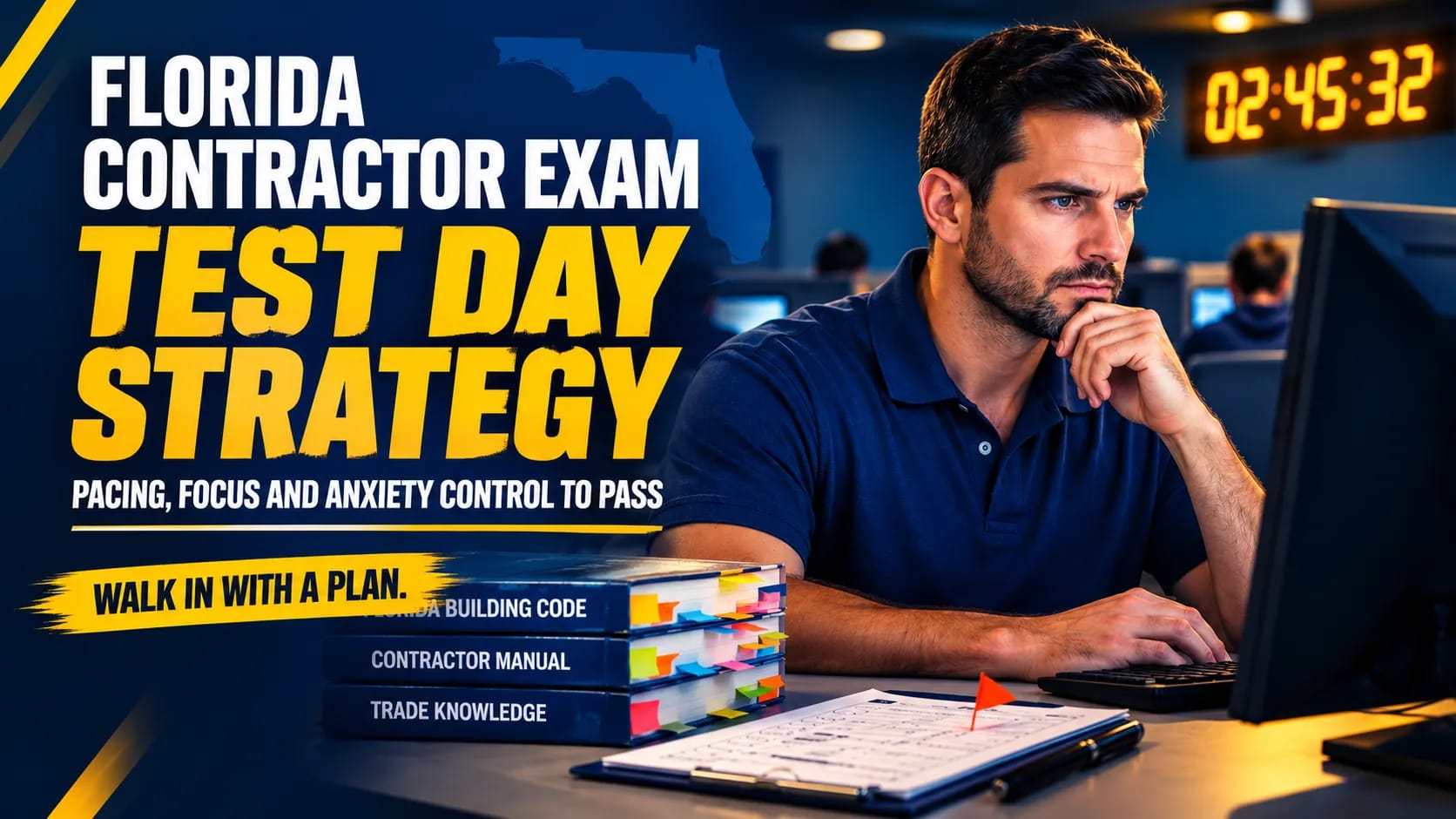
If you search "florida business and finance exam books" the week before your test date, you are probably staring at a stack of unopened manuals wondering which ones actually matter. Licensefix School of Construction covers this exact problem in their video "Showing you all the books you need for your Florida Business and finance EXAM!", walking through the physical stack every Division I and Division II candidate needs to bring into the Pearson VUE testing center. This guide expands on that walkthrough with the current Department of Business and Professional Regulation (DBPR) reference list, the rules that get books rejected at the door, and a tabbing approach that turns six manuals into an open-book advantage instead of a liability.
The Business and Finance exam is not a memorization test. It is an open-book, 120-question, 6.5-hour exam that every Division I contractor (General, Building, Residential) and every Division II specialty contractor must pass before they can hold a Florida license. Because it is open book, the exam rewards candidates who know exactly which book, which section, and which page holds the answer — not candidates who tried to memorize the Contractors Manual cover to cover.
The Official Florida Business and Finance Exam Books List
According to the DBPR's Business and Finance Computer-Based Testing (CBT) Reference List (effective January 2026), only these references may be brought into the testing room:
- Florida Statutes, Chapter 455 (2025 edition) — governs the regulation of professions and occupations, including licensing procedures, discipline, and complaint processes. A bound PDF version is accepted.
- Builder's Guide to Accounting (2001), published by Craftsman Book Company — covers job costing, financial statements, depreciation, and the accounting concepts tested on the exam's financial management questions.
- Contractors Manual (2025 edition), published by the Association of Builders and Contractors (ABC) Institute — the core reference for licensing law, contracts, lien law, and business practices. DBPR's current reference list still lists the 2021 printing with the note "(Includes the 2025 Circular E)" underneath it, and adds: "Beginning February 1, 2026, the 2025, Edition will be used for the exam" — so it is the 2025 edition, not the 2021 printing, that candidates should bring starting now.
- AIA Document A201 — General Conditions of the Contract for Construction (2017).
- AIA Document A401 — Standard Form of Agreement Between Contractor and Subcontractor (2017).
- AIA Document A701 — Instructions to Bidders (2018).
That is six references, three of them AIA contract documents, covering four distinct knowledge areas: state law, accounting, general contract conditions, and bidding procedure. Reference lists are refreshed periodically (DBPR publishes separate "Even" and "Odd" year versions), so always confirm the current edition on the DBPR Construction Examinations Reference Lists page before ordering books — using an outdated edition is allowed "at your own risk," but mismatched page numbers under a 6.5-hour clock is not a risk worth taking.
Why These Six Books, Specifically
Each book maps to a scored content area on the Business and Finance blueprint:
- Chapter 455 answers questions about licensing, discipline, unlicensed activity, and complaint procedure.
- Contractors Manual is the workhorse — it answers the majority of questions on lien law, contract law, insurance, and labor law.
- Builder's Guide to Accounting answers financial statement, ratio, and job-costing math questions, which are the section most experienced field contractors underestimate.
- AIA A201, A401, A701 answer contract-administration questions: general conditions, subcontractor agreements, and bidding instructions.
Candidates who only study the Contractors Manual and skip the AIA documents consistently lose points on contract-administration questions, because those three booklets are short but dense, and they are rarely opened until exam week.
Rules That Get Books Rejected at the Testing Center
The DBPR's Candidate Information Booklet is explicit about what makes a reference book usable versus disqualified on test day:
- One copy only. You may bring exactly one copy of each approved reference. A second copy of the same title will not be permitted.
- Books must remain as published. Underlining and highlighter marks are allowed. Loose annotations, printed summaries, or inserted pages are not.
- Tabs must be permanent and generic. Permanently attached tabs showing only normal chapter or page headings are allowed. Post-it notes, pull-off labels, or any removable tab must be taken out before you arrive — if a tab can be removed without damaging the page, proctors will treat it as removable and will not accept it.
- No photocopies, unless the publisher and DBPR's Bureau of Education and Testing have granted written authorization in advance.
- Anything not on the approved list gets stored along the wall or in lockers at the candidate's own risk — it will not travel with you to your seat.
These rules exist because the Business and Finance exam is administered by Pearson VUE on behalf of DBPR and Professional Testing, Inc. (PTI), and consistency across testing centers statewide depends on every candidate bringing an identical, standardized set of references.
How to Tab Your Business and Finance Exam Books the Right Way
A tabbed, indexed set of books is the single biggest lever a candidate controls in an open-book exam. The goal is not to tab everything — it is to tab the sections that answer real exam-blueprint categories.
Tab by Content Area, Not by Chapter Number
Instead of labeling a tab "Chapter 7," label it by the concept it answers: "Mechanic's Lien Notice," "Workers' Comp Exemption," "Change Order Procedure." When you are staring down 120 questions in 6.5 hours, your brain searches for the concept in the question stem — not the chapter number of a manual you have not opened since orientation.
Build a Cross-Reference Sheet in Your Head, Not on Paper
Because loose inserted notes are not permitted, memorize which book answers which category of question before test day: licensing and discipline questions point to Chapter 455; lien, contract, and labor law questions point to the Contractors Manual; ratio and job-costing math points to the Builder's Guide to Accounting; and any question mentioning "general conditions," "subcontractor agreement," or "bidder instructions" points straight to the relevant AIA document.
Practice Retrieval Speed, Not Just Comprehension
The Business and Finance exam gives roughly three minutes per question, but many questions take fifteen seconds to answer once you find the right page. The bottleneck is almost always retrieval speed inside a 400-plus-page manual, not comprehension of the underlying concept. This is exactly why License Fix builds guided highlighting and tabbing sessions directly into its Business and Finance course — students watch a video walkthrough of every book, showing exactly which passages to mark, before they ever sit for a full-length practice exam.
Florida Business and Finance Exam Books: Common Mistakes to Avoid
Buying the Wrong Edition
DBPR updates the reference list on a rotating "even year / odd year" schedule, and editions of the Contractors Manual, the Builder's Guide to Accounting, and the AIA documents do change over time. A candidate who studies from a hand-me-down set borrowed from a coworker who tested three years earlier may find that section numbers, page counts, or even entire chapters have shifted. Before you buy or borrow anything, cross-check the exact edition and printing year against the current list on DBPR's site — it takes five minutes and can save you from a very expensive surprise on test morning.
Over-Tabbing (or Under-Tabbing)
Some candidates tab every subheading in the Contractors Manual, which turns the book into a colorful mess that is just as slow to navigate as an untabbed one. Others tab nothing at all and try to rely on the table of contents alone, which is far too slow under a 6.5-hour clock spread across 120 questions. The sweet spot is 20 to 40 tabs per major reference, each one mapped to a scored content category rather than a chapter title.
Treating It Like a Closed-Book Exam
Contractors with 10, 15, or 20 years of field experience sometimes walk in assuming they already "know" the business side because they have run jobs for years. The Business and Finance exam tests statutory language and contract-document wording specifically, not general business sense — a candidate can be an excellent operator and still miss questions that hinge on the exact phrasing of a lien-law statute or an AIA general condition. Treating every question as "find it in the book, verify it, then answer" consistently outperforms answering from memory.
Ignoring the Math Section Until the Last Week
The Builder's Guide to Accounting questions (job costing, depreciation, financial ratios) are the section most technical tradespeople put off the longest, because it looks the least like construction. It is also one of the sections most candidates fail on their first attempt. Building comfort with the formulas in this book early, not the week before the exam, is one of the highest-leverage study decisions a candidate can make.
Quick Answers: Business and Finance Exam Books FAQ
Can I use an older edition of the Contractors Manual if that is what I already own?
DBPR's reference list notes that editions earlier or later than the current listed version can be brought in "at your own risk." It is legal, but section numbers and page references may not match current study materials, which can cost you time you do not have.
Do I need to buy the AIA documents separately, or are they included in a typical exam-prep bundle?
Most licensed exam-prep providers, including License Fix, include tabbed AIA A201, A401, and A701 booklets as part of their Business and Finance course materials, so you are not sourcing them individually from the American Institute of Architects at full price.
What happens if a proctor rejects one of my books at check-in?
Any reference that does not match the approved list, or that has non-permanent tabs, gets stored along the wall or in lockers for the duration of the exam — you will sit for the Business and Finance exam without it, which functionally means losing every question that reference would have answered.
Key Takeaways
- The 2026 Business and Finance exam allows exactly six references: Florida Statutes Chapter 455 (2025), Builder's Guide to Accounting (2001), Contractors Manual (2025 edition — DBPR's list still notes the 2021 printing shipped with the 2025 Circular E; the 2025 edition became required for exams beginning February 1, 2026), and AIA Documents A201, A401, and A701.
- Reference lists change by year — always confirm the current edition on DBPR's official reference list page before you order or bring books to the test center.
- Only one copy of each book is allowed, tabs must be permanent and generic, and photocopies are prohibited without written authorization.
- Tabbing by content area (not chapter number) and pre-memorizing which book answers which question type is the fastest way to convert 6.5 open-book hours into a passing score.
- License Fix builds pre-tabbed, video-guided versions of all six references directly into its Business and Finance course, so students are not tabbing cold the week of the exam.
Stop Guessing Which Page the Answer Is On
Six open-book manuals only help you if you can find the right page in under a minute. License Fix School's Business and Finance course ships with pre-tabbed, chapter-indexed versions of every reference on this list, plus video walkthroughs showing exactly what to highlight before your exam date. Start with the free Business and Finance intro course and see the tabbing system for yourself before you commit to a full study plan.

About Adrian Coastal Roofing
Adrian is the CEO of Coastal Roofing, a company specializing in roof installation in Florida, recognized for its quality, reliability, and excellence in residential and commercial projects. With years of experience in the construction industry and Florida roofing, Adrian has built his reputation by delivering durable solutions that withstand the state’s extreme weather. Under his leadership, Coastal Roofing has become a leader in roof installation in Florida, offering modern systems such as TPO, PVC, metal roofing, and other efficient solutions to reduce costs and extend the lifespan of roofs.