
Florida Contractor Exam: Business and Finance
The business and finance section of the Florida contractor exam trips up even experienced contractors. Here's exactly what it covers and how to pass it.

Adrian Coastal Roofing
You've been in construction your whole career. You know how to read a blueprint, manage a crew, and deliver a project on time. Then you sit down to take the Florida contractor exam and the Business and Finance section stops you cold.
This happens to a lot of contractors. Not because they're unprepared for the trade side of the exam. Because no one told them that more than half the Florida contractor exam is about things like accounting, cash flow, lien law, and government regulations and that this section is where most people fall short.
This article breaks down exactly what the Business and Finance section of the Florida contractor exam covers, what to expect inside each topic area, and how to walk in prepared.
Why the Business and Finance Part of the Florida Contractor Exam Catches People Off Guard
The Florida contractor exam is not just a test of what you know about construction. It's also a test of whether you can run a business. The CILB (Construction Industry Licensing Board) and the DBPR designed the exam this way intentionally, because a contractor who can frame a wall but can't manage cash flow, understand a lien, or comply with workers' compensation laws is a risk to the public.
Most contractors who fail the Florida contractor exam pass the technical trade portions and fail on the Business and Finance section. They underestimated it. They spent all their preparation time on construction methods and didn't open the financial management chapters of the Florida Contractors Manual.
The good news: this is a learnable section. The content is well-defined, the books are open during the exam, and with focused preparation, the Business and Finance part of the Florida contractor exam becomes manageable.
What the Business and Finance Contractor Exam Section Actually Covers
According to Florida Administrative Code (61G4-16.001(22)), the Business and Finance portion is the same across all construction certification categories. It covers six content areas, each with a specific weight:
AreaWeightConducting Accounting Functions32%Managing Administration Duties26%Complying with Government Regulations15%Establishing the Contracting Business11%Managing Trade Operations10%Managing Human Resources (Staffing)6%
The largest section by far, Accounting Functions at 32% is the one that surprises most contractors. The Florida contractor exam doesn't assume you already know accounting. But it does require you to understand the basics and to find answers in your reference materials quickly.
The Accounting Section Is Worth 32% — What That Means for You
Nearly one-third of the business and finance contractor exam is dedicated to accounting. That's not a small portion you can skip or skim. It means that if you struggle with the accounting questions, you're starting the section already 32 points behind and you need 70% to pass.
Here's what the accounting content in the Florida contractor exam covers, based on Chapter 3 (Financial Management) of the Florida Contractors Manual:
Balance sheet, assets, liabilities, and equity. The accounting equation, Assets = Liabilities + Equity is foundational. Questions may ask you to identify what goes on which side of a balance sheet, or how a transaction changes the equation.
Revenue recognition. Contractors don't always collect payment the moment work is done. The two main methods you need to understand are the Percentage of Completion Method and the Completed Contract Method. Both handle revenue differently, and the exam tests your ability to work with each.
Job costing. Knowing how to allocate costs to a specific project and how that affects billing, retainage, and profitability, is part of contractor accounting in Florida. The Florida Contractors Manual walks through this in practical terms.
Cash flow. Many contractors in Florida have gone out of business not because they lacked work, but because they ran out of cash between billings. The exam covers start-up capital, working capital, and expansion financing and how to manage each.
Financial ratios. The manual covers how to calculate and interpret ratios that tell you whether a business is financially healthy. Questions may ask you to apply these ratios or interpret what a given ratio means.
Payroll and taxes. Preparing payroll, withholding federal and state taxes, and complying with the IRS Circular E (Employer's Tax Guide) are all tested. The Florida Contractors Manual includes a full copy of the relevant tax guide, and knowing how to use it during the open book Florida contractor exam is part of the skill.
Florida Laws and Government Regulations: 15% of the Business and Finance Exam
The government regulations section of the Florida contractor exam is 15% of your business and finance score. This is not a section you can bluff through, it involves specific Florida statutes and federal law.
The major areas include:
Chapter 489, Florida Statutes — This is the contractor licensing law itself. It covers certification, registration, disciplinary action, and what contractors can and cannot legally do. The Florida contractor exam will reference specific sections of Chapter 489, so knowing how to find answers in it quickly matters.
Chapter 440, Florida Statutes (Workers' Compensation) — Florida requires contractors to maintain workers' compensation coverage or a valid exemption. The exam covers what's required, how to calculate workers' comp costs, and what happens if you're not in compliance.
Chapter 713, Florida Statutes (Florida Construction Lien Law) — The lien law governs how contractors, subcontractors, and suppliers can protect their right to payment on a project. Notices to owner, claims of lien, payment bonds, these all appear on the Florida contractor exam.
Chapter 553, Florida Statutes (Building Construction Standards) — Covers the Florida Building Code and related standards.
Davis-Bacon Act / Prevailing Wage — For federal and federally-funded projects, the Davis-Bacon Act sets minimum wage requirements by trade and region. The Florida contractor exam may include questions based on the Davis-Bacon Labor Standards guide included in the manual.
These are not questions you can answer from general knowledge. They require finding the right section in the right reference book, which is exactly why exam preparation focuses on book navigation, not memorization.
How the Open Book Format Works for the Business and Finance Section
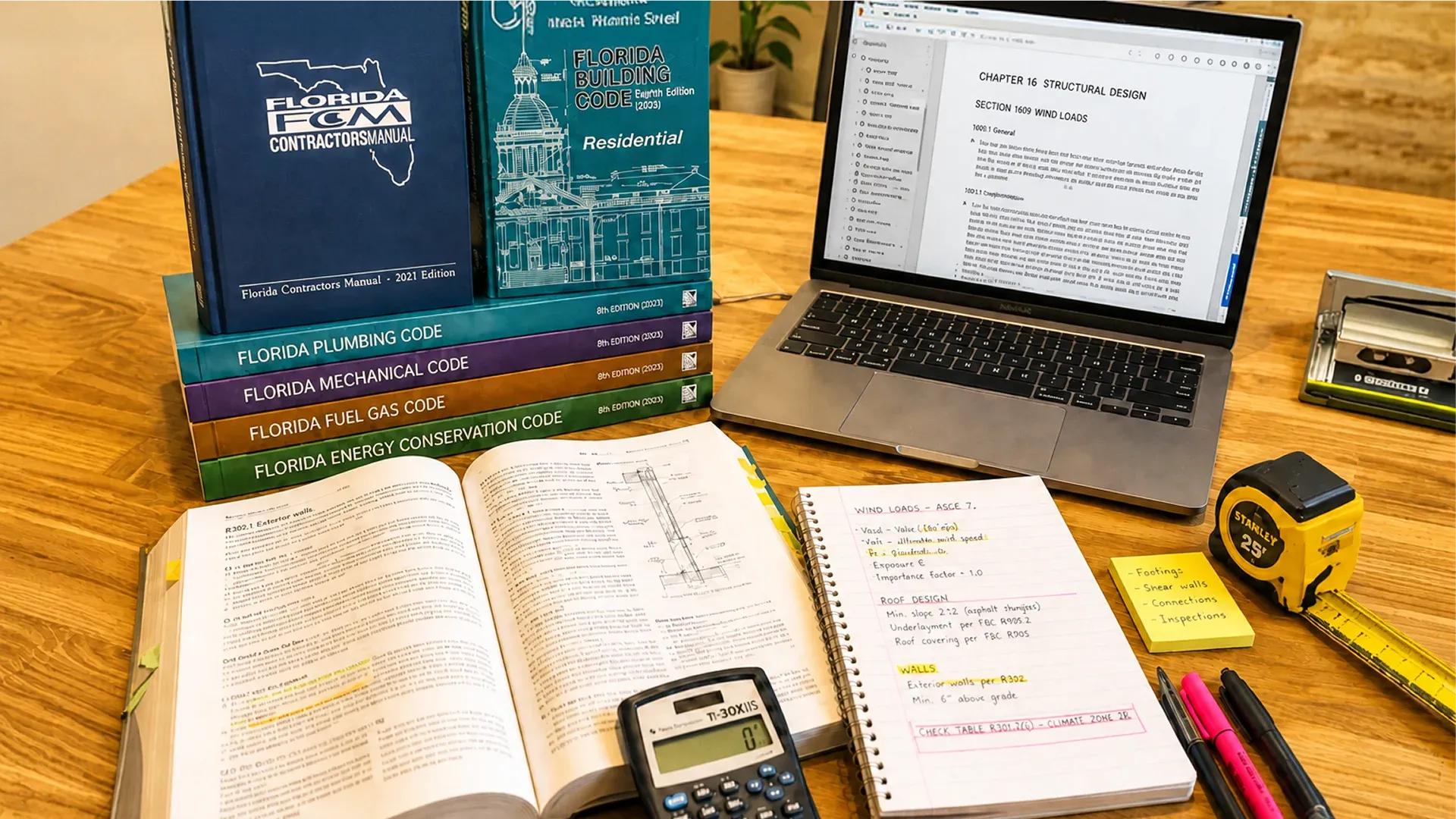
The Florida contractor exam is open book. That means you walk into the exam room with physical reference materials, including the Florida Contractors Manual, and you use them to find answers.
This changes how you should prepare. You're not memorizing accounting formulas or the exact text of Chapter 489. You're learning:
- Where each topic lives in your books
- How to navigate quickly under time pressure
- Which tables, formulas, and charts to find for specific question types
For the business and finance contractor exam, the Florida Contractors Manual (Chapters 1, 2, and 3) and the Circular E Employer's Tax Guide are your most important tools. Knowing which chapter has the financial ratio tables, where the lien law begins, and how to quickly cross-reference a payroll calculation is the skill that separates those who pass from those who have to retake it.
Tabs with chapter headings are allowed but without notes or formulas. Highlighting is allowed. Handwritten notes are not. Preparing your books well before the Florida contractor exam is part of the preparation itself.
How to Prepare for the Business and Finance Part of the Florida Contractor Exam
Knowing what the exam covers is step one. Here's how to actually prepare for the business and finance section:
Study the accounting chapters first. Open Chapter 3 of the Florida Contractors Manual and work through the accounting examples. Understand the balance sheet, cash flow statement, and revenue recognition methods, not to memorize them, but to recognize what the question is asking and where to find the answer.
Learn the Florida statutes by location, not by memory. You don't need to memorize Chapter 713 lien law. You need to know which part of your manual it's in and be able to flip to the right section within seconds.
Practice with timed questions. The Florida contractor exam has time limits. Sitting with a sample question and finding the answer in your open books is a skill that requires practice and it's the best single predictor of how well you'll do on exam day.
Don't skip the administration and HR sections. At 26% and 6%, respectively, these cover contracts, change orders, scheduling, estimating, and personnel management. They're more practical than accounting but still require knowing where the relevant content lives in your references.
Work with a prep program that supports your language. If your primary language isn't English, you can bring an approved translation dictionary into the Florida contractor exam. But you still need to understand the material well enough to answer the questions, which is why LicenseFix School offers preparation in English, Spanish, and Portuguese.
Frequently Asked Questions
Is the business and finance section the same for all contractor license categories in Florida?
Yes. According to Florida Administrative Code 61G4-16.001(22), the Business and Finance exam content and weights are the same regardless of the contractor category - general, residential, roofing, HVAC, plumbing, or specialty. It's always Test One in the Florida contractor exam series.
Can I skip the Business and Finance section if I already hold a license?
In some cases, yes. If you're already a certified contractor in one category and you're applying for a related or higher category, Florida law may exempt you from retaking the Business and Finance portion, provided you have a clean disciplinary record and are not under investigation. LicenseFix School can help you determine whether you qualify for this exemption.
What happens if I pass the trade section but fail the business and finance part of the Florida contractor exam?
You only retake the part you failed. Your passing scores on other sections remain valid for up to four years from the date of your first passing attempt. You'll pay a reexamination fee, wait the required period, and reapply to take that section again.
What books are allowed in the Florida contractor exam for the business and finance section?
The Florida Contractors Manual (current edition) is the primary reference. The DBPR exam reference list also includes AIA contract documents and other approved materials depending on your license category. The list is published by the DBPR and updated periodically. LicenseFix School prepares you to use the exact approved editions.
The Business and Finance Section Won't Beat You — If You're Ready
The Florida contractor exam is learnable. The Business and Finance section is specific, well-documented, and open book. The contractors who fail it are the ones who didn't take it seriously, who assumed that knowing the trade would be enough.
It's not. But knowing what's on this section, where to find it in your books, and how to move quickly through accounting and Florida law questions? That's how you pass.
Get exam-focused training with LicenseFix School! We prepare contractors for the full Florida contractor exam — including the Business and Finance section that trips most people up, in English or Spanish.

About Adrian Coastal Roofing
Adrian is the CEO of Coastal Roofing, a company specializing in roof installation in Florida, recognized for its quality, reliability, and excellence in residential and commercial projects. With years of experience in the construction industry and Florida roofing, Adrian has built his reputation by delivering durable solutions that withstand the state’s extreme weather. Under his leadership, Coastal Roofing has become a leader in roof installation in Florida, offering modern systems such as TPO, PVC, metal roofing, and other efficient solutions to reduce costs and extend the lifespan of roofs.