
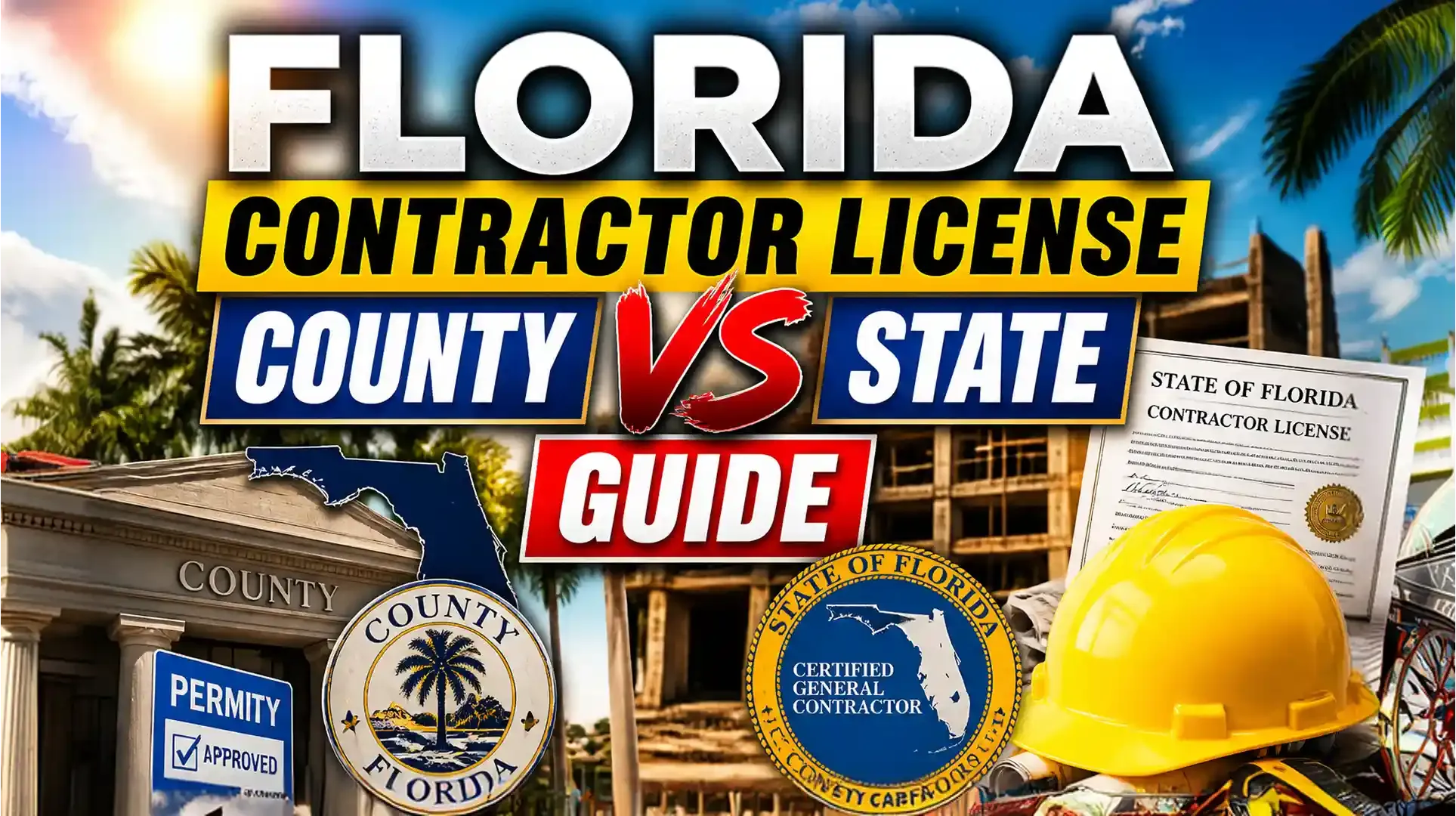
Florida Contractor License County vs State Guide
Learn the real difference between local and state contractor licensing in Florida, and find out which one your business actually needs.

Adrian Coastal Roofing
Florida has 67 counties, and each one has its own rules layered on top of state law. That is exactly why the Florida contractor license county vs state question trips up so many contractors, especially anyone moving between markets or expanding to a new area. Understanding Florida contractor license county vs state differences before you bid a job can save you from a denied permit or worse, and getting the Florida contractor license county vs state basics right from day one pays off for years.
This guide covers local contractor license Florida requirements, whether you still need a county license if you already hold a state contractor license Florida, the difference between Florida certified vs registered contractor county status, and the broader contractor license requirements Florida sets, so the Florida contractor license county vs state question stops being a guessing game.
Local Contractor License Florida Requirements
Local contractor license Florida requirements exist because counties and cities are allowed to set their own competency standards for contractors who only want to work within that jurisdiction. To meet local contractor license Florida requirements, an applicant typically submits an application, proof of a current local occupational license, and evidence local competency standards are met. This is where the Florida contractor license county vs state conversation usually starts for new contractors. That starting point shapes the rest of the Florida contractor license county vs state path.
A contractor who only meets local contractor license Florida requirements is registered, not certified, with the DBPR. That distinction matters a lot in the Florida contractor license county vs state conversation, since a registered contractor can only work in the county, city, or district that issued the registration, or in areas that formally recognize it. No statewide exam is required to satisfy local contractor license Florida requirements, which is often faster but more limited in scope. Understanding that tradeoff is half the battle in the Florida contractor license county vs state decision. This is the practical side of the Florida contractor license county vs state choice.
Local building departments cannot issue a permit to anyone who does not hold a valid active state certificate or registration covering that category of work, so meeting local contractor license Florida requirements alone is not enough to legally pull permits. That single rule is often the clearest illustration of the Florida contractor license county vs state divide in everyday practice, and it is exactly why the Florida contractor license county vs state question matters before you ever submit a bid. Skipping this step is one of the most common Florida contractor license county vs state mistakes new contractors make.
Do I Need a County License If I Have a State Contractor License Florida
This is one of the most common questions LicenseFix School gets, and the Florida contractor license county vs state answer depends on which type of state license you hold. If you ask do I need a county license if I have a state contractor license Florida issued through certification, the answer is no. A certified contractor passes a state exam and earns a certificate of competency valid in every city, county, and district in Florida. That distinction settles most of the Florida contractor license county vs state confusion.
The answer changes if your state contractor license Florida came through registration instead of certification. So do I need a county license if I have a state contractor license Florida that is registered rather than certified? In that case, yes, you stay limited to your registered jurisdiction, and working outside it without separately qualifying counts as unlicensed activity. This is the part of the Florida contractor license county vs state picture that catches the most contractors off guard.
Knowing which category you fall into is the real key to answering do I need a county license if I have a state contractor license Florida correctly, since certified and registered licenses behave completely differently once you cross county lines. Get this part of the Florida contractor license county vs state equation wrong, and you risk pulling permits you are not actually authorized to pull. Anyone who has typed do I need a county license if I have a state contractor license Florida usually learns the answer depends on certification type. Knowing the answer to do I need a county license if I have a state contractor license Florida simplifies the rest of your expansion plan.
Florida Certified vs Registered Contractor County Status
The Florida certified vs registered contractor county distinction comes down to geographic scope. A certified contractor passes a state exam through the DBPR and can legally contract in any city, county, or district in Florida, with no need to separately satisfy each jurisdiction's local rules. A registered contractor, by contrast, has only met the local competency requirements of the specific city, county, or district where the registration was issued.
In a Florida certified vs registered contractor county comparison, certification is the broader, more flexible credential, while registration is narrower but sometimes faster to obtain for contractors who only plan to work in one area. A registered contractor who later wants statewide reach can apply to upgrade to certified status after meeting requirements that typically include five years of experience, a substantially similar exam already passed, and a clean disciplinary history.
Choosing between the Florida certified vs registered contractor county paths early on can shape how much paperwork you deal with every time your business grows into a new market. At its core, that choice is the Florida contractor license county vs state decision every contractor eventually has to make.
Contractor License Requirements Florida
Beyond the county versus state question, contractor license requirements Florida sets apply no matter where you plan to work. Every applicant must be at least 18 years old, demonstrate good moral character, and meet one of several experience or education pathways under Chapter 489. None of these baseline contractor license requirements Florida demands change based on the Florida contractor license county vs state path you ultimately choose.
Contractor license requirements Florida also include passing the relevant trade examination for certified applicants, or proving local competency for registered applicants, along with meeting insurance and financial responsibility standards either way. These contractor license requirements Florida apply equally to general, building, residential, and specialty contractors, even though the specific exam content and experience thresholds vary by classification. The Florida contractor license county vs state split only changes geographic reach, not these underlying requirements. That split defines the Florida contractor license county vs state line in practice.
Ignoring contractor license requirements Florida has consequences well beyond a denied application. Consumers who hire a contractor who is neither certified by the state nor properly licensed under local law can recover triple damages plus attorney fees if something goes wrong, which is one more reason the Florida contractor license county vs state distinction is not just paperwork, it is real legal exposure for everyone involved.
Frequently Asked Questions
What is the difference between a certified and registered contractor license in Florida?
A certified license is issued by the state after passing an exam and works statewide. A registered license is tied to one local jurisdiction and only meets that area's competency requirements. This is the heart of the Florida contractor license county vs state distinction.
Can a registered contractor work in a different county?
Generally no. A registered contractor can only work in the county, city, or district that issued the registration, unless that area is formally recognized elsewhere, a common Florida contractor license county vs state limit that catches new contractors off guard.
Does a certified contractor still need a local business license?
A certified contractor does not need to meet local competency requirements, but most jurisdictions still require a local business tax receipt to operate within their boundaries, another small piece of the Florida contractor license county vs state puzzle.
How do I upgrade from a registered to a certified contractor license?
You generally need at least five years of experience in the category, a substantially similar exam already passed, and a clean record free of recent revocations or major fines. Making that move resolves the Florida contractor license county vs state question for good.
Conclusion
The Florida contractor license county vs state question is not just a technicality. It decides where you can legally pull permits and grow your business without risking an unlicensed activity complaint. Whether you go the certified route for statewide reach or stay registered locally, understanding the Florida contractor license county vs state rules upfront keeps your business protected, and revisiting the Florida contractor license county vs state basics any time you expand is always worth the few minutes it takes.
Not sure which path is right for you? LicenseFix School can walk you through certification and registration, so you choose the right license, without facing the Florida contractor license county vs state question again. It’s worth talking to us to fully understand the difference between a contractor’s license in Florida at the county level and at the state level. Contact our team: (888) 538-1225!

About Adrian Coastal Roofing
Adrian is the CEO of Coastal Roofing, a company specializing in roof installation in Florida, recognized for its quality, reliability, and excellence in residential and commercial projects. With years of experience in the construction industry and Florida roofing, Adrian has built his reputation by delivering durable solutions that withstand the state’s extreme weather. Under his leadership, Coastal Roofing has become a leader in roof installation in Florida, offering modern systems such as TPO, PVC, metal roofing, and other efficient solutions to reduce costs and extend the lifespan of roofs.