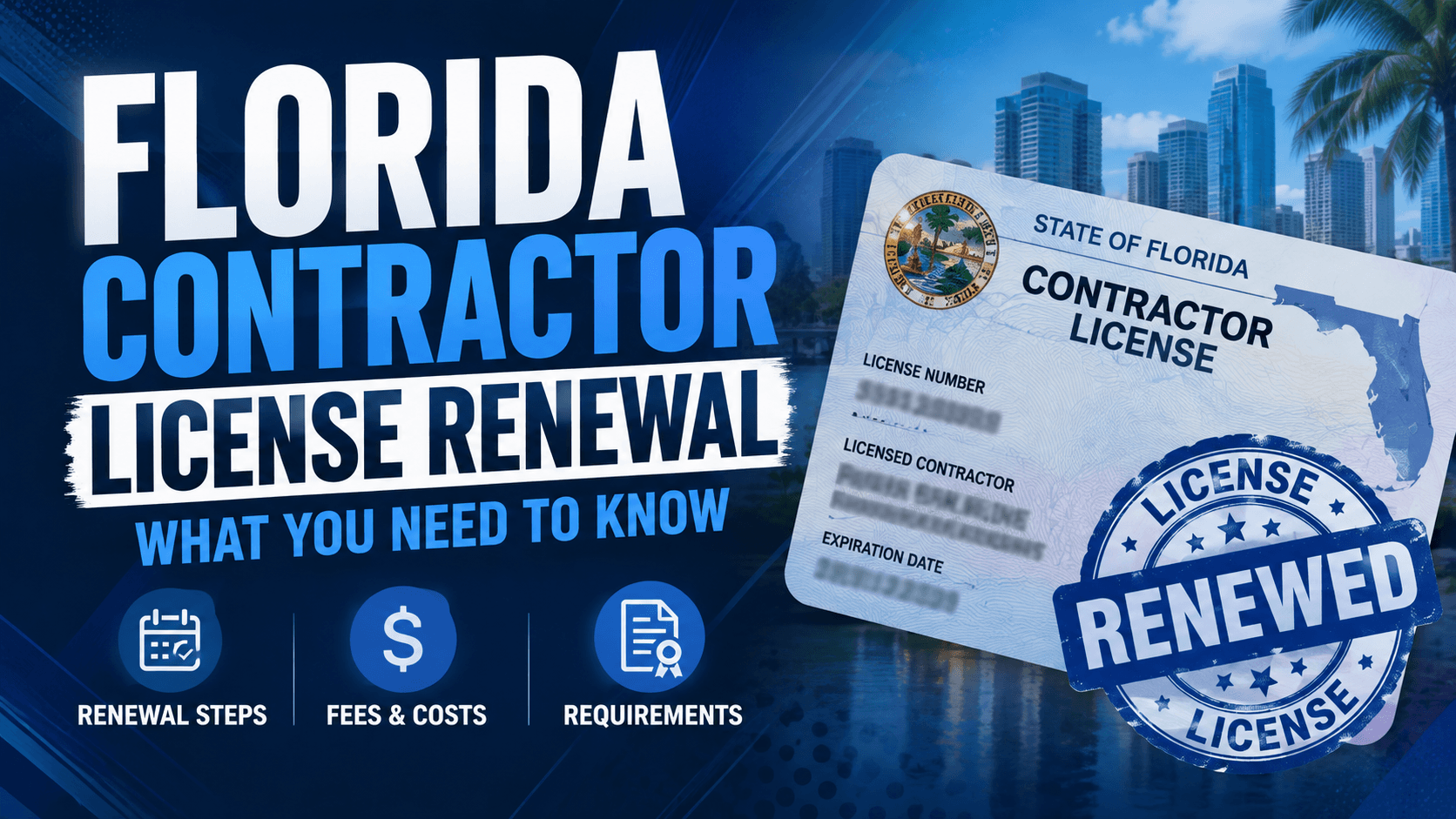
Florida Contractor License Renewal: 2026 Guide
Florida contractor license renewal in 2026, deadlines, fees, continuing education, status rules, and the steps contractors should know before August 31.

Adrian Coastal Roofing
Keeping a contractor credential current in Florida involves more than paying a fee. For many licensees, Florida contractor license renewal also requires continuing education, an accurate DBPR account, the correct license status, and completion before the state deadline.
For contractors regulated by the Construction Industry Licensing Board, certified licenses expire on August 31 of every even numbered year. In 2026, current certified contractors must complete the required steps before midnight EST on August 31. Registered contractors generally renew in odd numbered years.
Florida contractor license renewal requirements vary by license type and status, so contractors should always confirm the rules attached to their own credential.
License Fix School of Construction focuses on Florida contractor exam preparation. Its website lists preparation for Business and Finance, General Contractor, Building Contractor, Residential Contractor, Air Conditioning, Mechanical, Plumbing, Roofing, Solar, and Specialty Structure exams, with online study options and locations in Orlando, Tampa, and Miami. The school supports the licensing exam side of the process, while Florida contractor license renewal itself is handled through DBPR.
This guide explains the 2026 process, including deadlines, continuing education, fees, inactive status, late renewal, and common questions.
When Is Florida Contractor License Renewal Due?
For certified contractors regulated by the Construction Industry Licensing Board, Florida contractor license renewal is due by August 31 of every even numbered year. DBPR states that for 2026, continuing education and the applicable renewal fee must be completed before midnight EST on August 31.
DBPR generally opens the renewal period 90 to 120 days before expiration and sends renewal notices by email. Contractors should keep the email address in their account current and should not rely on receiving a paper notice.
Registered CILB contractors generally renew on August 31 of odd numbered years. Electrical and alarm contractors are regulated separately, and DBPR states that both certified and registered electrical and alarm contractor licenses expire on August 31 of even numbered years.
The first step in Florida contractor license renewal is therefore simple, verify your license type, board, status, and expiration date.
How Much Continuing Education Is Required?
For most established active contractors regulated by the CILB, Florida contractor license renewal requires 14 hours of board approved continuing education.
DBPR requires at least one hour in Workplace Safety, Workers' Compensation, Business Practices, Advanced Module Building Code, and Laws and Rules. General, Building, Residential, Roofing, Specialty Structure, and Glass and Glazing Specialty contractors must also complete one hour of Wind Mitigation Methodology within the 14 hour total.
Completing 14 hours is not enough if the courses do not satisfy the required categories. Before Florida contractor license renewal, contractors should compare their education history with the requirements for their specific license.
DBPR has also announced a new one hour requirement covering cementitious cladding, stucco, plastering, and lath application and repair methodologies for certain license types. For certified General, Building, Residential, and Specialty Structure contractors, enforcement begins with the August 31, 2028 expiration, not the 2026 cycle.
Do New Contractors Need All 14 Hours?
Not always. Florida contractor license renewal rules include exceptions for some first renewal cycles.
According to DBPR, a contractor whose license was issued less than 12 months before August 31 of the renewal year does not owe continuing education for that first renewal. A contractor licensed for more than one year but less than two years before the renewal date owes seven hours of general continuing education.
New licensees should check the original licensure date before purchasing courses. For a first Florida contractor license renewal, the standard 14 hour requirement may not apply.
How Much Does Florida Contractor License Renewal Cost?
For current certified contractors under the CILB, the 2026 DBPR renewal notice lists $205 to renew an active license, or $255 when the contractor qualifies a business.
For a current inactive certified license, the listed Florida contractor license renewal fee is $55. Status changes can involve different forms and fees.
If a current active certified license is renewed after August 31, 2026, DBPR lists $230, or $280 with a qualified business. These are current 2026 figures and can change in later cycles.
Before paying for Florida contractor license renewal, check the amount shown in the official DBPR portal for your license.
How Does the Online Renewal Process Work?
For many current certified contractors, Florida contractor license renewal can be completed through DBPR online services.
A practical process is:
- Sign in to your DBPR account.
- Confirm that the correct license is linked.
- Review the license status and expiration date.
- Check the continuing education record.
- Complete any missing approved education.
- Confirm that credits have been reported.
- Review the renewal information.
- Pay the required fee.
- Save the transaction confirmation.
- Keep a copy of the renewed license.
DBPR states that it no longer prints and mails renewed licenses. After Florida contractor license renewal, a copy is sent to the email address connected to the account, and licensees can print a copy through the portal.
Do not wait until the deadline to check CE credits. A missing course report or account problem can take time to resolve.
How Can Contractors Check Continuing Education Credits?
DBPR provides online tools for reviewing continuing education history and finding approved courses.
Before Florida contractor license renewal, make sure each required category is satisfied and that completed courses appear in the state record. If a credit is missing, contact the provider and keep the course completion certificate.
The CILB must approve courses used for construction continuing education credit. A useful business or technical class does not automatically count toward Florida contractor license renewal.
Keeping course certificates, dates, provider names, and subjects organized throughout the cycle can make the process easier.
What Happens If the Deadline Is Missed?
A license that is not renewed by its expiration date can become delinquent. DBPR explains that a delinquent active contractor license cannot be used to practice until the status is corrected.
That makes timely Florida contractor license renewal important for anyone actively working under the credential. Late renewal can also result in higher fees.
If a license remains delinquent long enough to become null and void, the consequences are more serious. DBPR states that, in general, a certified contractor whose license becomes null and void must begin the licensing process again and retake the state contractor examination, although limited reinstatement provisions can apply in cases such as illness or economic hardship.
Missing Florida contractor license renewal can therefore affect both cost and the ability to work legally.
Can an Inactive Contractor License Be Renewed?
Yes. DBPR states that an inactive contractor license must still be renewed every two years.
For the current certified contractor cycle, the listed fee to renew a current inactive license is $55. A contractor who wants to change from inactive to active, or active to inactive, may need a status change form and may owe a different fee.
Inactive status means the license remains current, but the licensee is not actively practicing under it. It is different from delinquent status.
Before Florida contractor license renewal, verify which status reflects your current situation.
Does Renewal Require Retaking the Contractor Exam?
A normal, timely Florida contractor license renewal does not require the original licensing examination to be taken again. The usual renewal process focuses on continuing education, status, and fees.
The examination can become relevant if a certified license eventually becomes null and void. DBPR says that the contractor generally must restart the licensing process and retake the state exam, subject to limited reinstatement provisions.
This is also where the role of License Fix School is different from the role of DBPR. License Fix provides exam preparation, books, practice resources, and structured study programs for people pursuing Florida contractor credentials. Florida contractor license renewal remains an official DBPR process.
What Should Contractors Check Before August 31?
Several weeks before the deadline, review your license number, status, expiration date, email address, continuing education record, required subject categories, qualified business information, and current fee.
Florida contractor license renewal is easier when those details are checked early. Contractors should also confirm that course credits are visible in the state system rather than assuming a provider has already reported them.
If you qualify a business, verify that the relationship shown in the state record is accurate. If you hold multiple licenses, review each one separately because renewal schedules and requirements can differ.
Common Florida Contractor License Renewal Mistakes
One common mistake is waiting for the renewal notice before checking anything. Licensees are responsible for maintaining their credentials even if an email is missed.
Another is completing 14 hours without checking the required subject categories. Florida contractor license renewal depends on qualifying approved credits, not simply the total time spent in training.
Contractors also confuse certified and registered renewal schedules, assume an inactive license does not need renewal, or discover account problems on the final day.
Starting Florida contractor license renewal early provides time to correct missing credits, status issues, or login problems before they interrupt work.
Frequently Asked Questions
Can Florida contractor license renewal be completed online?
Yes. DBPR encourages licensees to use its online services. Contractors should complete required continuing education first, confirm that credits are recorded, then submit Florida contractor license renewal through the official account.
What is the 2026 deadline for certified CILB contractors?
The deadline is August 31, 2026, before midnight EST.
Is continuing education required for every renewal?
Most established active CILB contractors need 14 hours, but first renewal exceptions can apply. Check your initial licensure date and the requirements associated with your credential.
Is wind mitigation required?
For General, Building, Residential, Roofing, Specialty Structure, and Glass and Glazing Specialty contractors, one hour of Wind Mitigation Methodology is part of the required 14 hours.
What happens if I renew late?
The license may become delinquent, higher fees may apply, and an active contractor may not practice until the status is corrected. Completing Florida contractor license renewal before expiration avoids that disruption.
Does License Fix School process renewals?
The License Fix School website focuses on contractor exam preparation and licensing education. It is not the DBPR renewal portal. Florida contractor license renewal should be completed through the official state process.
A Simple Florida Contractor License Renewal Checklist
Before submitting Florida contractor license renewal, confirm that your DBPR account is accessible, your contact information is current, your license status is correct, required continuing education is complete, all credits appear in the record, and the correct renewal fee is ready.
Submit before the deadline, save confirmation, and keep a digital copy of the renewed credential.
Good Florida contractor license renewal starts early, and each Florida contractor license renewal should follow DBPR records.
Passing the contractor exam gets a professional license started, maintaining it keeps that credential usable. For certified CILB contractors in 2026, August 31 is the key date. Review the requirements now and complete Florida contractor license renewal through DBPR before the deadline.

About Adrian Coastal Roofing
Adrian is the CEO of Coastal Roofing, a company specializing in roof installation in Florida, recognized for its quality, reliability, and excellence in residential and commercial projects. With years of experience in the construction industry and Florida roofing, Adrian has built his reputation by delivering durable solutions that withstand the state’s extreme weather. Under his leadership, Coastal Roofing has become a leader in roof installation in Florida, offering modern systems such as TPO, PVC, metal roofing, and other efficient solutions to reduce costs and extend the lifespan of roofs.