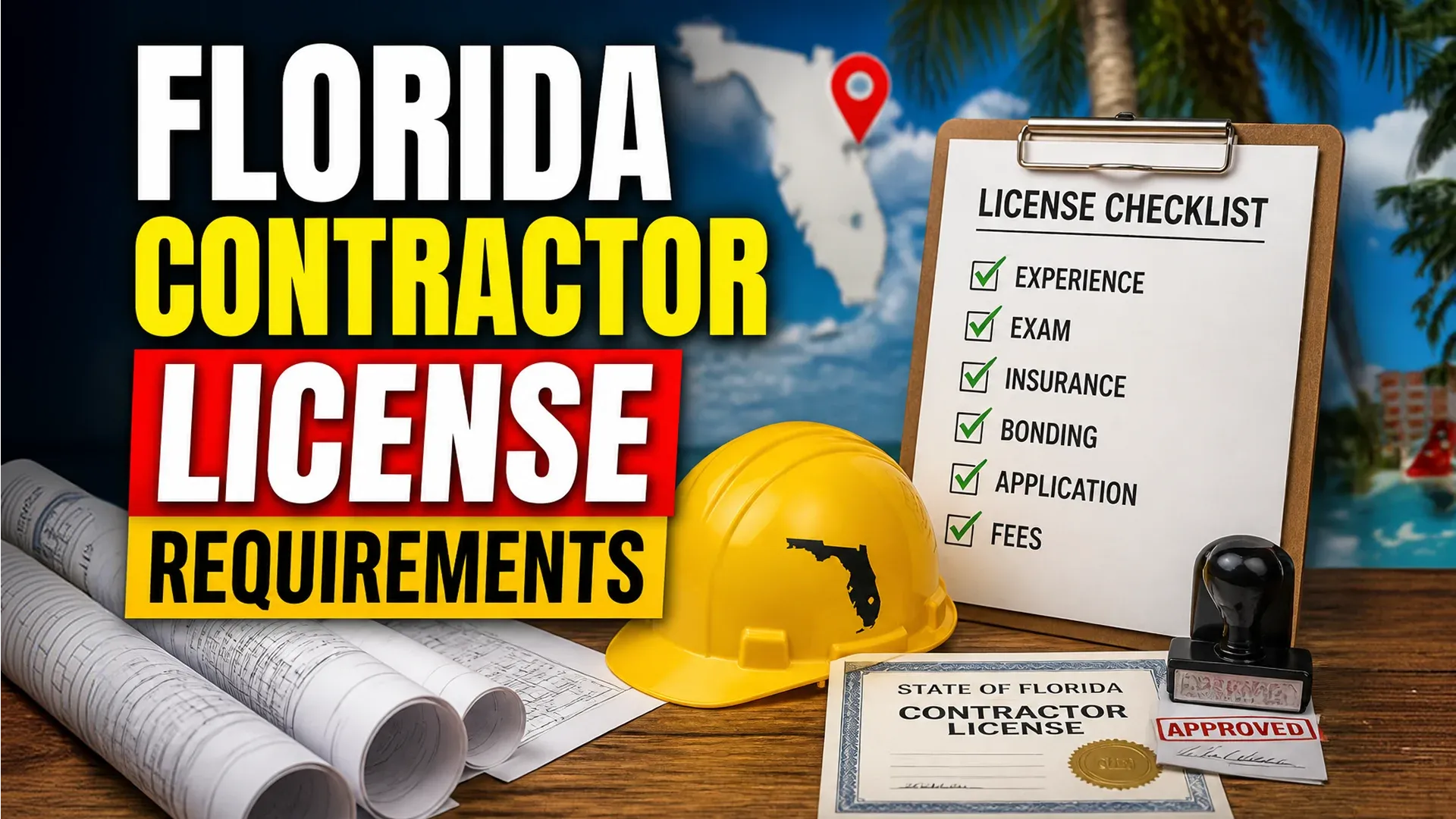
Florida Contractor License Requirements, What to Know
A clear, editorial look at Florida contractor license requirements, from GC eligibility to the business and finance exam and license types.

Adrian Coastal Roofing
Every year, hundreds of aspiring builders in Florida sit down for their state exam without fully understanding the Florida contractor license requirements they need to meet first. Some show up with the wrong reference books. Others miss an eligibility rule buried in a DBPR page and lose weeks waiting on a resubmission. If you are preparing to become a licensed contractor in Florida, knowing the Florida contractor license requirements before you schedule anything can be the difference between passing on your first attempt and starting the whole process over.
This guide walks through the most important warnings every candidate should know about the Florida contractor license requirements, from what the state expects before you can even sit for the exam, to how the different license paths work, and what actually happens on test day. Treat this as a checklist, not just a read, since missing even one of these Florida contractor license requirements can push your license date back by months.
Florida GC License Requirements, Where Most Applicants Get Stuck
The Florida GC license requirements are often misunderstood, and that confusion causes real delays. To qualify for a general contractor license, the Construction Industry Licensing Board expects proof of experience, a clean financial and criminal background, and passing scores on both required exams. Many candidates assume that any construction experience counts, but the board is specific about the type and duration of experience it accepts, and this is one of the Florida contractor license requirements that trips up otherwise qualified applicants.
Before you apply, gather your documentation early. That means letters from supervisors, proof of employment history in the trade, and financial statements if you plan to qualify a business. Applicants who wait until the last minute to collect this paperwork often see their application timeline stretch by months. Understanding the Florida GC license requirements ahead of time lets you build a realistic study and application schedule instead of scrambling once a deadline appears, and it keeps you aligned with the full set of Florida contractor license requirements from day one.
It is also worth noting that the state periodically updates its rules, so relying on outdated blog posts or forum threads can set you up for failure. The Florida contractor license requirements you read about two years ago may no longer match the current statute. Always confirm current requirements directly with the DBPR or through an updated, structured course.
The Florida Business and Finance Exam, A Requirement You Cannot Skip
No matter which trade you are licensing in, the Florida business and finance exam sits between you and your license. This exam covers business organization, financial management, lien law, contracts, tax obligations, and risk management. It is a separate test from your trade specific exam, and passing both is one of the non-negotiable Florida contractor license requirements every applicant faces.
Candidates frequently underestimate this exam because it does not sound as technical as a trade exam. That is a mistake. The business and finance section is open book, but open book does not mean easy. Without a strategy for navigating your reference materials quickly, you can run out of time before finishing every question. Building tabs, indexes, and a clear system inside your approved books before exam day is one of the smartest moves a candidate can make when tackling the Florida contractor license requirements tied to this exam.
Reviewing sample questions that mirror the real exam format helps you understand where the traps usually appear, particularly around accounting terminology and contract law scenarios that look similar but have very different correct answers. Skipping this step is one of the most common reasons candidates fall short of meeting the Florida contractor license requirements on their first attempt.
Florida Contractor License Types, Choosing the Right Path
Not every contractor license in Florida covers the same scope of work, and choosing incorrectly among the Florida contractor license types can cost you time and money. A general contractor license allows unlimited scope across commercial and residential projects. A building contractor license covers commercial and residential buildings up to three stories. A residential contractor license is limited to single family homes and townhouses up to two stories, and each of these paths carries its own version of the Florida contractor license requirements.
Beyond these core categories, Florida also licenses specialty trades separately, including air conditioning, mechanical, plumbing, roofing, solar, and specialty structure work. Each of these paths has its own exam and its own scope limitations set by the state, along with its own specific Florida contractor license requirements for experience and documentation.
Picking the right category among the Florida contractor license types starts with an honest look at the work you actually plan to do. Contractors who choose a broader license than they need often pay more in bonding and insurance without ever using the additional scope. Contractors who choose too narrow a license end up applying again later, repeating exam fees and study time they could have avoided with better planning up front, and re walking through the same Florida contractor license requirements a second time.
Why a Florida General Contractor License Course Matters
Trying to piece together the Florida contractor license requirements from scattered forum posts and outdated PDFs is one of the most common reasons candidates fail their first attempt. A structured Florida general contractor license course brings everything into one place, current statutes, updated exam content, practice questions modeled on the real test, and a clear study timeline that keeps you accountable to the actual Florida contractor license requirements rather than guesswork.
A good course does more than hand you information. It teaches you how to use your open book materials efficiently, how to manage your time across both required exams, and how to avoid the small mistakes that trip up otherwise well prepared candidates. Structured guidance also keeps you current when the state updates codes or exam content, something self study rarely accounts for, and it means you are never studying an outdated version of the Florida contractor license requirements.
For many candidates, enrolling in a Florida general contractor license course is what turns a vague goal into an actual exam date on the calendar, backed by a clear understanding of every Florida contractor license requirement standing between them and their license.
Common Questions About Florida Contractor License Requirements
What happens if I do not meet the Florida contractor license requirements on my first application? The board will typically request additional documentation or deny the application with an explanation. Reapplying with complete paperwork usually resolves the issue, though it does add time to your path toward meeting the full Florida contractor license requirements.
Is the Florida business and finance exam the same for every trade? Yes, every applicant across every trade must pass this exam, in addition to their trade specific exam, as part of the broader Florida contractor license requirements.
Can I study for the Florida contractor license types on my own? Yes, but most candidates find that a structured course saves significant time and reduces the risk of missing state specific Florida contractor license requirements that are easy to overlook without guidance.
Ready to Meet Every Florida Contractor License Requirement With Confidence
Understanding the Florida contractor license requirements is the first step. Meeting them with a clear plan, the right materials, and consistent preparation is what actually gets you licensed. Candidates who treat the Florida contractor license requirements as a checklist, rather than an afterthought, are consistently the ones who pass on their first attempt.
If you are ready to stop guessing and start studying with a proven system, explore a structured Florida general contractor license course, join a free practice exam, or connect with hundreds of other candidates preparing for the same test in the License Fix community. Your license is closer than it feels once you know exactly what the Florida contractor license requirements ask of you, and once you have a plan built around them.

About Adrian Coastal Roofing
Adrian is the CEO of Coastal Roofing, a company specializing in roof installation in Florida, recognized for its quality, reliability, and excellence in residential and commercial projects. With years of experience in the construction industry and Florida roofing, Adrian has built his reputation by delivering durable solutions that withstand the state’s extreme weather. Under his leadership, Coastal Roofing has become a leader in roof installation in Florida, offering modern systems such as TPO, PVC, metal roofing, and other efficient solutions to reduce costs and extend the lifespan of roofs.