
Florida CRC Exam: What the Test Covers
Florida residential contractor exam prep guide covering CRC content, scope, reciprocity, and a full study plan.

Adrian Coastal Roofing
If you are studying for the Florida residential contractor exam, you already know the CRC license lets you build, remodel, and repair one and two family homes. What most candidates do not know going in is how the exam actually tests that knowledge, how it differs from the way the CBC and CGC exams test similar material, and what a focused study plan for the CRC looks like. This guide goes deep into the Florida residential contractor exam itself: the content areas, the scope of work the license grants you, how it compares to the building and general contractor tracks, reciprocity questions out of state candidates ask us constantly, and how to structure your prep so you walk in ready instead of guessing.
CRC License Scope of Work: What You Are Actually Allowed to Build
The Certified Residential Contractor license authorizes you to construct, remodel, repair, and improve one family, two family, and three family residences that do not exceed two habitable stories above grade. That includes accessory structures on the same property, such as garages and pool enclosures tied to a residential project. Understanding the CRC license scope of work matters before you study because it tells you which topics on the exam are relevant to your future work and which ones you can deprioritize compared to a CBC or CGC candidate. The CRC is a full construction license, not a specialty license. You are qualified to act as the contractor of record on complete home builds and major remodels within that residential scope, coordinating subcontractors, managing permits, and taking responsibility for the finished project.
Residential Contractor Exam Content: What Is Actually Tested
The Florida residential contractor exam is split into two parts, a business and finance section and a trade knowledge section, and both must be passed. The residential contractor exam content in the trade portion focuses heavily on residential construction practices and covers areas such as:
- Site work, foundations, and footings for one and two story homes
- Framing, roofing systems, and wind mitigation requirements specific to residential structures
- Florida Building Code provisions that apply to residential occupancies
- Plan reading and takeoffs for residential drawings
- Contract administration, change orders, and lien law as applied to residential projects
- Safety requirements and OSHA standards relevant to home construction sites
The business and finance section is largely shared across the CRC, CBC, and CGC tracks and covers licensing law, business organization, estimating, project scheduling, and risk management. The trade section is where the residential contractor exam content diverges, since it drills into residential specific code sections and construction methods rather than the commercial and multi story content that shows up on the CBC and CGC exams.
CRC vs CBC vs CGC: How the Scope Compares
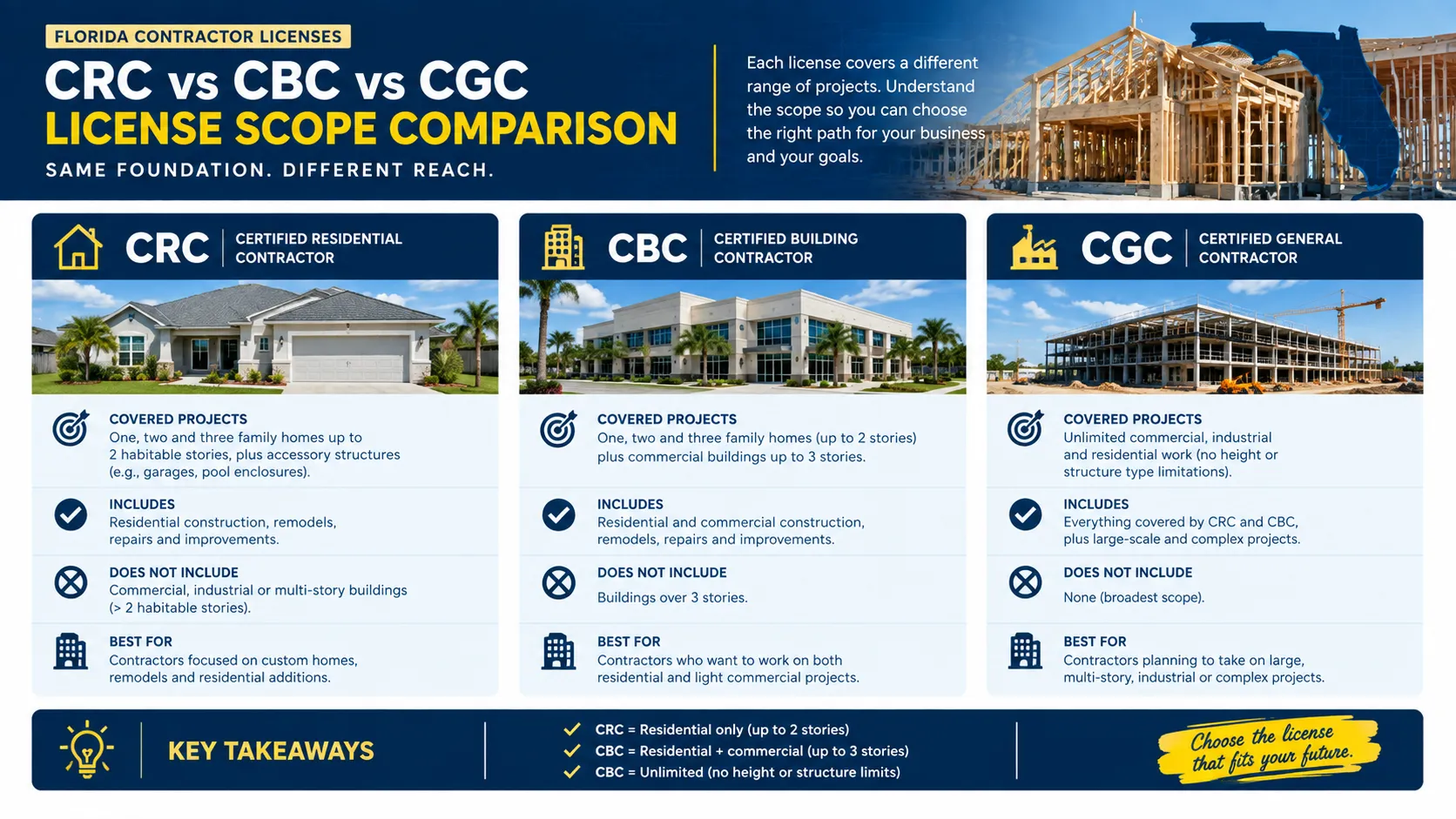
A lot of candidates land on the Florida residential contractor exam because they assumed it was the easier path, without fully understanding how the CRC vs CBC vs CGC scope compares. Here is the practical difference:
- CRC covers one, two, and three family homes up to two habitable stories, plus related accessory structures.
- CBC, the Certified Building Contractor license, covers those same residential structures plus commercial buildings up to three stories, giving a broader scope than CRC.
- CGC, the Certified General Contractor license, has no height or structure type limitation and covers unlimited commercial, industrial, and residential work.
If your business is focused on custom homes, remodels, and residential additions, the CRC scope is usually a complete match for the work you plan to take on, and your exam prep can stay focused rather than spread across commercial code you may never use. If you already know you want to bid on multi story or commercial work down the road, that is a separate conversation about which license fits your business plan, not something this exam prep guide needs to resolve for you.
Florida Contractor License Reciprocity for Out of State Candidates
We get this question from out of state contractors constantly: can an existing residential license transfer into a Florida CRC. Florida contractor license reciprocity exists with a limited number of states, and even where an agreement exists, it typically does not waive the exam entirely. In most cases reciprocity can reduce the paperwork burden or credit certain experience requirements, but candidates from non reciprocal states, or those whose out of state license scope does not line up with Florida's CRC definition, still need to sit for the state exam. Because Florida contractor license reciprocity rules change and depend on your state of origin, the safest approach is to confirm your specific situation with the Florida DBPR before assuming you can skip the exam, and to prepare as if you will need to pass it. That is the approach we recommend to every out of state student who comes through our program.
CRC Exam Study Plan: A Six to Eight Week Structure
A scattered study approach is the single biggest reason candidates need multiple attempts. Here is a CRC exam study plan structure that works for most candidates preparing over a six to eight week window:
- Week one and two: build familiarity with your code book and reference materials. Learn the index and tab system so you can locate answers quickly under timed conditions.
- Week three and four: work through trade knowledge content by topic, residential code, framing and roofing, site work, and plan reading, rather than jumping between subjects.
- Week five: shift to the business and finance section, covering contract law, estimating, and licensing regulations.
- Week six: take full length timed practice exams under real testing conditions, then review every missed question against the code book.
- Final week: focus only on your weak areas identified from practice exam results, and do a final open book speed drill to confirm you can find answers fast.
The exam is open book, but that only helps candidates who have practiced finding answers quickly as part of their CRC exam study plan. Students who treat the code books as something to search live, without prior practice, consistently run out of time.
CRC Exam Mistakes That Cause Candidates to Fail
Most failed attempts come down to a short list of avoidable CRC exam mistakes. Candidates study general contractor material instead of residential specific content, which wastes prep time on topics not tested. They underprepare for the business and finance section because they assume the trade section is harder, when in practice both sections require a passing score. They do not practice tabbing and navigating their code books before test day, so they lose time hunting for references during the exam. And they skip realistic timed practice exams, walking in without a sense of pacing for a test that has strict time limits per section.
CRC Exam Prep Courses at License Fix School
Our CRC exam prep track is built specifically around the residential scope of the Florida residential contractor exam, not a general contractor curriculum with residential topics mixed in. Course materials are organized by the same trade categories the exam tests, so you study residential code, framing and roofing, site work, and plan reading as focused units instead of jumping between commercial and residential content. We pair that with a full business and finance module covering contract law, estimating, and licensing regulations, plus timed practice exams built to match the actual test format and pacing. Students who complete our courses see a 91% pass rate, and they also get guided instruction on code book navigation, so the open book format works in their favor instead of costing them time on exam day.
Frequently Asked Questions
What is the difference between a CRC and a CBC license?
The CRC covers one, two, and three family residences up to two habitable stories. The CBC covers those same residential structures plus commercial buildings up to three stories, giving it a broader scope than the CRC while still falling short of the unlimited CGC.
Do I need to pass both sections of the Florida residential contractor exam?
Yes. The exam has a business and finance section and a trade knowledge section, and both require a passing score. If you fail one, you typically only need to retake that section, but skipping preparation for either one is a common reason candidates fail.
Can an out of state residential contractor license transfer to Florida?
Sometimes, depending on Florida contractor license reciprocity agreements with your home state, but reciprocity rarely waives the exam entirely. It is safest to confirm your specific situation with the Florida DBPR and prepare as if you will need to sit for the exam.
How long should I study for the CRC exam?
Most candidates who follow a structured CRC exam study plan need six to eight weeks, covering code book familiarity, trade content by topic, the business and finance section, and full length timed practice exams before test day.
Ready to Prepare for the Florida Residential Contractor Exam
If you are ready to prepare for the Florida residential contractor exam with a study plan built around the actual CRC content, check out the residential contractor courses at licensefixschool.com. Our materials are structured to get you exam ready without wasting time on content outside your license scope, so you can walk into test day prepared and confident.

About Adrian Coastal Roofing
Adrian is the CEO of Coastal Roofing, a company specializing in roof installation in Florida, recognized for its quality, reliability, and excellence in residential and commercial projects. With years of experience in the construction industry and Florida roofing, Adrian has built his reputation by delivering durable solutions that withstand the state’s extreme weather. Under his leadership, Coastal Roofing has become a leader in roof installation in Florida, offering modern systems such as TPO, PVC, metal roofing, and other efficient solutions to reduce costs and extend the lifespan of roofs.