Florida GC License CE Requirements: How License Fix Helps
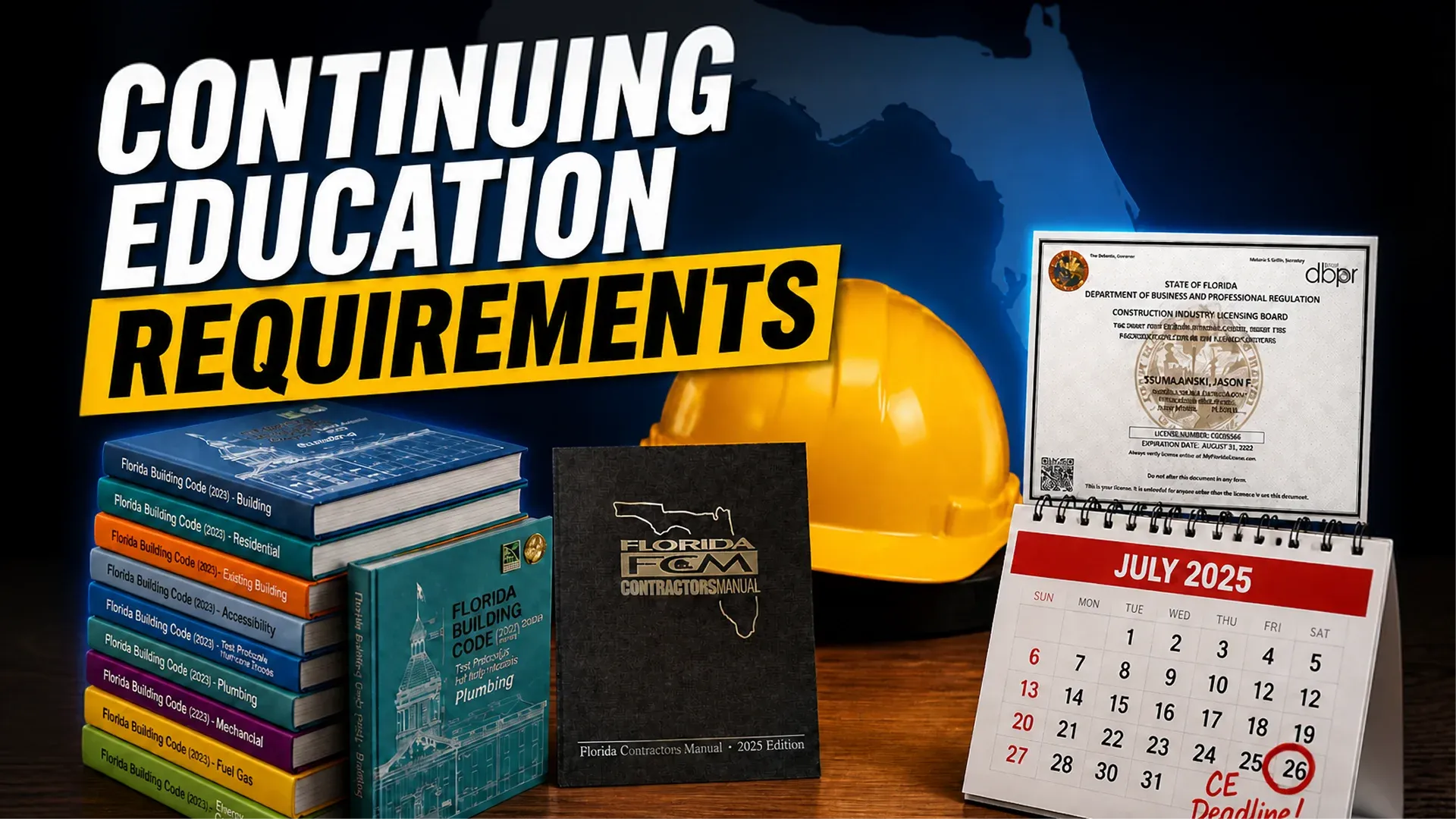
Keeping your GC license Florida-compliant means 14 hours of CE every two years. License Fix breaks down exactly what is required and how to stay on track.

Earning a GC license in Florida is a significant achievement, but maintaining it requires ongoing commitment. The state mandates continuing education for every licensed contractor, and missing a deadline or falling short on required topics puts that license at risk. License Fix helps contractors understand exactly what Florida general contractor continuing education requires, choose the right courses, and meet every renewal deadline without the stress of last-minute scrambling.
Why Continuing Education Is Required for Your GC License in Florida
Florida's Construction Industry Licensing Board requires continuing education as a condition of license renewal for every certified and registered contractor in the state. The requirement exists to ensure that licensed contractors stay current with building codes, safety standards, business regulations, and workers' compensation law, each of which evolves over time. Codes are updated on a regular schedule, and regulatory requirements shift as the state responds to new construction trends, storm data, and safety research.
Holding a gc license in Florida without completing the required continuing education hours before the renewal deadline results in a lapsed license. A lapsed license means the contractor cannot legally operate, may face late fees, and can encounter complications with insurance coverage and active contracts. License Fix makes it straightforward to avoid that outcome by guiding contractors through the CE process well before any deadline approaches.
The continuing education requirement is not simply a formality. It reflects the practical reality that construction standards in Florida are tied to hurricane codes, energy efficiency rules, and evolving insurance requirements. Contractors who stay current on these topics are better positioned to complete projects that pass inspection, satisfy clients, and hold up under Florida's demanding weather conditions. Florida general contractor continuing education supports not just regulatory compliance but the quality and durability of the work itself.
How Many Hours Florida General Contractor Continuing Education Requires
Florida general contractor continuing education requires 14 hours completed within each two-year renewal cycle. This applies to both certified contractors, whose license numbers begin with the letter C, and registered contractors, whose license numbers begin with R. The distinction matters because the renewal deadlines differ between the two groups.
Certified contractors must complete their 14 hours and renew by August 31 of even-numbered years. The next deadline for this group is August 31, 2026. Registered contractors renew by August 31 of odd-numbered years. Both groups must meet the same 14-hour requirement, though the specific mandatory topics and elective options are consistent across license types for general and building contractors.
New licenses are generally exempt from continuing education requirements during their first renewal cycle, but the requirement applies in full starting with the second renewal. License Fix walks new contractors through what to expect so that the first renewal deadline does not catch them off guard. Starting CE coursework early in the renewal cycle, rather than in the weeks before the deadline, gives contractors time to choose the most relevant elective courses and absorb the material without rushing.
The Mandatory Topics Every Florida Contractor Must Cover
Of the 14 required hours, six are mandatory for general and building contractors and must cover specific topics designated by the CILB. Completing these six hours in approved subject areas is not optional. The remaining hours can be completed through approved elective courses, giving contractors some flexibility in how they structure their CE cycle.
The mandatory topics for general and building contractors are as follows:
- Advanced Module Building Code (1 hour)
- Workers' Compensation (1 hour)
- Workplace Safety (1 hour)
- CILB Laws and Rules (1 hour)
- Business Practices (1 hour)
- Wind Mitigation Methodology (1 hour, required for general and building contractor license holders)
Each of these mandatory topics serves a specific purpose. The building code module keeps contractors aligned with the Florida Building Code as it is updated. Workers' compensation coverage addresses the legal requirements that protect both employees and the business. Workplace safety covers OSHA standards and best practices that reduce on-site incidents. CILB Laws and Rules ensures contractors are familiar with the regulatory framework that governs their license. Business practices covers financial management, contract law basics, and professional conduct. Wind mitigation methodology addresses construction techniques that improve a building's performance during high-wind events, which is a critical concern for any contractor working in Florida.
The remaining eight hours may be completed through any DBPR-approved Florida contractor course covering topics relevant to the construction industry. License Fix helps contractors identify which elective courses are most relevant to their work and most efficient to complete within the renewal window. Popular elective topics include green building practices, accessibility standards, project management, and advanced code applications.
Choosing the Right Florida Contractor Course
Not every Florida contractor course qualifies for CILB credit. Courses must be approved by the DBPR and taught by a licensed provider before they count toward the renewal requirement. Contractors who complete hours through an unapproved provider find themselves in a difficult position at renewal time, with no eligible credits to show and a deadline approaching.
The format of continuing education has expanded in recent years. Contractors can now complete approved courses in person or online, making it easier to work CE around project schedules and seasonal demand. What matters is that the provider holds active DBPR approval and that the course covers the required subject areas in the required hours.
Online courses are especially useful for contractors managing multiple active projects. A course completed in the evening or between job sites counts the same as one completed in a classroom, as long as the provider is properly approved. Contractors should verify provider credentials before enrolling and keep records of completion certificates in case documentation is requested during renewal.
License Fix takes the guesswork out of course selection. The program directs contractors to approved courses that satisfy both the mandatory and elective hour requirements, so the 14-hour total is met correctly and completely before the renewal deadline. Having a knowledgeable resource review course options before enrollment saves time and eliminates the risk of completing hours that do not count.
What Happens If You Miss the CE Deadline
A gc license in Florida that lapses due to missed CE is not simply late. It becomes inactive, and the contractor cannot legally perform work under that license until the renewal is completed and the license is reactivated. Depending on how long the license remains inactive, additional fees and requirements may apply before it can be reinstated.
Beyond the regulatory consequences, a lapsed license can affect ongoing project contracts, bonding and insurance requirements, and relationships with clients who verify license status before authorizing work. Many commercial clients and general contractors require proof of an active license before issuing a subcontract. A lapsed license discovered mid-project creates delays and can put payment at risk.
The financial impact of a lapsed license extends beyond late fees. A contractor who cannot legally operate for even a short period loses revenue and may face breach-of-contract claims if scheduled work is interrupted. Reinstatement may also require additional documentation depending on how long the license has been inactive.
Avoiding this scenario is straightforward when CE is approached as an ongoing responsibility rather than a last-minute obligation. License Fix helps contractors stay ahead of their renewal cycle from the start, so the August 31 deadline is never a surprise and no license is put at risk.
Keeping Track of Your CE Progress
One of the most common reasons contractors fall short of CE requirements is simply losing track of completed hours across a two-year period. A contractor who completes a few hours early in the cycle and then sets the matter aside may find a significant gap when the deadline approaches. Tracking progress consistently from the beginning of each renewal period makes it far easier to plan the remaining hours and select appropriate courses.
The CILB maintains records of approved course completions, and contractors can verify their status through the DBPR's online licensing portal. Checking that portal periodically during the renewal cycle confirms that submitted hours have been recorded and prevents surprises at renewal time. If a discrepancy appears, addressing it early gives time to resolve it before the deadline.
License Fix encourages contractors to treat Florida general contractor continuing education as a routine part of business operations rather than a periodic compliance task. Scheduling courses at predictable points in the renewal cycle, keeping certificates organized, and checking the DBPR portal regularly all contribute to a renewal process that is straightforward and stress-free.
Keep Your GC License Florida-Compliant with License Fix
Florida general contractor continuing education is not complicated when contractors know exactly what is required, when it is due, and how to complete it through approved providers. License Fix provides that clarity as part of a broader commitment to helping Florida contractors build and maintain their licenses throughout their careers.
Whether you are approaching your first CE renewal or working through your third license cycle, License Fix is ready to help you identify the right courses, meet every mandatory topic requirement, and submit a complete renewal on time. Contact the team today to get started.

About Adrian, Gold Alumni
Adrian is the CEO of Coastal Roofing, a company specializing in roof installation in Florida, recognized for its quality, reliability, and excellence in residential and commercial projects. With years of experience in the construction industry and Florida roofing, Adrian has built his reputation by delivering durable solutions that withstand the state’s extreme weather. Under his leadership, Coastal Roofing has become a leader in roof installation in Florida, offering modern systems such as TPO, PVC, metal roofing, and other efficient solutions to reduce costs and extend the lifespan of roofs.
More from Adrian, Gold Alumni