
Florida Mechanical Contractor License Guide
How to get a Florida mechanical contractor license: requirements, exam format, and prep tips from License Fix School.

Adrian Coastal Roofing
If you install, repair, or service HVAC equipment, boilers, ventilation systems, process piping, or other mechanical systems in Florida, you have probably run into the question of which license actually covers your work. The Florida mechanical contractor license is the broadest option in this trade category, and it is often confused with the more limited HVAC contractor license. Understanding the difference matters because it determines what jobs you can legally bid, sign, and pull permits for. This guide breaks down who needs a Florida mechanical contractor license, what the state requires to get one, how the exam works, and how to prepare so you pass on your first attempt.
Who Needs a Florida Mechanical Contractor License
A mechanical contractor license in Florida is built for professionals whose work goes beyond air conditioning and heating. If your business handles any of the following, a Florida mechanical contractor license is likely the one you need:
- Installation and repair of HVAC systems, including commercial and industrial units
- Boiler installation, repair, and maintenance
- Ventilation and exhaust systems for commercial kitchens, labs, and industrial facilities
- Process piping and steam systems
- Refrigeration systems tied to mechanical infrastructure
- Air distribution and duct systems in large scale commercial buildings
General contractors, HVAC business owners looking to expand their scope, and facilities professionals moving into contracting all pursue this license because it covers a wider range of mechanical systems than a standalone HVAC contractor license allows.
Mechanical Contractor License Scope of Work
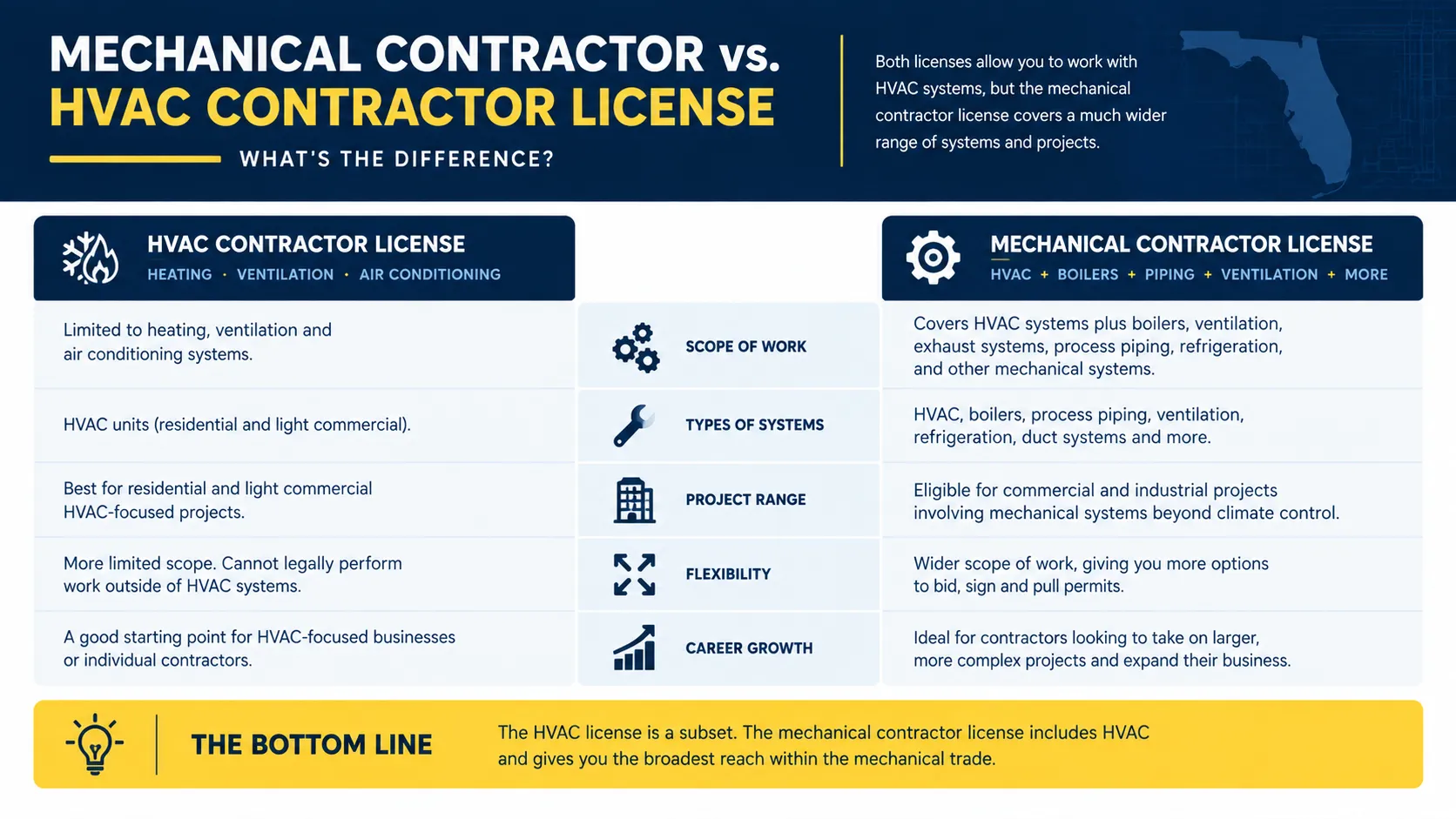
The scope of work is where this license earns its reputation as the more flexible option. A mechanical contractor license scope of work authorizes HVAC systems, but it also covers piping, boilers, ventilation, and other mechanical components that fall outside the narrower HVAC contractor classification. If your project involves connecting mechanical systems to plumbing or gas lines beyond what your license class allows, you still need to coordinate with the appropriate trade licenses, but the mechanical license gives you the widest reach within the mechanical trade itself. Contractors who only hold an HVAC license often find themselves turning away work on boilers or process piping because it falls outside their authorized scope of work. A mechanical license removes that ceiling.
Mechanical Contractor vs HVAC Contractor License: What Is the Difference
This is the question we get asked most often at License Fix School. Comparing mechanical contractor vs HVAC contractor license options comes down to range: the HVAC contractor license in Florida is limited to heating, ventilation, and air conditioning systems. It is a solid license for a business that focuses purely on residential and light commercial HVAC work. The Florida mechanical contractor license includes HVAC but extends further into boilers, process piping, and broader mechanical systems that HVAC only contractors cannot legally perform.
In practical terms, think of the HVAC license as a subset and the mechanical license as the full category. If your business plans to bid on commercial or industrial projects that involve mechanical systems beyond climate control, the mechanical contractor license is the one that keeps every option open. Many contractors start with an HVAC license and later upgrade to a full mechanical license once they want to compete for larger commercial contracts.
Mechanical Contractor License Experience Requirements
Florida takes experience verification seriously for mechanical licensing. Before you can sit for the exam, the mechanical contractor license experience requirements call for documented time in the trade. Generally, applicants need at least four years of proven experience, which can come from a combination of:
- Direct hands on work experience in mechanical contracting under a licensed contractor
- Credit for relevant education, such as a degree in mechanical engineering or a related field, which can offset a portion of the required years
- Military training or apprenticeship programs recognized by the state
You will need to document this experience with detailed records, including dates, employer information, and a description of the work performed. Meeting the mechanical contractor license experience requirements on paper matters as much as meeting them in practice, since the DBPR reviews applications closely and incomplete or vague documentation is one of the most common reasons applications get delayed or rejected.
DBPR Mechanical License Requirements Beyond Experience
Experience is only one piece of the application. The full DBPR mechanical license requirements also include:
- Passing the state mechanical contractor exam, which covers both business and finance and trade knowledge
- Financial stability documentation, including a credit report that meets the state threshold
- Proof of financial responsibility, which may include a surety bond or letter of credit depending on your credit standing
- General liability and workers compensation insurance once licensed
- A clean background check, since criminal history can affect eligibility
Applicants sometimes assume the exam is the hardest part, but gathering clean, accurate documentation to satisfy every DBPR mechanical license requirement trips up just as many candidates. Start collecting your records early so you are not scrambling once you are ready to submit.
What Is on the Mechanical Contractor Exam
The mechanical contractor exam is a two part test. The first part covers business and finance, which includes topics like contract law, project management, lien law, and general business practices that apply across all Florida contractor license categories. The second part is the trade knowledge exam specific to mechanical systems, covering load calculations, ventilation design, equipment sizing, piping systems, codes, and safety standards.
Both sections are closed book or open book depending on the specific mechanical contractor exam version and reference materials allowed, and both require a passing score to earn your license. Candidates who fail one section but pass the other typically only need to retake the section they failed, but that still costs time and money. Most people who fail the mechanical contractor exam do so because they studied the trade content and skipped the business and finance section, assuming it would be easier. It is not something to guess your way through.
How to Prepare for the Mechanical Contractor Exam
Passing on the first attempt comes down to structured preparation, not just experience on the job. Field experience teaches you how to do the work. It does not automatically teach you how the state tests that knowledge, how questions are worded, or how to manage your time across a long exam.
Effective preparation to pass the mechanical contractor exam usually includes:
- Working through practice exams that mirror the actual question format and difficulty
- Reviewing the approved reference materials so you know exactly where to find answers quickly during the open book portions
- Studying business and finance content with the same intensity as trade content
- Taking timed practice sessions to build speed and reduce exam day anxiety
- Identifying weak areas early and focusing study time there instead of re reviewing what you already know
Contractors who treat exam prep as a real project, with a schedule and clear milestones, consistently pass faster and with less stress than those who try to cram in the final weeks.
How License Fix School Helps You Get Licensed
License Fix School builds exam prep specifically around the way the Florida mechanical contractor exam is structured. Our courses walk you through both the business and finance section and the trade knowledge section, with practice questions built to match the real exam format and reference material lookups you will actually use on test day. Students who complete our courses see a 91% pass rate, which comes from focusing on efficient, targeted study rather than endless hours of generic content that has nothing to do with what you will be tested on.
Whether you are moving up from an HVAC contractor license or starting fresh toward a full mechanical contractor license, our goal is the same: get you exam ready with the least wasted time possible.
Frequently Asked Questions
How long does it take to get a Florida mechanical contractor license?
Timelines vary based on how quickly you can document your four years of experience and gather your financial paperwork. Once your application is submitted and approved, the mechanical contractor exam itself can typically be scheduled within a few weeks.
Can I hold both an HVAC and a mechanical contractor license?
You can, but most contractors treat the mechanical contractor license as an upgrade path rather than holding both at once, since the mechanical license already includes everything the HVAC license covers plus boilers, process piping, and broader mechanical systems.
Do I need a degree to qualify for the mechanical contractor license?
No. A degree in mechanical engineering or a related field can offset part of the four year experience requirement, but hands on work experience under a licensed contractor, or recognized military or apprenticeship training, also qualifies on its own.
What happens if I fail one section of the mechanical contractor exam?
You typically only need to retake the section you failed, whether that is the business and finance portion or the trade knowledge portion, rather than the entire exam. That still costs time and money, which is why preparing both sections equally matters from the start.
Ready to Get Started
If you are ready to move forward with your mechanical contractor license, License Fix School has the courses and practice materials built to get you through the exam efficiently. Check out our mechanical contractor exam prep courses at licensefixschool.com and start studying with a plan built around how the exam actually works.

About Adrian Coastal Roofing
Adrian is the CEO of Coastal Roofing, a company specializing in roof installation in Florida, recognized for its quality, reliability, and excellence in residential and commercial projects. With years of experience in the construction industry and Florida roofing, Adrian has built his reputation by delivering durable solutions that withstand the state’s extreme weather. Under his leadership, Coastal Roofing has become a leader in roof installation in Florida, offering modern systems such as TPO, PVC, metal roofing, and other efficient solutions to reduce costs and extend the lifespan of roofs.