Florida Mechanical Contractor License: The Real Path
What it takes to earn a Florida mechanical contractor license, from requirements to the exam prep that gets you licensed fast.

Adrian Coastal Roofing
If you install ductwork for a living, size refrigeration systems in your sleep, or have spent years crawling through attics running HVAC lines, you already know the trade. What you might not know is how brutal the path to a Florida mechanical contractor license can feel once you actually sit down to apply. Between the DBPR paperwork, the credit checks, and two open book exams that punish anyone who walks in unprepared, plenty of skilled techs stall out before they ever touch a state seal.
A Florida mechanical contractor license is not just a piece of paper. It is the credential that lets you legally bid, sign permits, and run your own mechanical contracting business anywhere in the state, without registering city by city. Every step in this guide leads back to that one goal, a Florida mechanical contractor license in hand. It separates the contractor who owns the job from the technician who only ever works under someone else's number. That difference shows up in your paycheck, in the projects you can chase, and in who gets to put their name on the permit.
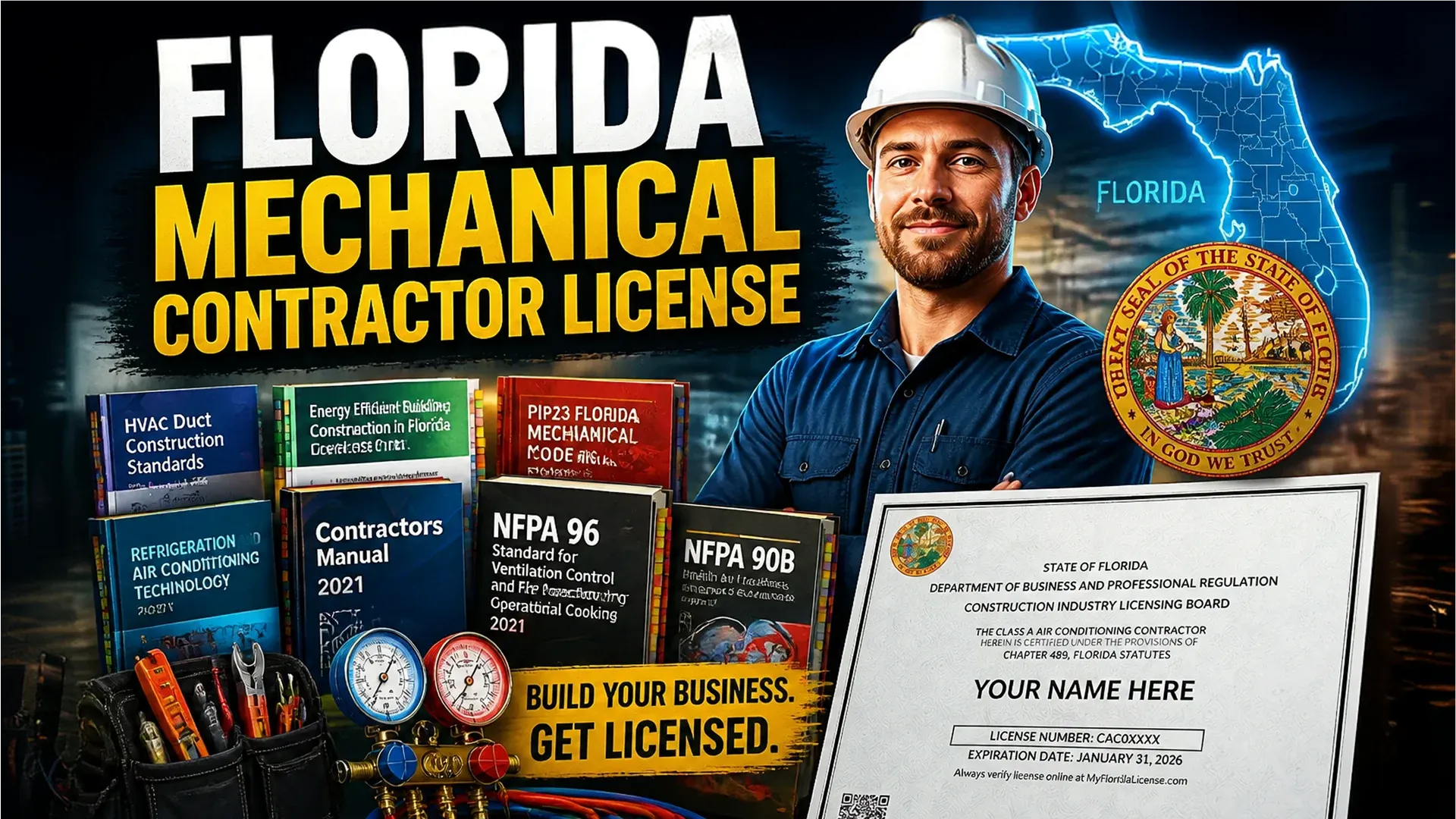
This article breaks down what a Florida mechanical contractor license actually covers, what the state expects from applicants, and how a structured exam prep course, like the one built by License Fix School, changes your odds of passing the Florida mechanical contractor license exams on the first attempt.
What a Mechanical Contractor License Actually Lets You Do
A mechanical contractor license in Florida is broader than most people assume, and a Florida mechanical contractor license in particular carries statewide weight that a local registration simply cannot match. Certified Mechanical Contractors are authorized, without scope limits tied to tonnage or BTU, to install, maintain, repair, alter, extend, or design central air conditioning, refrigeration, heating, and ventilating systems, including all the ductwork that connects them into a complete system. That covers everything from a single family HVAC swap to a full mechanical package on a mid rise commercial build.
There are limits worth knowing before you commit to the process. A Florida mechanical contractor license does not authorize potable water line work, sanitary sewer connections, swimming pool piping and filters, or electrical power wiring. Those trades fall under separate licenses, so a mechanical contractor license is a specialty credential, not a catch all for every system in a building.
Because this is a certified license issued directly by the state, holders of a Florida mechanical contractor license can work anywhere in Florida once they are approved, unlike a registered license, which is tied to a specific local jurisdiction. For a contractor who wants to grow beyond one county, that statewide reach is often the entire reason to pursue a Florida mechanical contractor license instead of a local registration. Put simply, a Florida mechanical contractor license travels with you, county to county, project to project.
Most applicants qualify one of a few ways. A four year construction related degree from an accredited college counts as the equivalent of three years of experience, combined with one additional year of proven experience in the category. Alternatively, a year as a foreman plus at least three years of accredited college credit can satisfy the requirement, and a combination of worker, foreman, and college credit years works as well. Whichever path applies to you, the state also wants to see substantial, documented experience on systems above 25 tons of cooling and 500,000 BTU of heating capacity, along with hands on exposure across at least four additional experience categories.
How to Get a Mechanical Contractor License Florida Applicants Actually Need
Chasing a Florida mechanical contractor license usually starts long before anyone opens a textbook. The Department of Business and Professional Regulation, working through the Construction Industry Licensing Board, oversees the entire process, and it will not let you begin the formal application for a Florida mechanical contractor license until you have already passed both required exams.
Here is the general sequence most successful applicants follow when working toward a Florida mechanical contractor license.
- Confirm you meet the experience or education requirement for a Certified Mechanical Contractor license
- Register and sit for the Business and Finance exam, roughly 120 to 125 questions covering how to legally and financially run a contracting business
- Register and sit for the Mechanical Trade Knowledge exam, roughly 130 questions covering ductwork, refrigeration, HVAC systems, energy management, safety, and indoor air quality
- Pass both exams with a minimum score of 70 percent, since Florida will not activate a license on one passing score alone
- Submit your DBPR application with employer verification of experience, your credit report, and proof of the required insurance
- Obtain or confirm workers compensation coverage, or file for an exemption within 30 days of licensure
Both exams tied to a Florida mechanical contractor license are open book, which sounds like a relief until you realize the reference list runs across multiple dense manuals, including the Florida Contractors Manual, code books, and trade specific references you are expected to navigate under a strict time limit. The Mechanical Trade Knowledge exam runs about seven and a half hours, and the Business and Finance exam runs close to six and a half. Knowing where information lives inside those books, before the clock starts, is often the real difference between Florida mechanical contractor license candidates who finish comfortably and candidates who run out of time on the last twenty questions.
Florida also reviews your credit history as part of the financial responsibility check tied to a Florida mechanical contractor license. Applicants whose credit score falls below the state's threshold are not automatically disqualified, but they may need to complete an approved financial responsibility course before the board will sign off on a Florida mechanical contractor license. It is one more reason to start the paperwork side of the process early instead of treating it as an afterthought once the exams are behind you.
Why an Exam Prep Course Changes the Outcome
Here is the part most self taught candidates underestimate. Passing on raw field experience alone is possible, but it is a gamble, because the exams test how fast you can locate and apply information inside the approved references, not just whether you know the trade. That is exactly the gap the Florida Mechanical Trade Exam Preparation course from License Fix School was built to close, and it is why so many candidates chasing a Florida mechanical contractor license enroll before scheduling their first exam date.
The course walks students through a full breakdown of every chapter in the Florida Contractor's Manual, the most important sections of the Builder's Guide to Accounting, and the relevant portions of the AIA contract documents, so nothing on exam day feels unfamiliar. Students also get a video walkthrough on how to physically navigate and tab their books before the exam, along with math instruction built specifically for the calculations that show up on both the trade and Business and Finance sections. Practice questions come with video explanations for every reference book, and the question bank is refreshed quarterly by past students who already passed, so the material stays current with what the state is actually testing.
None of that preparation happens in isolation either. Enrolled students join a WhatsApp community alongside alumni and returning "Alumni Gold" members, so questions about the Florida mechanical contractor license process get answered by people who sat the exact same exam recently, not a generic support line. For a working contractor trying to study around job hours, that kind of responsive, peer level support often matters as much as the course content itself.
License Fix School backs the program with a straightforward guarantee. Students who complete the full Business and Finance course and dedicate themselves to studying, but do not pass within 12 months, receive a full refund. That is not a marketing line, it is a structural incentive for the school to build a course that actually works, because a Florida mechanical contractor license candidate walking away without passing costs the business money too.
What This Means for Your Business, Not Just Your Exam
It is easy to think of the exam as the finish line, but the license itself is really the starting point for everything that follows. Once you hold a Florida mechanical contractor license, you can qualify your own business entity, pull your own permits, and bid on work that was previously off limits without a licensed contractor attached to the job. Over 200 students have gone through the License Fix School program with a 91 percent pass rate since the school opened in 2022, which says less about luck and more about what happens when preparation replaces guesswork on the road to a Florida mechanical contractor license.
There is also a compliance side worth taking seriously. Contracting without the proper license in Florida is not a gray area. It is treated as a real offense under state statute, with penalties that escalate for repeat violations. A Florida mechanical contractor license protects you legally as much as it opens doors commercially, which is part of why so many experienced techs eventually stop putting off the application and start studying with a real plan.
Frequently Asked Questions
How long does it take to get a Florida mechanical contractor license?
Timelines vary based on how quickly you complete the two required exams and gather your experience documentation, but most candidates pursuing a Florida mechanical contractor license who prepare with a structured course move from enrollment to a passed exam within a few months, with DBPR application review adding additional time afterward.
Is the Florida mechanical contractor license exam open book?
Yes. Both the Mechanical Trade Knowledge exam and the Business and Finance exam required for a Florida mechanical contractor license are open book, but only approved reference materials can be used, and candidates are still timed, so simply owning the books is not enough without knowing how to navigate them quickly.
What score do I need to pass the Florida mechanical contractor license exams?
Florida requires a minimum score of 70 percent on each exam. Passing one exam does not carry over if you fail the other, so both the Trade Knowledge and Business and Finance sections need to be passed independently before a Florida mechanical contractor license can be issued.
Can I get a Florida mechanical contractor license without a college degree?
Yes. Florida offers multiple qualifying paths toward a Florida mechanical contractor license, including combinations of foreman experience and accredited college credit, so a four year degree is one route among several, not a strict requirement.
Ready to Get Your Florida Mechanical Contractor License
Studying alone with a stack of code books is one way to approach a Florida mechanical contractor license. Studying with a course built around the exact exam you are about to take, backed by people who passed it recently and a school willing to guarantee the outcome, is another. Either way, the Florida mechanical contractor license is worth pursuing with a real plan, not a rushed one. If you are serious about passing on your first attempt, explore the Florida Mechanical Trade Exam Preparation course from License Fix School and see what a real study plan looks like before you walk into the testing center.


About Adrian Coastal Roofing
Adrian is the CEO of Coastal Roofing, a company specializing in roof installation in Florida, recognized for its quality, reliability, and excellence in residential and commercial projects. With years of experience in the construction industry and Florida roofing, Adrian has built his reputation by delivering durable solutions that withstand the state’s extreme weather. Under his leadership, Coastal Roofing has become a leader in roof installation in Florida, offering modern systems such as TPO, PVC, metal roofing, and other efficient solutions to reduce costs and extend the lifespan of roofs.