
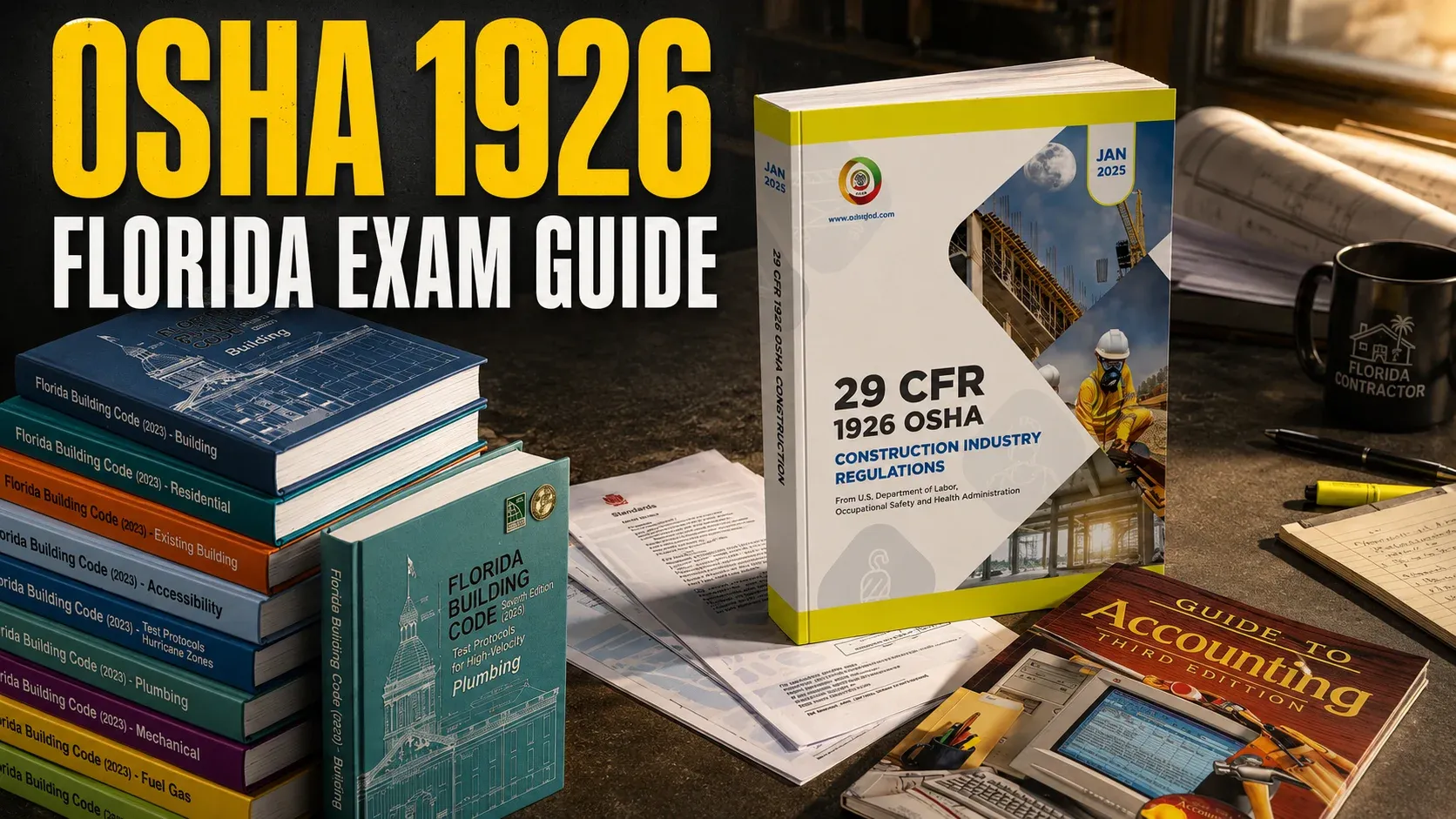
OSHA 1926 Guide for the Florida Contractor Exam
Learn what OSHA 1926 covers, why it shows up on the Florida contractor exam, and how to study it the right way with License Fix School.

Adrian Coastal Roofing
If you are studying for your Florida contractor exam, you have probably already heard the term OSHA 1926 tossed around by instructors, classmates, or the DBPR reference list. Most candidates know it is one of the required books, but very few actually understand what it covers or why it matters so much on exam day and on the jobsite. That gap is exactly what this guide is here to close.
OSHA 1926 is the federal safety standard that governs construction work in the United States, and it is one of the core references tested on the Trade Knowledge portion of the Florida contractor exam. Whether you are pursuing a General Contractor, Building Contractor, Residential, or specialty trade license, understanding this standard is not optional. In this article, we will break down what the standard actually says, how it shows up on your exam, and how License Fix students learn to navigate it with confidence.
What Is OSHA 1926 Construction Standard?
So, what is the OSHA 1926 construction standard exactly? It is the section of the Code of Federal Regulations that the Occupational Safety and Health Administration wrote specifically for the construction industry. Unlike the general industry standard, 1926 addresses the unique hazards of building sites, scaffolding, excavation, fall protection, electrical work, and heavy equipment.
The OSHA 1926 construction standard is broken into subparts, each one covering a different hazard category. Subpart M covers fall protection, Subpart P covers excavations, Subpart K covers electrical safety, and so on. For a Florida contractor, knowing how that book is organized matters just as much as knowing the content itself, because the exam is open book and speed matters.
Contractors who understand this structure walk onto their jobsite with a clear framework for keeping workers safe and staying compliant with federal law.
The OSHA 1926 Book Every Florida Contractor Should Own
Every candidate preparing for the Trade Knowledge exam needs a physical or digital copy of the OSHA 1926 book. It is one of the required references listed in the License Fix Complete Course, Books, and Tabs package, alongside the Florida Building Code volumes and the Florida Contractor Manual.
The OSHA 1926 book is dense. It runs hundreds of pages and is written in regulatory language that was never designed for fast navigation under a timer. That is exactly why so many candidates who bring that book into the Pearson VUE testing center still struggle. Owning the book is only step one.
License Fix teaches students how to tab the OSHA 1926 book by subpart before exam day, so instead of scanning page by page, you flip straight to the section a question is testing. Students who go through the License Fix video lessons on this book consistently report finding answers faster and with less stress during the actual exam.
OSHA 1926 Exam Questions on the Florida Contractor Exam
A common question from new students is how many OSHA 1926 exam questions actually appear on the Trade Knowledge exam. The exact number varies by license type, but safety related content pulled directly from this standard shows up across nearly every trade, from General Contractor to Roofing to Air Conditioning.
Typical OSHA 1926 exam questions ask about required fall protection heights, scaffolding clearance distances, trenching and excavation safety, personal protective equipment requirements, and hazard communication rules. These are not questions you can guess your way through. They require you to locate the correct subpart quickly and read the exact language of the standard.
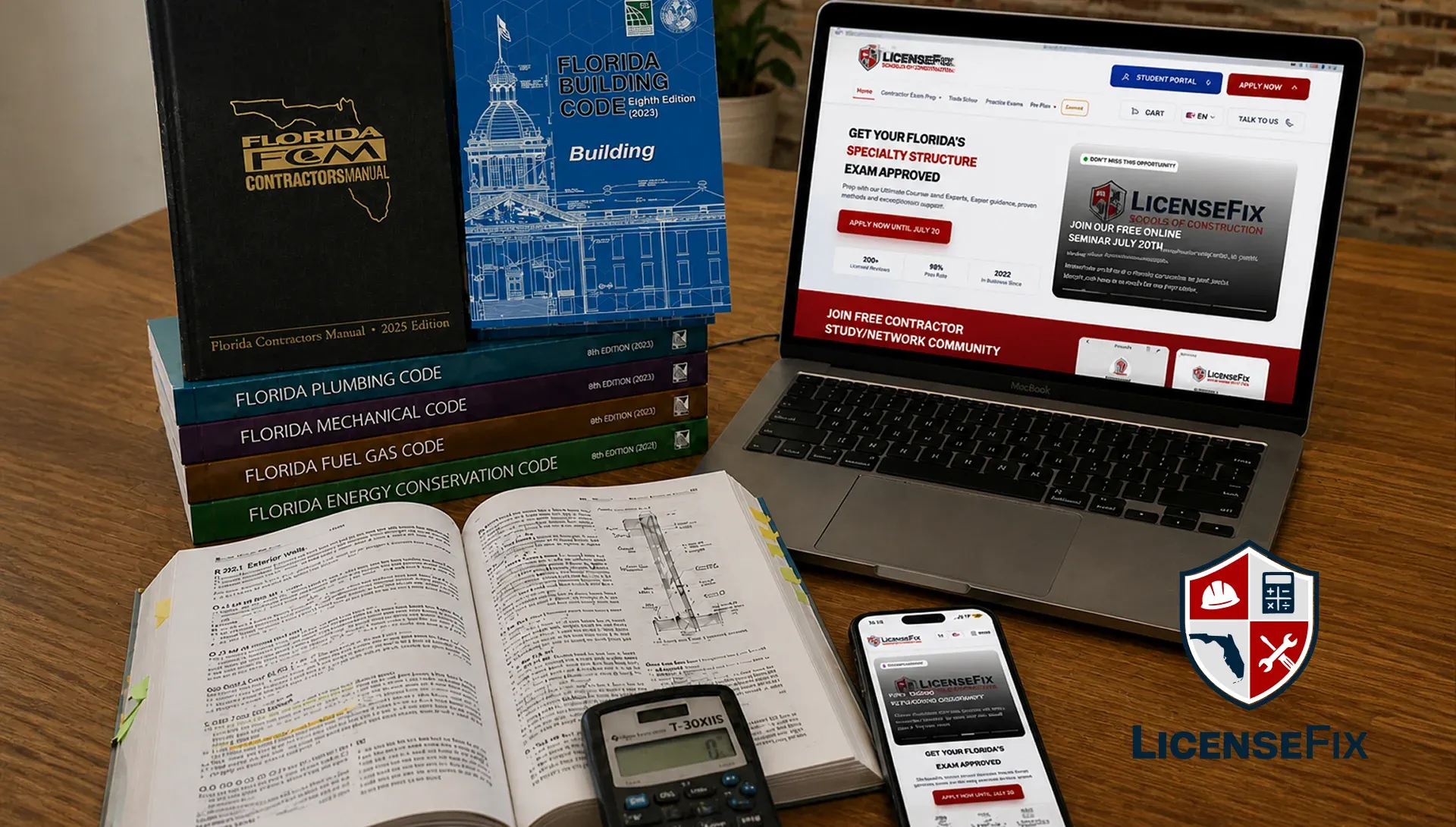
License Fix practice exams include OSHA 1926 exam questions modeled after what recent Gold Alumni actually saw on their test day, updated every quarter so your preparation reflects the current exam, not an outdated question bank.
Contractors OSHA Safety Requirements on Florida Construction Jobsites
Beyond the exam itself, contractors OSHA safety requirements are not just a testing formality. Florida construction sites face real hazards year round, from hurricane season debris to high heat exposure to the fall risks that come with the state's booming residential and commercial building activity.
Meeting contractors OSHA safety requirements on a Florida construction jobsite means training your crew on fall protection above six feet, maintaining proper trench shoring, securing scaffolding, and documenting safety meetings. A license holder who does not understand this material is exposed to fines, stop work orders, and liability if an accident happens.
This is why License Fix does not treat this subject as an exam formality. The course connects every safety concept back to how it plays out on an actual Florida construction jobsite, so what you study is what you will actually use once you are running projects.
OSHA 30 vs OSHA 1926, What Is the Difference?
Students frequently ask about OSHA 30 vs OSHA 1926, and the confusion is understandable since both are commonly discussed in construction licensing circles. OSHA 30 is a training course, a 30 hour outreach program that teaches workers and supervisors general safety awareness. It is the actual federal regulation, the legal standard that OSHA 30 training is based on.
In other words, the OSHA 30 vs OSHA 1926 comparison is not really an either or situation. OSHA 30 teaches you about the rules, while the other is the book of rules itself. Some Florida jurisdictions require an OSHA 30 card for certain permits, but the Florida contractor exam tests your ability to navigate that text directly, not your OSHA 30 certificate.
Understanding this distinction helps candidates stop wasting study time. If your goal is passing the Trade Knowledge exam, your focus needs to be on the OSHA 1926 book itself, tabbed and ready for fast reference.
Contractor Exam Jobsite Safety Topics to Study
Beyond this standard specifically, there are broader contractor exam jobsite safety topics that show up throughout the Trade Knowledge exam. These include ladder safety, electrical lockout procedures, confined space entry, respiratory protection, and hazardous material handling.
Smart candidates build a study plan that groups contractor exam jobsite safety topics by category instead of trying to memorize the entire OSHA 1926 book cover to cover. License Fix structures its Trade Knowledge modules this way, walking students chapter by chapter through the exact topics that appear most often on current exams.
Because Gold Alumni update the question bank quarterly, the contractor exam jobsite safety topics covered in your course reflect what is being tested right now, not what was tested three or four years ago.
Why OSHA 1926 Matters for the Florida Contractor Exam
At the end of the day, every Florida contractor exam candidate needs to treat this material as a core part of their preparation, not a side reference. It appears across every trade license, it is tested consistently, and it reflects real world responsibility once you are licensed and running your own projects.
License Fix has helped more than 209 students pass their Florida contractor exam since 2022, with a 91% pass rate built on a structured, chapter by chapter method that includes proper handling of the OSHA 1926 book. Students do not just memorize facts, they learn how to move through the reference material the way the exam actually demands.
If you want a study system that treats OSHA 1926 with the seriousness it deserves, explore the full License Fix course lineup or pick up the OSHA 1926 book directly from the License Fix bookstore.
Frequently Asked Questions
What is OSHA 1926? It is the federal construction safety standard published by the Occupational Safety and Health Administration. It covers hazards specific to construction sites, including fall protection, excavation, scaffolding, and electrical safety, and it is one of the required reference books for the Florida Trade Knowledge exam.
Do I need to buy the OSHA 1926 book separately? This book is included in the License Fix Complete Course, Books, and Tabs package. It is also available individually through the License Fix bookstore if you already have your course materials and only need the book.
How many OSHA 1926 questions are on the Florida contractor exam? The number varies by license type, but this content appears across nearly every trade exam, since the Trade Knowledge portion consistently tests jobsite safety topics drawn directly from this standard.
Is OSHA 30 the same as OSHA 1926? No. OSHA 30 is a 30 hour training course covering general safety awareness, while the other is the actual federal regulation. Some Florida permits require an OSHA 30 card, but the state exam tests your knowledge of the OSHA 1926 text itself.
Can the OSHA 1926 book be used during the open book exam? Yes. The Florida contractor exam is an open book, and this book is one of the approved references. Knowing how to tab and navigate it quickly is a skill License Fix teaches directly in its Trade Knowledge modules.
Stop Guessing, Start Studying OSHA 1926 the Right Way
This standard is dense, technical, and easy to underestimate until you are sitting in the Pearson VUE testing center running out of time. Between understanding what is OSHA 1926 construction standard, knowing how its exam questions are structured, and meeting contractors OSHA safety requirements on real Florida jobsites, there is a lot riding on how well you know this book.
License Fix School built its entire Trade Knowledge curriculum around exactly this kind of material, tabbed, chapter by chapter, and updated every quarter by Gold Alumni who passed the same exam you are preparing for. If you are ready to stop guessing and start studying OSHA 1926 with a system that has a 91% pass rate behind it, enroll in a License Fix course today or grab your OSHA 1926 book from the bookstore and get started.

About Adrian Coastal Roofing
Adrian is the CEO of Coastal Roofing, a company specializing in roof installation in Florida, recognized for its quality, reliability, and excellence in residential and commercial projects. With years of experience in the construction industry and Florida roofing, Adrian has built his reputation by delivering durable solutions that withstand the state’s extreme weather. Under his leadership, Coastal Roofing has become a leader in roof installation in Florida, offering modern systems such as TPO, PVC, metal roofing, and other efficient solutions to reduce costs and extend the lifespan of roofs.