Mastering Circular E and Payroll Tax Questions on the Florida Business & Finance Exam
Crack IRS Circular E and payroll tax math on the Florida Business and Finance contractor exam. Master FICA, FUTA, and withholding with License Fix.

Every candidate taking the Florida Construction Industry Licensing Board (CILB) Business & Finance exam knows that open-book does not mean easy. The exam requires rapid navigation across multiple dense volumes, and none generates more anxiety than Circular E (IRS Publication 15, Employer's Tax Guide).
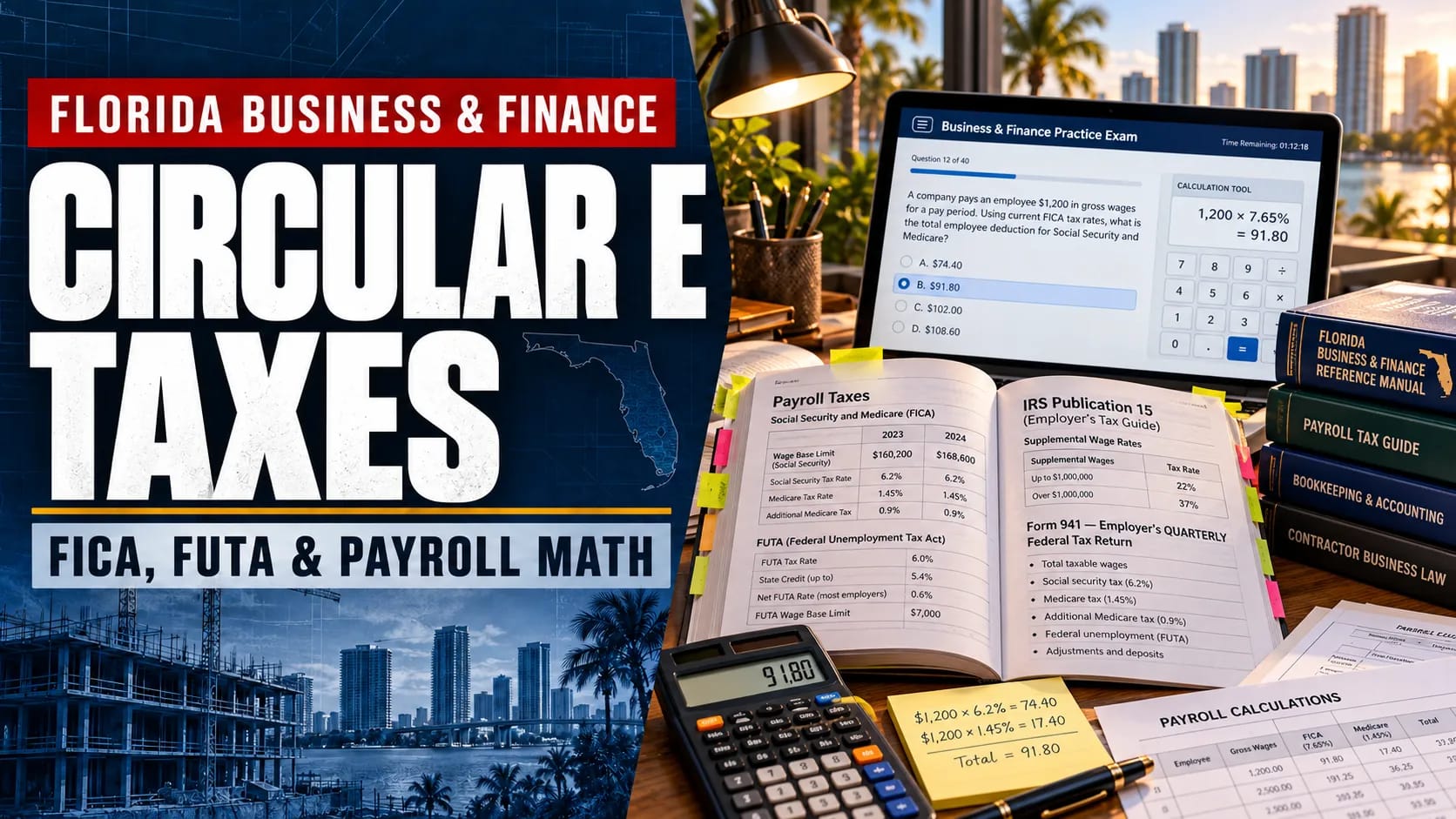
Circular E governs the federal tax rules for employers: income tax withholding, Social Security, Medicare, Federal Unemployment Tax (FUTA), and reporting calendars. On test day, Pearson VUE will hand you scenarios with gross wages, marital statuses, payroll periods, and deposit schedules, expecting you to calculate exact tax withholdings down to the penny.
If you don't understand how to read federal withholding wage-bracket tables, or if you confuse employee withholdings with employer matching contributions, you will lose precious time. In this comprehensive study guide, License Fix School demystifies Circular E and teaches you how to conquer payroll math on the Florida Business and Finance exam.
1. What Is Circular E and Why Does the CILB Test It?
As a licensed Florida contractor, you are not just a builder; you are a business owner and statutory employer. The State of Florida expects licensed contractors to manage payroll responsibly, pay statutory labor contributions on time, and avoid tax liens that could harm consumers or subcontractors.
Circular E covers:
- Federal Income Tax (FIT) withholding calculations.
- Federal Insurance Contributions Act (FICA), which includes Social Security and Medicare.
- Federal Unemployment Tax Act (FUTA).
- Payroll tax deposit schedules (Monthly vs. Semi-Weekly).
- Form 941 (Employer's Quarterly Federal Tax Return) and Form 940 (Annual FUTA Return).
2. FICA Taxes: Social Security and Medicare Rules
FICA taxes are split into two distinct components, both of which are tested heavily on the Florida examination:
1. Social Security (OASDI)
- Tax Rate: 6.2% for the employee + 6.2% employer matching contribution = 12.4% total.
- Wage Base Limit: Social Security applies only up to the annual statutory wage limit. Any earnings above this threshold in a calendar year are exempt from the 6.2% Social Security deduction. (Always reference the exact tax year edition specified in your exam bulletin).
2. Medicare (Hospital Insurance)
- Tax Rate: 1.45% for the employee + 1.45% employer matching = 2.9% total.
- Wage Base Limit: None. Medicare tax applies to all taxable wages, regardless of how much an employee earns.
- Additional Medicare Tax: High earners (wages over $200,000 for single filers) are subject to an extra 0.9% employee withholding, but employers do NOT match this additional tax.
Critical Exam Concept: Employee Withholding vs. Total Employer Liability
Exam questions often test whether you know what comes out of the worker's paycheck versus the total tax check the contractor must send to the IRS:
- Employee Share: 7.65% (6.2% Social Security + 1.45% Medicare).
- Employer Match: 7.65%.
- Total FICA Remittance: 15.3% of taxable wages.
3. FUTA (Federal Unemployment Tax Act): Calculation & Credits
FUTA is entirely an employer-paid tax. Employees never pay FUTA, and it is never deducted from employee paychecks.
The FUTA Formula:
- Statutory FUTA Rate: 6.0%.
- Wage Base Cap: FUTA only applies to the first $7,000 of wages paid to each employee during the calendar year.
- The Maximum State Unemployment Credit: In states with approved unemployment programs like Florida, employers who pay their State Unemployment Tax (SUTA / Florida Reemployment Tax) on time receive a maximum credit of 5.4% against the 6.0% FUTA tax rate.
- Effective FUTA Net Rate: 6.0% - 5.4% = 0.6%.
Sample Exam Question:
A Florida contractor employs a carpenter who earns $28,000 during the first quarter of the year. Assuming the employer pays Florida Reemployment Tax on time and qualifies for the maximum 5.4% federal credit, what is the employer's net FUTA tax liability for this employee for the quarter?
Solution:
FUTA only applies to the first $7,000 of wages per employee per year.
Net FUTA Rate = 6.0% - 5.4% = 0.6% (0.006).
FUTA Liability = $7,000 x 0.006 = $42.00.
If you mistakenly calculated 0.6% of $28,000 ($168.00), you would select a trap distractor option on the exam!
4. Reading Circular E Withholding Tables
On the exam, you may be presented with an employee's pay record and asked to determine their federal income tax withholding using the wage bracket method:
- Verify the Payroll Frequency: Weekly, biweekly, semimonthly, or monthly? Opening a weekly table for a biweekly check will result in an incorrect answer.
- Identify Marital Status / Form W-4 Version: Circular E contains tables for Single, Married Filing Jointly, and Head of Household. Pay close attention to whether the question references standard withholding or an older/newer W-4 format.
- Trace the Bracket Range: Locate the row where the gross wage falls ('at least X but less than Y') and read across to the appropriate allowance or step column.
5. Deposit Schedules: Monthly vs. Semi-Weekly Depositors
Another frequent question category involves determining when an employer must deposit their accumulated payroll taxes (FIT + employee FICA + employer FICA) with the IRS via EFTPS (Electronic Federal Tax Payment System).
- The Lookback Period: The IRS determines your deposit schedule based on total taxes reported on Form 941 during a 4-quarter lookback period (July 1 of two years prior through June 30 of the previous year).
- Monthly Depositor: If reported taxes were $50,000 or less during the lookback period. Payments are due by the 15th day of the following month.
- Semi-Weekly Depositor: If reported taxes were more than $50,000 during the lookback period.
- If payday is Wednesday, Thursday, or Friday: deposit by the following Wednesday.
- If payday is Saturday, Sunday, Monday, or Tuesday: deposit by the following Friday.
- The $100,000 Next-Day Deposit Rule: If an employer accumulates $100,000 or more in undeposited taxes on any day, they must deposit the money by the next business day, regardless of whether they are normally a monthly or semi-weekly depositor.
6. W-2 Employee vs. 1099 Independent Contractor
The exam frequently tests IRS common-law rules for worker classification. Misclassifying employees as independent contractors to evade payroll taxes is a major enforcement focus for both the IRS and the Florida DBPR.
The IRS evaluates three categories of evidence:
- Behavioral Control: Does the contractor control when, where, and how the worker does the job? If the contractor provides tools, sets hourly shifts, and dictates step-by-step instructions, the worker is an employee.
- Financial Control: Does the worker have an unreimbursed business investment? Can the worker realize a profit or loss? Does the worker market services to the general public? If not, they are an employee.
- Type of Relationship: Are there written contracts with employee-type benefits (insurance, vacation, pension)? Is the work performed an integral part of the business's regular operations?

Fast-Track Your Exam Success With License Fix School
Circular E does not have to be a stumbling block. Once you know the exact pages, tables, and formula shortcuts, payroll tax questions become the fastest points you can score on the Florida Business & Finance exam.
At License Fix School, our specialized exam preparation courses provide:
- Precision-indexed book tabs for IRS Publication 15 / Circular E.
- Guided video walkthroughs of every tax math problem type.
- Simulated Pearson VUE mock tests with instant feedback.
Turn confusing tax tables into your competitive advantage. Sign up with License Fix School today and pass your Florida contractor licensing exam on the very first try.

About Pascual, Contractor Licensing Instructor
Pascual is a Florida contractor licensing exam prep specialist, with a focus on the Business & Finance and General Contractor exams. He has helped numerous candidates prepare for and pass their state exams, combining technical knowledge of Florida's regulations with practical study strategies. His approach is straightforward and grounded in real experience with the exam format, helping future contractors understand not just the content, but also how to avoid the most common mistakes that trip up candidates.
More from Pascual, Contractor Licensing Instructor