
Florida Construction Lien Law for Contractors: What the B&F Exam Tests
Master Florida construction lien law for the B&F exam. Five deadlines, four documents, one timeline. Get exam-focused prep with LicenseFix School.

What does the CILB Business and Finance exam test on lien law?
Lien law is not one small chapter on the CILB Business and Finance exam. It is spread across the whole test. The DBPR content outline for the exam lists "knowledge of lien laws" under managing accounts receivable and accounts payable (Content Area D, 32% of questions). It also appears under preparing invoices and draw requests and under managing contracts (Content Area B, 26%). Finally, "Chapter 713 F.S. (Liens)" is listed under complying with state laws (Content Area F, 15%).
The outline is dated 2009 and says each percentage can vary by plus or minus three points, so treat it as a guide, not a promise. The exam itself has 120 scored questions in 6.5 hours, and you need 70%, which is 84 correct answers, according to the DBPR Candidate Information Booklet. Lien questions are usually date math or "which document comes first" questions. The good news is that these are learnable.
What is a notice of commencement in Florida?
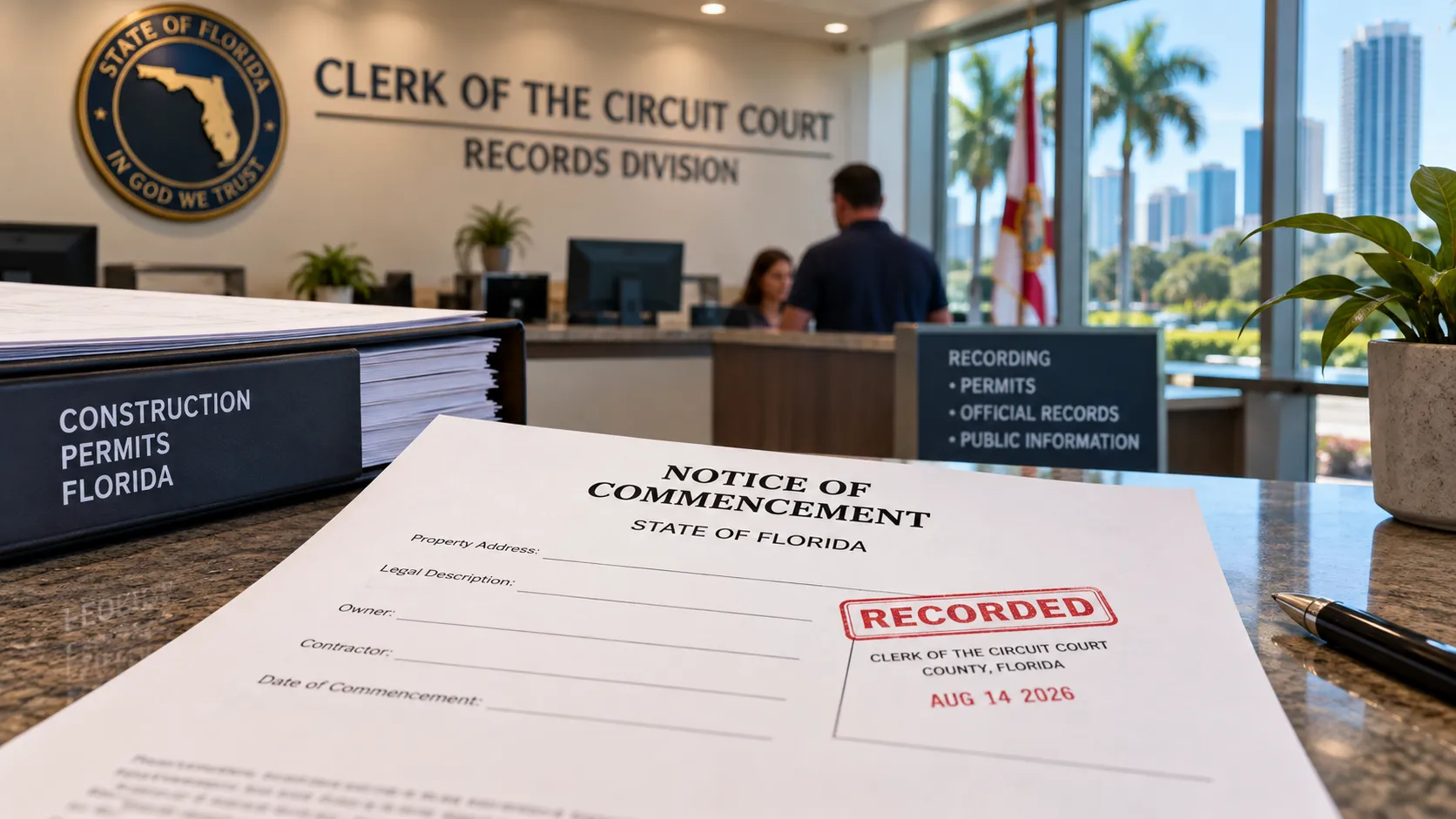
A notice of commencement in Florida is a document the property owner records in the county clerk's office before work begins on an improvement. Under Section 713.13, it must describe the property, the improvement, the owner, the contractor, any surety on a payment bond, any lender, and a person the owner designates to receive notices. The owner also posts a certified copy, or a notarized statement that it was filed, at the job site.
Two timing rules are easy exam points. If the work does not actually start within 90 days after the notice is recorded, the notice is void. The statutory form also says the notice expires 1 year after recording unless the owner enters a different date. For you as a contractor, it is the paper trail that shows who the owner, the lender, and the notice recipient are on the job.
What is a notice to owner in Florida?
A notice to owner in Florida is a written notice that a subcontractor, sub-subcontractor, or supplier serves on the property owner to keep its lien rights. Section 713.06 requires it from lienors who are not in privity with the owner, meaning they did not contract directly with the owner. Laborers are the exception. The notice must be served before starting work or no later than 45 days after starting to furnish labor, services, or materials, and in any event before the owner's final payment after the contractor's affidavit.
A late or missing notice is a complete defense to a lien claim. This is a favorite exam trap: a general contractor with a direct contract does not serve a notice to owner, but its subs and suppliers do. Example: a supplier starts delivering on March 10. Its 45 days end on April 24. The statute also prescribes warning language for the notice, so know where to find that form in your reference materials.
How do you file a claim of lien in Florida?
A claim of lien in Florida is the sworn document a lienor records in the clerk's office to perfect its lien. Section 713.08 says it must state the lienor's name and address, who the lienor contracted with, the labor, services, or materials furnished and their price or value, a description of the property, the owner's name, the dates of the first and last furnishing, and the amount unpaid. A lienor without a direct contract must also state the date and method of service of its notice to owner.
The deadline is strict. The claim may be recorded during the work or after, but not later than 90 days after the final furnishing of labor, services, or materials. If the last day of work is June 1, the last day to record is August 30. The claim must also be served on the owner before recording or within 15 days after recording, or it can be voidable to the extent the delay prejudiced someone.
What does Chapter 713 Florida Statutes say about how long a lien lasts?
Chapter 713 Florida Statutes, Part I, is called the Construction Lien Law, and Section 713.22 sets how long a lien lasts. A lien does not continue for more than 1 year after the claim of lien is recorded, unless an action to enforce it is filed in court within that time. An owner can shorten that window by recording a notice of contest of lien. The lienor then has 60 days from service to file suit, or the lien is extinguished automatically.
Residential work has one more rule. Section 713.015 says a direct contract above $2,500 for improvements to single or multiple family dwellings of up to four units must include the statutory construction lien notice, in capitalized boldface type of at least 12 points, signed by the owner and dated.
How should you study Florida construction lien law for the exam?
Build a one page timeline, then practice with real dates. Keep it to the numbers the statutes give you:
- Notice of commencement: void if work does not start within 90 days after recording.
- Notice to owner: before starting work or within 45 days after starting.
- Claim of lien: recorded no later than 90 days after final furnishing.
- Lien duration: 1 year after recording, unless a suit is filed.
- Notice of contest of lien: 60 days to sue after service.
Then tab the lien law sections in your approved references and practice the lookup against a timer. Our Business and Finance reference book list shows what to bring, and the exam format guide covers pacing.
Frequently Asked Questions
Does a general contractor need to send a notice to owner in Florida?
Generally no. Section 713.06 requires the notice from lienors who are not in privity with the owner, and a general contractor with a direct contract is in privity. Subcontractors, sub-subcontractors, and suppliers serve it. A general contractor still has to record a claim of lien to perfect its own lien.
Can you file a claim of lien after the 90 day deadline?
No. Section 713.08 says a claim of lien may not be recorded later than 90 days after the lienor's final furnishing of labor, services, or materials. Track your last day of work and record the claim well before the deadline.
Is lien law a big part of the Florida contractor exam?
It is spread across several content areas instead of sitting in one section. The DBPR outline mentions lien laws under accounting, contracts, and state regulations, so expect lien questions throughout the test.
Conclusion
Florida construction lien law feels heavy until you see it as a timeline: record, notify, claim, enforce. Memorize the five numbers above, know where each statute sits in your books, and lien questions stop being a risk. This guide is for exam preparation, not legal advice, so talk to a Florida construction attorney about a real dispute.
Get exam-focused training with LicenseFix School! See our Business and Finance exam preparation course or start with the free study materials.
Sources: Florida Statutes Chapter 713 and the DBPR Business and Financial Management content outline.

About Pascual, Contractor Licensing Instructor
Pascual is a Florida contractor licensing exam prep specialist, with a focus on the Business & Finance and General Contractor exams. He has helped numerous candidates prepare for and pass their state exams, combining technical knowledge of Florida's regulations with practical study strategies. His approach is straightforward and grounded in real experience with the exam format, helping future contractors understand not just the content, but also how to avoid the most common mistakes that trip up candidates.
More from Pascual, Contractor Licensing Instructor