
Florida Business and Finance Exam Mistakes to Avoid
Learn the Florida Business and Finance exam mistakes that fail even experienced contractors, and how License Fix helps you avoid them.

Adrian Coastal Roofing
If you are prepping for your DBPR exam, you have probably already heard the warnings: the Business and Finance section is where qualified, experienced contractors go in confident and come out with a failing score. It is not a knowledge problem. It is a preparation problem, and the same handful of Florida Business and Finance exam mistakes show up again and again in License Fix's own student data. In this article, you will see exactly which mistakes cost candidates the most points, why they happen even to people who have run a construction business for years, and what to do instead before your Pearson VUE appointment.
Treating the Open-Book Format as an Easy Pass
The single most common Business and Finance exam mistake is assuming that open-book means easy. Candidates walk in thinking they can simply look up whatever they don't know, then discover that Pearson VUE gives them a strict time limit and hundreds of pages spread across multiple reference books. This open-book exam mistake is less about knowledge and more about speed: if you don't already know roughly where an answer lives, you will burn minutes you don't have flipping through the Florida Contractor Manual or the Builder's Guide to Accounting.
The fix is practice under real time pressure, not just reading. License Fix students run full-length timed practice exams before test day specifically to catch this open-book exam mistake early, when it is still cheap to correct. If you have not yet worked through how the actual test is structured, our guide on the Florida Business and Finance exam format is the right place to start before tackling timing strategy.
Skipping Deep Study on Contract Law and Lien Law
A close second among Business and Finance exam mistakes is underestimating the contract law and lien law portion. Many candidates spend the bulk of their study time on numbers and accounting, then treat Chapter 489 licensing law, contract clauses, and Florida's lien statutes as background reading. That is a costly assumption, because contract law and lien law questions make up a meaningful share of the exam and cover material that field experience simply does not teach.
This contract law and lien law mistake shows up most often with notice-to-owner requirements, payment bond rules, and the difference between a certified and a registered contractor's contract obligations. Candidates who have never had to file a lien or respond to one arrive at these questions with no frame of reference. Our full breakdown of what is tested in this part of the Florida Business and Finance exam walks through exactly which chapters and statutes to prioritize.
Getting Financial Ratios and Financial Statements Wrong
Financial ratio mistakes are so common that License Fix built an entire dedicated guide around them, and they still show up constantly in exam post-mortems. Candidates memorize a formula in isolation, then freeze the moment a question changes the wording or asks them to interpret what a ratio means for a company's financial health rather than just calculate it. Current ratio, quick ratio, and working capital are the usual suspects, along with basic balance sheet and income statement reading.
The pattern behind this financial ratio mistake is studying formulas without studying the underlying financial statements they come from. If you can calculate a ratio but can't explain what it tells a lender or a bonding company about the business, you are one reworded question away from missing it. For the full formula list and worked examples, see our Business and Finance exam financial ratios guide.
Walking In With Untabbed or Wrong Reference Books
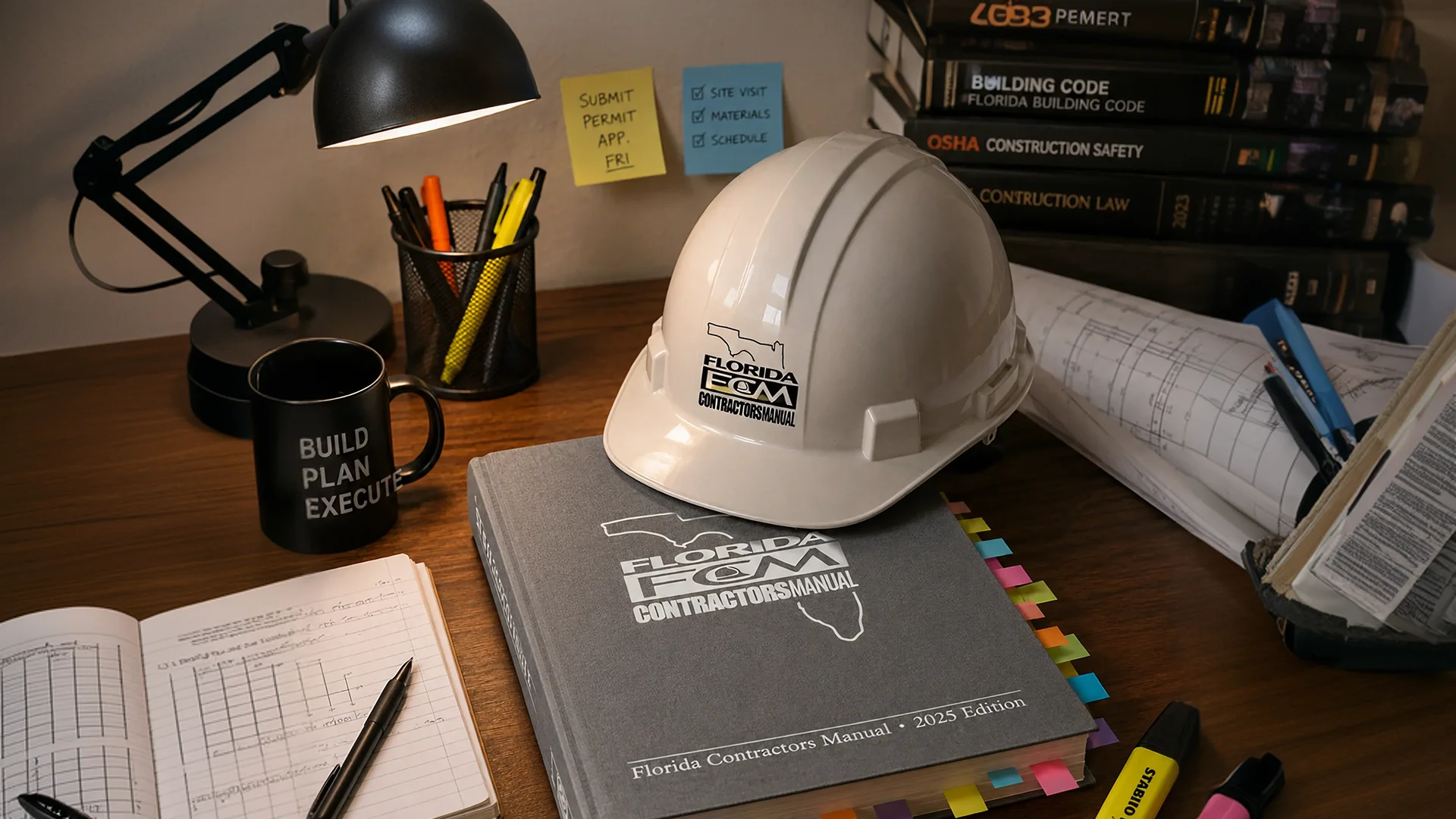
Exam book tabbing mistakes are entirely avoidable, yet they remain one of the most repeated Business and Finance exam mistakes License Fix sees. Some candidates bring the wrong edition of a required book. Others bring the right books, untabbed, and lose ten or fifteen minutes per question just locating the right section. A few show up with materials Pearson VUE does not allow into the testing room at all, which can mean losing the appointment entirely.
This exam book tabbing mistake is fixable in an afternoon. License Fix's course includes video-guided tabbing sessions that show students exactly which pages of the Florida Contractor Manual, the Builder's Guide to Accounting, and the AIA documents matter most, and how to mark them so any question can be answered in under a minute. Confirm your required list against the official Florida DBPR Construction Industry Licensing requirements well before your test date, not the week of.
Practicing With Outdated or Generic Questions
The last major Business and Finance exam mistake happens before candidates even open a book: studying from outdated practice exam questions pulled from a generic bank that has not been updated in years. Florida's licensing rules and exam blueprint shift over time, and a practice set built for a prior version of the test can leave you confident about material that no longer matches what Pearson VUE actually asks.
License Fix avoids this outdated practice exam questions problem by having its Gold Alumni, contractors who passed the exact same exam recently, refresh the practice question bank every quarter. That keeps every study session tied to what is currently being tested, not what used to be tested two or three years ago.
Frequently Asked Questions
What is the biggest Business and Finance exam mistake candidates make?
Underestimating how much time contract law, lien law, and financial statement questions require, then running out of time on sections that felt manageable in isolation but add up under the clock.
Can I avoid these mistakes just by reading the required books?
Reading alone rarely prevents these mistakes because most of them are about application and timing under exam conditions, not raw knowledge. Timed practice exams and guided book tabbing address the mistakes reading cannot.
How many of these mistakes does License Fix's course address directly?
All five. The course pairs video lessons on contract law, lien law, and financial statements with tabbed reference books and a quarterly-updated practice question bank built specifically to target these Business and Finance exam mistakes.
Is it normal for experienced contractors to fail this section?
Yes. Field experience does not cover licensing law, lien rights, or financial ratio interpretation, which is exactly why this section catches even veteran builders off guard.
Final Thoughts on Avoiding These Business and Finance Exam Mistakes
None of these Business and Finance exam mistakes are about intelligence or work ethic. They are about preparation gaps that are completely predictable and completely fixable once you know where they are. Treating the open-book format as easy, skimming contract law and lien law, guessing at financial ratios, showing up with untabbed books, and studying outdated questions account for the overwhelming majority of failed attempts License Fix has seen.
License Fix School built its Business and Finance course specifically to close these gaps, with a 91% pass rate and a 100% money-back guarantee behind it. If you are ready to prepare the right way instead of learning these mistakes the hard way on exam day, enroll in the License Fix Business and Finance course and start studying with a system built around exactly what Pearson VUE tests.

About Adrian Coastal Roofing
Adrian is the CEO of Coastal Roofing, a company specializing in roof installation in Florida, recognized for its quality, reliability, and excellence in residential and commercial projects. With years of experience in the construction industry and Florida roofing, Adrian has built his reputation by delivering durable solutions that withstand the state’s extreme weather. Under his leadership, Coastal Roofing has become a leader in roof installation in Florida, offering modern systems such as TPO, PVC, metal roofing, and other efficient solutions to reduce costs and extend the lifespan of roofs.