Florida Contractor Financial Requirements for a GC License
What Florida contractor financial requirements really mean: credit score, the 14-hour course, liens and insurance, explained step by step.

What are the Florida contractor financial requirements for a GC license?
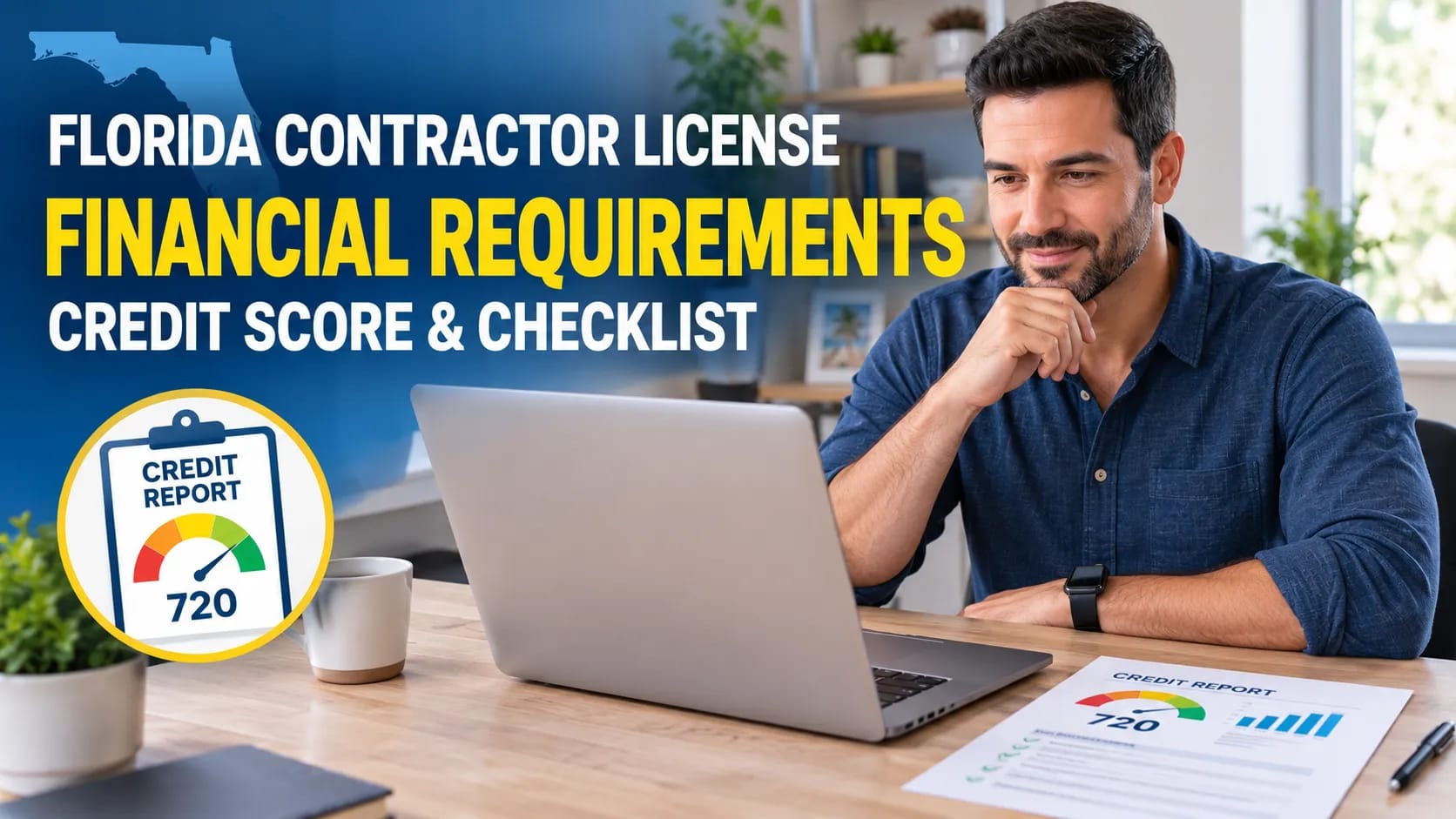
The Construction Industry Licensing Board wants proof that you can run a contracting business without leaving customers or suppliers unpaid. The DBPR says the rule applies to all construction contractor applicants before a license is issued. The DBPR sheet on financial responsibility and stability says a contractor is deemed financially responsible and stable when four items are established: no unsatisfied liens against you or the company you will qualify, no unsatisfied judgments against either, a 660 FICO derived credit score or higher, and, if your score is under 660, a board-approved 14-hour financial responsibility course.
The proof is a credit report. You submit a personal report, and a report on the business you intend to qualify. Section 489.115 of the Florida Statutes is the legal base for this rule, and the board defines financial responsibility by rule.
It helps to separate the two words. Financial responsibility is met when your credit report shows no outstanding unsatisfied judgments or liens. Financial stability is met when the report shows a FICO derived score of 660 or higher, or when you complete the course. Example: a contractor with a 645 score and a clean report does not need to repair anything else, but does need the 14-hour course.
What is the Florida contractor credit score requirement?
The Florida contractor credit score requirement is 660 or higher, and it has to be a FICO derived score. The DBPR says your personal credit report must come from a nationally recognized credit reporting agency, must show that records were searched at the federal, state, and local levels, and must show your credit score and indicate that it is a FICO or Beacon score. The report cannot show any unsatisfied liens or judgments. The score requirement is tied to your personal report, while the business report is there to show that the company has no unsatisfied liens or judgments either.
DBPR keeps a list of acceptable credit reporting agencies on its website, so check that list before you order your report. The report also has to include the credit score itself, not only the credit history, so confirm that before you pay.
What is the financial responsibility course Florida contractor applicants take?
If your FICO derived score is below 660, you must complete a course approved by the Construction Industry Licensing Board. The financial responsibility course Florida contractor applicants take is 14 hours long, and the DBPR keeps a list of board-approved courses. You only need to complete it if your score is below 660.
On the CILB 5-A application you list the school name, the provider number, the course name, and the dates you attended. Treat the course as part of your timeline, not a last minute task, because you need proof of completion when you file.
How do liens and judgments affect your CILB license application?
Your CILB license application must show no unsatisfied liens or judgments. The DBPR instructions say financial responsibility is met when the credit report shows no outstanding unsatisfied judgments or liens against you. If the report does show one, you must submit proof that it was satisfied. Bankruptcy works the same way: you must submit proof of discharge if one appears on the report.
Section 489.115 also tells the board to consider the applicant's credit history, ability to be bonded, and any history of bankruptcy or assignment of receivers when it defines financial responsibility. Clean up old items before you apply, and keep the satisfaction letters in one folder, because the application asks you to attach them. Our guide on mistakes that delay license approval lists what else slows applications.
What are the Florida contractor insurance requirements?
Florida contractor insurance requirements appear right on the CILB 5-A application. As of the July 2024 form, the minimum general liability amounts for general and building contractors are $300,000 in public liability and $50,000 in property damage. All other categories need $100,000 in public liability and $25,000 in property damage.
The form also asks whether you have workers' compensation coverage or have filed for an exemption with the Division of Workers' Compensation. If you have not, you attest that you will obtain an exemption within 30 days after your license is issued. Active applicants complete the insurance section. If you choose inactive status, you skip it.
What are the Florida contractor bond requirements for a GC license?
The Florida contractor bond requirements are not part of the DBPR financial requirements sheet. That sheet lists a credit score of 660 or a 14-hour course as the path to financial stability, and it does not list a surety bond for an individual applicant. Section 489.115 does mention "ability to be bonded" as something the board may consider, so keep your credit report clean.
Bonds can still appear elsewhere. A public project, a lender, or a local jurisdiction may ask for a payment bond or performance bond in a specific contract. Read each contract, and ask your local building department if you are unsure. For the full license path, see our Florida contractor license requirements guide and the cost breakdown.
Frequently Asked Questions
Do you need a 14-hour financial responsibility course?
Only if your FICO derived credit score is under 660. If your score is 660 or higher and your report shows no unsatisfied liens or judgments, the DBPR does not require the course.
Does the business need its own credit report?
Yes, when you qualify a business. The DBPR asks for a personal credit report and a credit report on the business you intend to qualify, both from a nationally recognized credit reporting agency.
Where do you find an approved financial responsibility course?
The DBPR publishes a list of the board's approved financial responsibility courses on its website. Choose a provider from that list, and keep your certificate, because the CILB 5-A asks for the school name, provider number, course name, and dates attended.
Can a bankruptcy stop a Florida contractor license?
A bankruptcy does not automatically end your application. You must submit proof of discharge, and the board considers bankruptcy history when it reviews financial responsibility. Talk with the DBPR or an attorney about your specific record.
Conclusion
Financial requirements are simple when you gather them early. Use this checklist:
- A personal credit report with a FICO or Beacon score from a nationally recognized agency.
- A credit report on the business you intend to qualify.
- Proof that any liens, judgments, or bankruptcy on the report were satisfied or discharged.
- The 14-hour course certificate if your score is below 660.
- Your general liability insurance details and your workers' compensation coverage or exemption.
Need help understanding the license process? Talk to the LicenseFix team! You can also see how our general contractor exam preparation course fits into your timeline.
Sources: the DBPR financial responsibility and stability sheet and Section 489.115, Florida Statutes.

About Pascual, Contractor Licensing Instructor
Pascual is a Florida contractor licensing exam prep specialist, with a focus on the Business & Finance and General Contractor exams. He has helped numerous candidates prepare for and pass their state exams, combining technical knowledge of Florida's regulations with practical study strategies. His approach is straightforward and grounded in real experience with the exam format, helping future contractors understand not just the content, but also how to avoid the most common mistakes that trip up candidates.
More from Pascual, Contractor Licensing Instructor