Can You Get a GC License in Florida With a Degree Instead of Experience?
The short answer is no, a degree does not fully replace experience for a Florida GC license. A four year const...
Topic
Everything Florida checks before it issues a certified contractor license, including experience or education, a 660 credit score, liability insurance, fingerprints and fees. Use these guides to confirm you qualify before you apply.

Understanding Handyman Work Under Florida Law If you are offering home repair, maintenance, or improvement services in Florida, one of the m...

The short answer is no, a degree does not fully replace experience for a Florida GC license. A four year const...

What are the Florida contractor financial requirements for a GC license? The Construction Industry Licensing B...

Getting a Florida contractor license is not a single appointment or form. For most applicants, the process inc...

If you are planning to become a licensed contractor in Florida, the first budgeting question is usually simple...

You've been working in construction for years. You know the trade. You're ready to get licensed. You submit yo...

You've been building in Florida for years. You know how to read a blueprint, manage a crew, and deliver a proj...

Meeting the Florida GC license requirements isn't just about checking boxes. It's about understanding what the...
What does Florida check before it issues a certified contractor license? These guides walk through each item on the application: experience or education, credit, insurance, fingerprints, fees and waiting times. They are for candidates who want to confirm they qualify before paying exam fees, and for applicants assembling their file.
An applicant must be 18 and of good moral character. The standard route in the licensing statute is four years of active experience, at least one of them as a foreman, with a year counted as 2,000 hours. A four-year degree in the appropriate field of engineering, architecture or building construction plus one year of proven experience is a second route, and college credits or up to three years of military service can replace part of the time. How a degree shortens the experience requirement explains which routes qualify.
General and building applicants also need commercial experience in four of six structural areas, and general applicants one year on structures of four stories or more; the general contractor requirements checklist lists every item. If you only take small repair jobs, read what a handyman can do without a license first.
The board's financial stability rule asks for a FICO-derived credit score of 660 or higher on a report with no unsatisfied judgments or liens. Below 660, the requirement is met with a 14-hour financial responsibility course approved by the board, and no minimum net worth has to be shown. What the financial requirements mean, step by step goes through each one.
Insurance is attested by affidavit: $300,000 public liability and $50,000 property damage for general and building contractors, $100,000 and $25,000 for residential and every other category, plus workers' compensation coverage or an exemption obtained within 30 days after the license is issued. Fingerprints go through a Livescan provider right after you apply. Citizenship is not required, but a Social Security number is; see what applicants who are not U.S. citizens need.
The exams come before the application. Exam fees are $135 to register, $80 for Business and Finance and $40 each for Contract Administration and Project Management. The application form sets the initial certification fee at $245 from May 1 of an even year through August 31 of an odd year, and $145 for the rest of the cycle. What a license costs in 2026 adds books, fingerprints and other expenses.
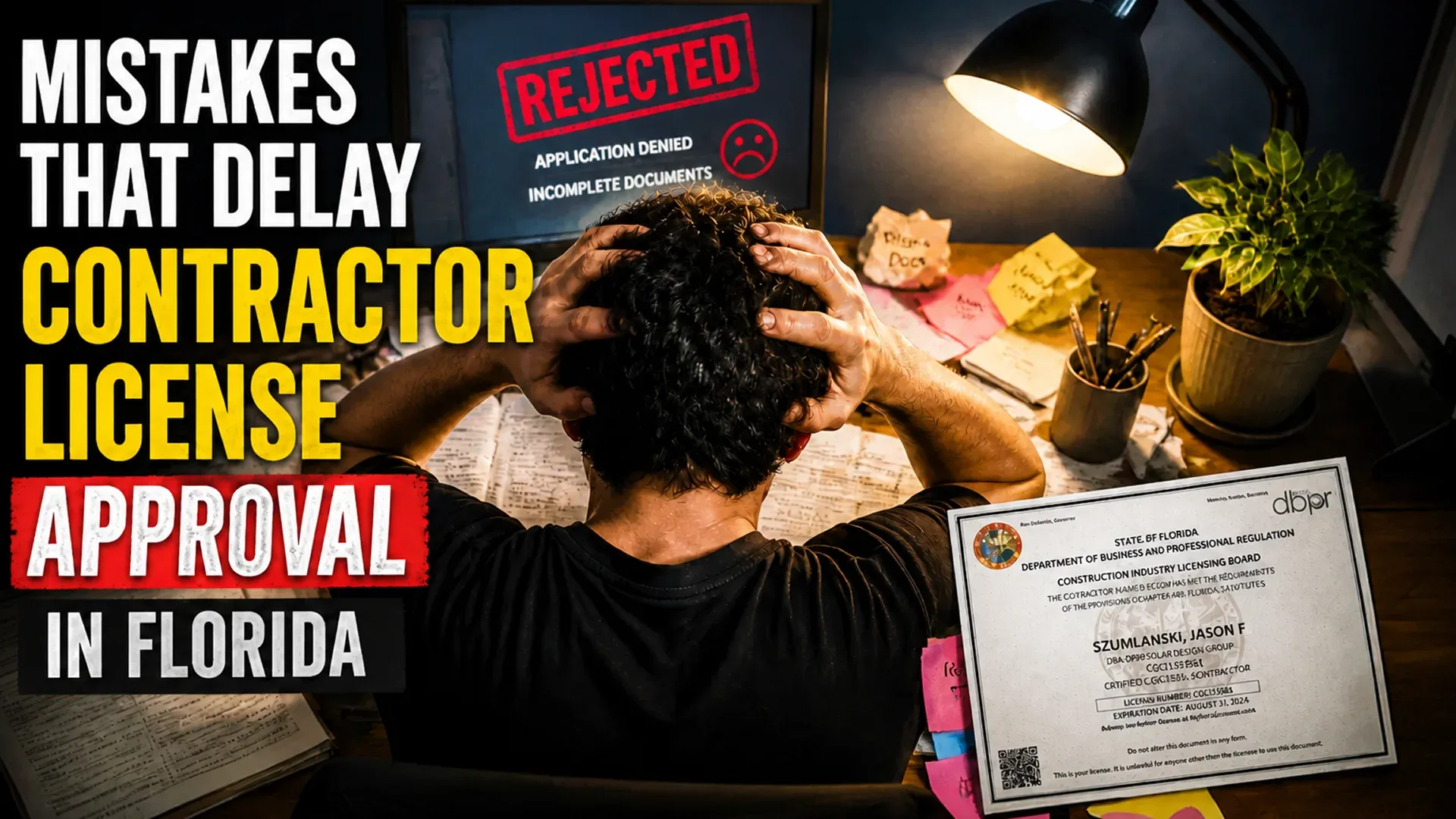
By statute an agency must point out errors or omissions within 30 days and approve or deny a completed application within 90 days. How long the whole process takes and the application mistakes that leave a file stuck at DBPR show where time is lost. License Fix keeps these steps together in its licensing requirements guide.

The board rule asks for a FICO-derived credit score of 660 or higher on a credit report that shows no unsatisfied judgments or liens. An applicant below 660 meets the financial stability requirement by completing a 14-hour financial responsibility course approved by the board. No minimum net worth has to be demonstrated.
General and building contractors must carry at least $300,000 in public liability and $50,000 in property damage coverage. Residential contractors and every other category need $100,000 and $25,000. The policy is carried in the name of the licensee, and the applicant attests to it by signed affidavit; a certificate of insurance is sent only when the board asks for it.
Yes. Up to three years of active duty service in the United States Armed Forces can be accepted toward the experience requirement, regardless of duty or training. At least one more year of active experience as a foreman in the trade, civilian or military, is still required. Veterans who apply within 60 months of an honorable discharge also have the initial licensing, application and unlicensed activity fees waived.
A conviction is not an automatic bar. The board may not deny a license based solely on a felony conviction; it weighs the severity of the crime, its relation to contracting, the potential for public harm, the time elapsed and rehabilitation. The application asks about convictions in any jurisdiction, including cases where adjudication was withheld, so disclose them.
No. The only requirement the state lists to apply for the certification examination is being at least 18. Experience, credit and background are reviewed in the license application you file after passing. The state still advises checking that you meet every requirement before applying for the exam, because a passing grade alone does not qualify you for a license.