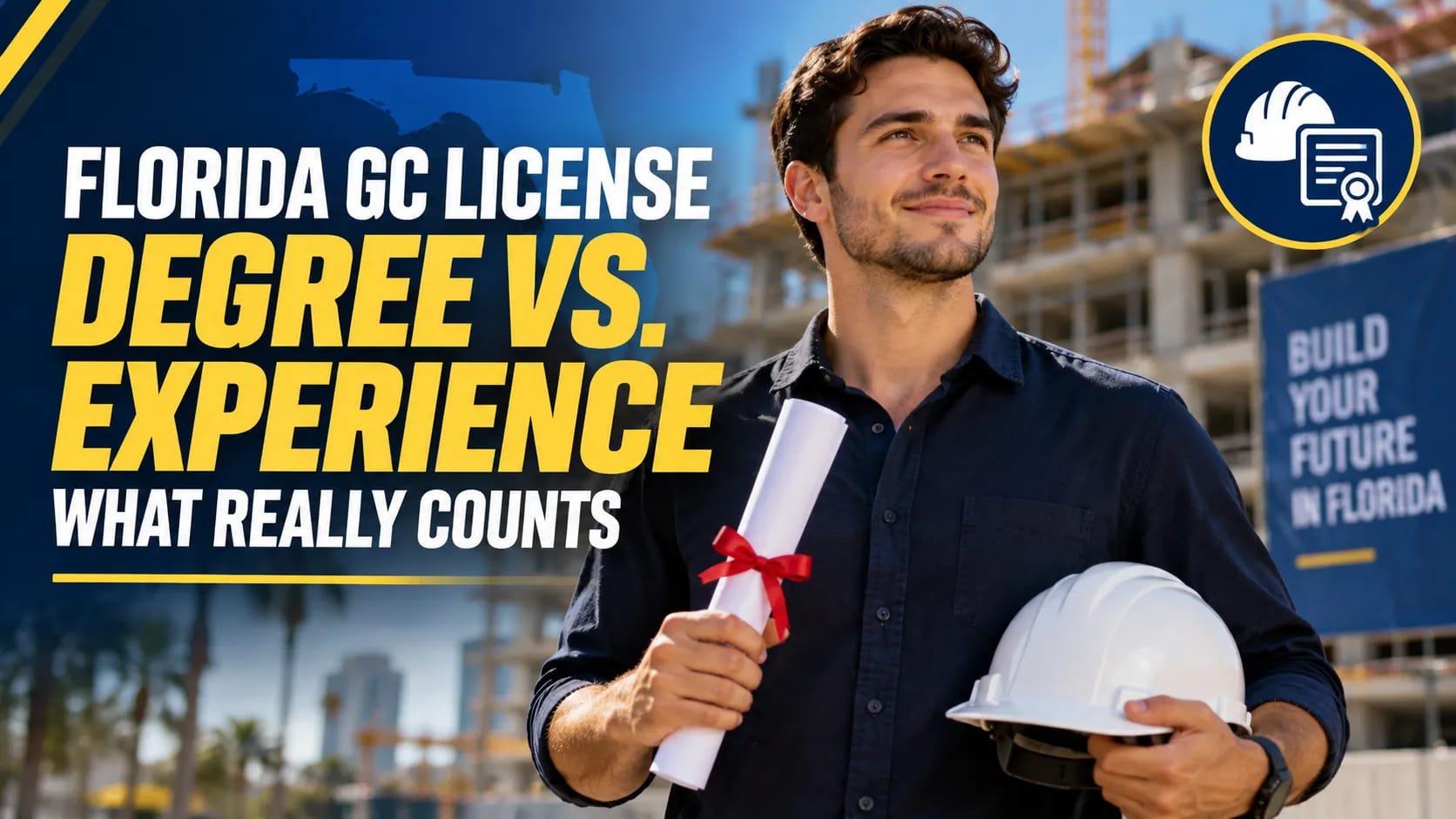
Can You Get a GC License in Florida With a Degree Instead of Experience?
A degree shortens the path to a Florida contractor license, but does not replace experience. See which degrees and routes qualify.

The short answer is no, a degree does not fully replace experience for a Florida GC license. A four year construction related degree counts as three years of experience, but you still need one year of proven experience in the category you want. Most general contractor applicants must also show commercial experience in specific areas, including at least one year on structures four stories or taller. This guide explains how the degree and experience rules for a Florida contractor license work, based on Section 489.111 and the DBPR application.
We checked the 2026 Florida Statutes, Rule 61G4-15.001 (effective May 16, 2024), and the July 2024 CILB 5-A application for a certified general contractor in September 2026. Confirm the current form on the DBPR website before you apply.
Which degree counts for a Florida CGC license?
For the Florida CGC license, the degree route requires a baccalaureate degree from an accredited four year college in the appropriate field of engineering, architecture, or building construction. For general, building, and residential contractors, Rule 61G4-15.001 narrows that to three degrees: civil engineering, building construction, or architecture. DBPR calls this a construction related degree. Under Section 489.111, that degree plus one year of proven experience in the category you are applying for makes you eligible to sit for the exam. The statute uses 2,000 person hours to measure a full year.
A degree in another field, such as business or electrical or mechanical engineering, does not use this route for a GC license. That does not mean your college work is wasted. The combination routes below accept credits from any accredited college-level courses, and junior or community college courses count.
Do I need experience to get a Florida contractor license?
Do I need experience to get a Florida contractor license? Yes. Every route to a Florida certified contractor license requires some experience. The CILB 5-A application lists the routes, and you pick one:
- Degree route: a four year degree in civil engineering, building construction, or architecture (counted as three years) plus one year of proven experience in the category.
- Combination route 1: one year as a foreman plus at least three years of accredited college-level credits.
- Combination route 2: one year as a worker, one year as a foreman, and two years of college-level credits.
- Combination route 3: two years as a worker, one year as a foreman, and one year of college-level credits.
- No college route: four years as a worker or foreman, with at least one year as a foreman.
- Upgrade route: an active certified residential or building contractor with at least four years of proven experience in that license.
The application also lists separate routes for military veterans, which combine military service with foreman experience. If you are asking whether you need experience to get a Florida contractor license, the answer is yes, but the amount depends on your education and your route.
Here is how the routes look in practice. A civil engineering graduate with one year of proven experience fits the degree route. Someone with one year as a worker, one year as a foreman, and two years of community college credits fits the second combination route. A carpenter with four years on job sites, one of them as a foreman, can qualify with no college at all. In every case the board still reviews your documents.
What extra experience does a general contractor need?
Rule 61G4-15.001 of the Florida Administrative Code, cited in the CILB 5-A note, adds two conditions for a certified general contractor. On the degree, worker, and foreman routes, your experience must be commercial construction in four or more of the listed areas. You also need at least one year of that experience on structures at least four stories tall.
The areas include foundations or slabs larger than 20,000 square feet, column erection, masonry walls, formwork for structural reinforced concrete, steel erection, and elevated slabs. The four story year surprises many degree holders. The rule exempts only one group: active certified residential and building contractors who upgrade to general contractor after four years in their license. So a residential or building license is a practical first target if you do not have tall structure experience yet. See our guide to CGC, CBC, or CRC licenses.
How to get a contractor license in Florida: how does DBPR check your experience?
How to get a contractor license in Florida starts with your employment history, which you list on the application. For each entry, you give the employer, the name and license number of the qualifying contractor, whether you were a worker or a foreman, the project dates, and a description of the work. You also state whether the project involved structures four stories or higher.
Rule 61G4-15.001 says the board accepts lawfully acquired experience gained under the supervision of a contractor who was properly licensed at the time, in the category you apply for or one that covers the full scope of the work. Ask former employers for dates and details early. Missing documents are a common reason applications stall, so collect employer names, dates, and license numbers early. Our license requirements guide shows what to gather.
What are the steps to become a general contractor in Florida?
To become a general contractor in Florida, follow this order:
- Choose your qualification route and confirm your experience, including the four story requirement if your route needs it.
- Apply for the exams with Professional Testing, Inc. Division I contractors pass three: Business and Finance, Contract Administration, and Project Management, each at 70% or higher.
- Meet the financial requirements: a 660 FICO derived credit score or a 14-hour financial responsibility course, and no unsatisfied liens or judgments.
- Show insurance and workers' compensation coverage or an exemption.
- Submit the CILB 5-A application with your credit reports, employment history, and fees.
For a plain-language roadmap, read our how to become a general contractor guide. Our general contractor exam preparation course helps with step 2.
Frequently Asked Questions
Do community college courses count toward a Florida contractor license degree experience?
Yes. Section 489.111 says all junior college or community college level courses are accredited college-level courses. They count toward the combination routes that mix credits with worker or foreman experience.
Can I skip the four story experience with a degree?
No. Rule 61G4-15.001 requires at least one year on structures four stories or taller for general contractor applicants, and a degree does not change that. The only exception is for active certified residential or building contractors who upgrade after four years in their license. Keep proof of every project you count toward that year.
How many years of experience do you need?
It depends on the route. The degree route needs one year of proven experience. The combination routes need between one and three years of worker and foreman experience plus college credits. The route with no college needs four years as a worker or foreman, including at least one as a foreman.
Can a residential or building contractor upgrade to general contractor?
Yes. Under Section 489.111, an active certified residential or building contractor with at least four years of proven experience in that classification can qualify to take the general contractor exam. Rule 61G4-15.001 also exempts this upgrade route from the four story experience year.
Conclusion
A degree helps, but it does not remove the experience requirement, and the rules on degrees and experience for a Florida contractor license reward people who plan early. Map your route first, then build a plan for the exams.
Get help preparing for your licensing journey with LicenseFix School. Start with the free study materials.
Sources: Rule 61G4-15.001, Florida Administrative Code; Section 489.111, Florida Statutes; and the DBPR CILB 5-A application.

About Pascual, Contractor Licensing Instructor
Pascual is a Florida contractor licensing exam prep specialist, with a focus on the Business & Finance and General Contractor exams. He has helped numerous candidates prepare for and pass their state exams, combining technical knowledge of Florida's regulations with practical study strategies. His approach is straightforward and grounded in real experience with the exam format, helping future contractors understand not just the content, but also how to avoid the most common mistakes that trip up candidates.
More from Pascual, Contractor Licensing Instructor