Florida HVAC Contractor License: Requirements and Exam Guide
Learn how to get a Florida HVAC contractor license, from DBPR eligibility to the Mechanical and Air Conditioning exams. Study with License Fix.

Adrian Coastal Roofing
If you have spent years installing and servicing air conditioning systems in Florida, you already know the trade. What most technicians underestimate is how much paperwork, experience documentation, and exam preparation stand between them and a Florida HVAC contractor license. This guide walks through exactly what the state requires, which license category fits your goals, and what to expect on exam day.
A Florida HVAC contractor license is issued by the Department of Business and Professional Regulation (DBPR) through the Construction Industry Licensing Board (CILB). Without it, you cannot legally pull permits, bid HVAC work above the threshold set by local jurisdictions, or represent yourself as a certified air conditioning contractor. Technicians who work unlicensed put their business, and their client's home, at risk. In this article, you will see how the Florida HVAC contractor license process works from eligibility through the exam, and how License Fix prepares candidates to pass on the first attempt.
Every year, more Florida technicians decide the field experience they already have deserves the credential to match it. Getting a Florida HVAC contractor license is not just a legal formality, it is what lets you sign contracts in your own name, carry your own insurance, and grow past whatever a subcontractor role has capped you at.
Florida Mechanical Contractor License Requirements
Before you can sit for any state exam, you need to satisfy the Florida mechanical contractor license requirements set by the CILB. These requirements apply whether you are pursuing a Class A air conditioning license, a Class B air conditioning license, or the broader Certified Mechanical Contractor license.
At minimum, applicants must document four years of related construction experience, with at least one year in a supervisory or foreman role. A four-year construction-related degree can offset part of that experience requirement, and up to three years of college credit may count toward the total, though the state still expects at least one year of hands-on supervisory time. The CILB also reviews your credit history and requires a background check, so applicants with unresolved financial or legal issues should address those before applying.
The distinction between the license types matters. A Class A or Class B air conditioning license covers installation, maintenance, and repair of HVAC systems within defined size and scope limits. A Certified Mechanical Contractor license covers a wider range of work, including refrigeration, process piping, and boiler systems that fall outside the scope of a straight air conditioning license. Choosing the wrong category early on can mean redoing the application later, so it helps to map your intended scope of work against the Florida mechanical contractor license requirements before you file anything with the DBPR.
Once your application is approved, the DBPR issues a Notice of Eligibility, which authorizes you to schedule your exams through Pearson VUE. You then have a window to complete testing and finalize your license. Applicants should also budget for liability insurance and the licensing fees due at activation, since an incomplete financial package is one of the most common reasons an otherwise qualified application gets delayed.
Passing the Florida HVAC Contractor Exam
Every Florida HVAC contractor exam path includes two parts: the Business and Finance exam and a trade knowledge exam specific to your license category. Both are open book, both are timed, and both require a minimum score of 70 percent to pass.
The Business and Finance exam runs roughly 120 questions over 6.5 hours and covers contract law, financial statements, project cost management, and lien law. This is the section that catches experienced technicians off guard, because deep field knowledge does not automatically translate into comfort with balance sheets or contract clauses. The trade knowledge portion of the Florida HVAC contractor exam, whether you are testing for Class A, Class B, or the Mechanical Contractor category, covers load calculations, ductwork design, refrigeration principles, and the mechanical provisions of the Florida Building Code.
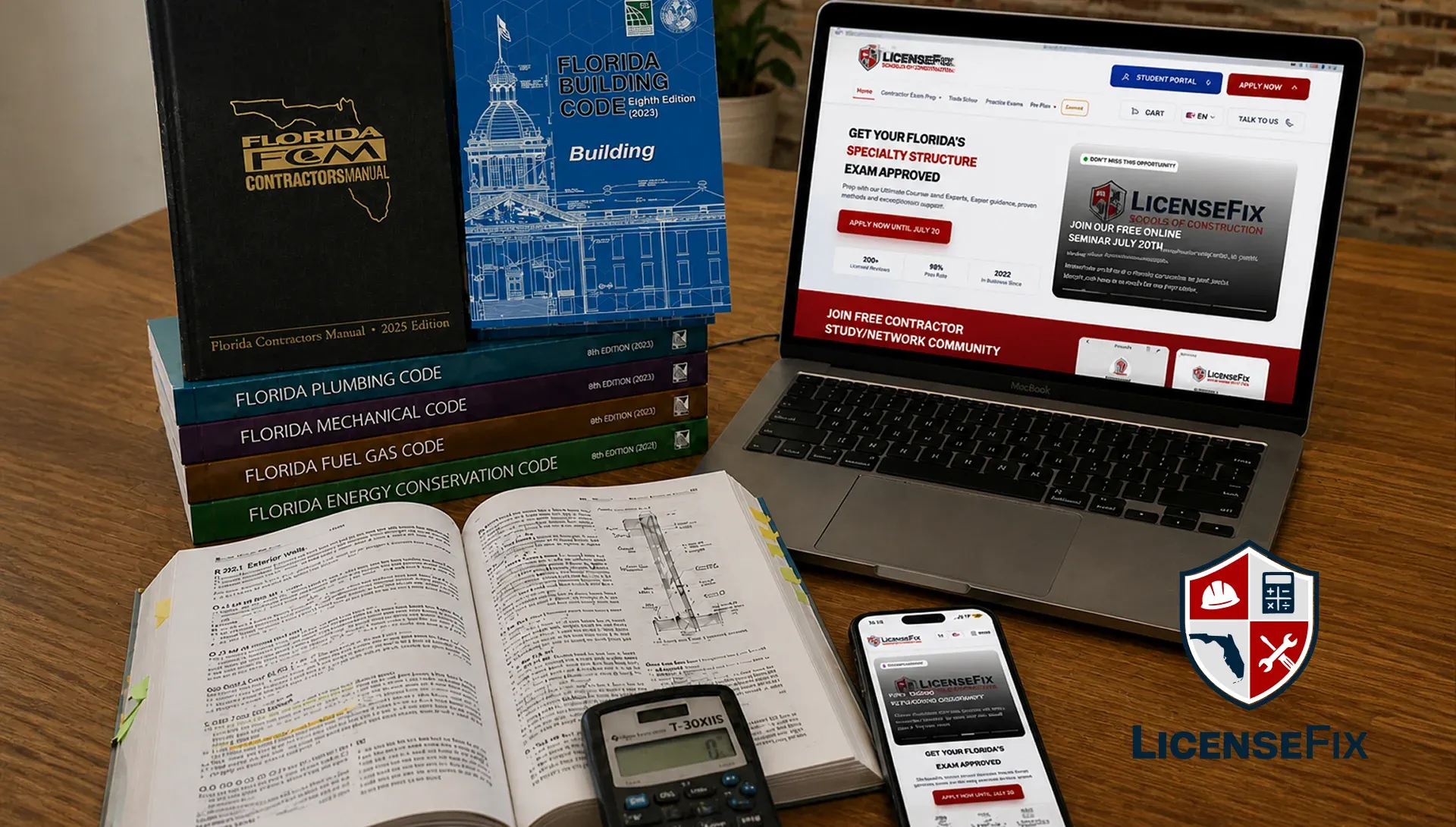
Because both exams are open book, candidates often assume the test will be easy. It is not. The reference books allowed in the exam room are hundreds of pages long, and if you do not know exactly where to find an answer, you will burn through your time limit before finishing the exam. This is where structured tabbing and highlighting make the real difference between candidates who pass and candidates who run out of time.
License Fix built its HVAC and mechanical courses around this exact problem. Every book is tabbed and indexed in advance, video lessons walk through each chapter in the order it appears on the exam blueprint, and practice questions are refreshed quarterly by Gold Alumni who recently passed the same Florida HVAC contractor exam. One of our Gold Alumni, the founder of a mechanical contracting company built through the program, used this exact system to get licensed and start his HVAC business in Florida.
For a closer look at how the Business and Finance exam is structured across every trade, see our guide on the Florida Contractor Exam: Business and Finance. If you are still deciding between license categories, our breakdown of CGC, CBC, or CRC: Which License Fits You explains how specialty trades like HVAC compare to general contracting paths.
Frequently Asked Questions
How long does it take to get a Florida HVAC contractor license?
Most candidates spend several weeks to a few months preparing for the exams once their DBPR application is approved. The application review itself can take additional time, so most technicians start studying for the Florida HVAC contractor exam while their paperwork is still under review.
Is the Florida HVAC contractor exam open book?
Yes. Both the Business and Finance exam and the trade knowledge exam allow approved reference books at the testing center. Open book does not mean easy, since you still have to locate the correct answer within a strict time limit.
What is the difference between a Class A, Class B, and Mechanical Contractor license in Florida?
Class A and Class B air conditioning licenses cover HVAC installation, service, and repair within specific scope limits. A Certified Mechanical Contractor license covers a broader range of systems, including refrigeration and process piping, beyond standard air conditioning work.
Can I work statewide with a certified HVAC license?
Yes. A certified license issued by the DBPR allows you to work anywhere in Florida without additional local registration, unlike a registered license, which limits you to the jurisdiction that issued it.
Do I need a Florida HVAC contractor license to work as a subcontractor?
In most cases, yes. If you are contracting the work directly, even as a subcontractor to a general contractor, you generally need your own Florida HVAC contractor license or mechanical license to perform and be paid for that scope of work legally.
Get Your Florida HVAC Contractor License with License Fix
Getting a Florida HVAC contractor license is not something you want to leave to chance. Between the documentation the DBPR expects and the density of the trade knowledge exam, most candidates who try to study alone end up retaking a section they could have passed the first time. License Fix has helped more than 209 Florida contractors pass their state exams with a 91 percent pass rate, and our Mechanical and Air Conditioning courses are built specifically around the current DBPR exam blueprint.
Call License Fix School at (321) 333-2825 or visit our Mechanical Contractor course page to start studying for your Florida HVAC contractor license the right way.

About Adrian Coastal Roofing
Adrian is the CEO of Coastal Roofing, a company specializing in roof installation in Florida, recognized for its quality, reliability, and excellence in residential and commercial projects. With years of experience in the construction industry and Florida roofing, Adrian has built his reputation by delivering durable solutions that withstand the state’s extreme weather. Under his leadership, Coastal Roofing has become a leader in roof installation in Florida, offering modern systems such as TPO, PVC, metal roofing, and other efficient solutions to reduce costs and extend the lifespan of roofs.