License Fix: Florida Contractor License Types Explained
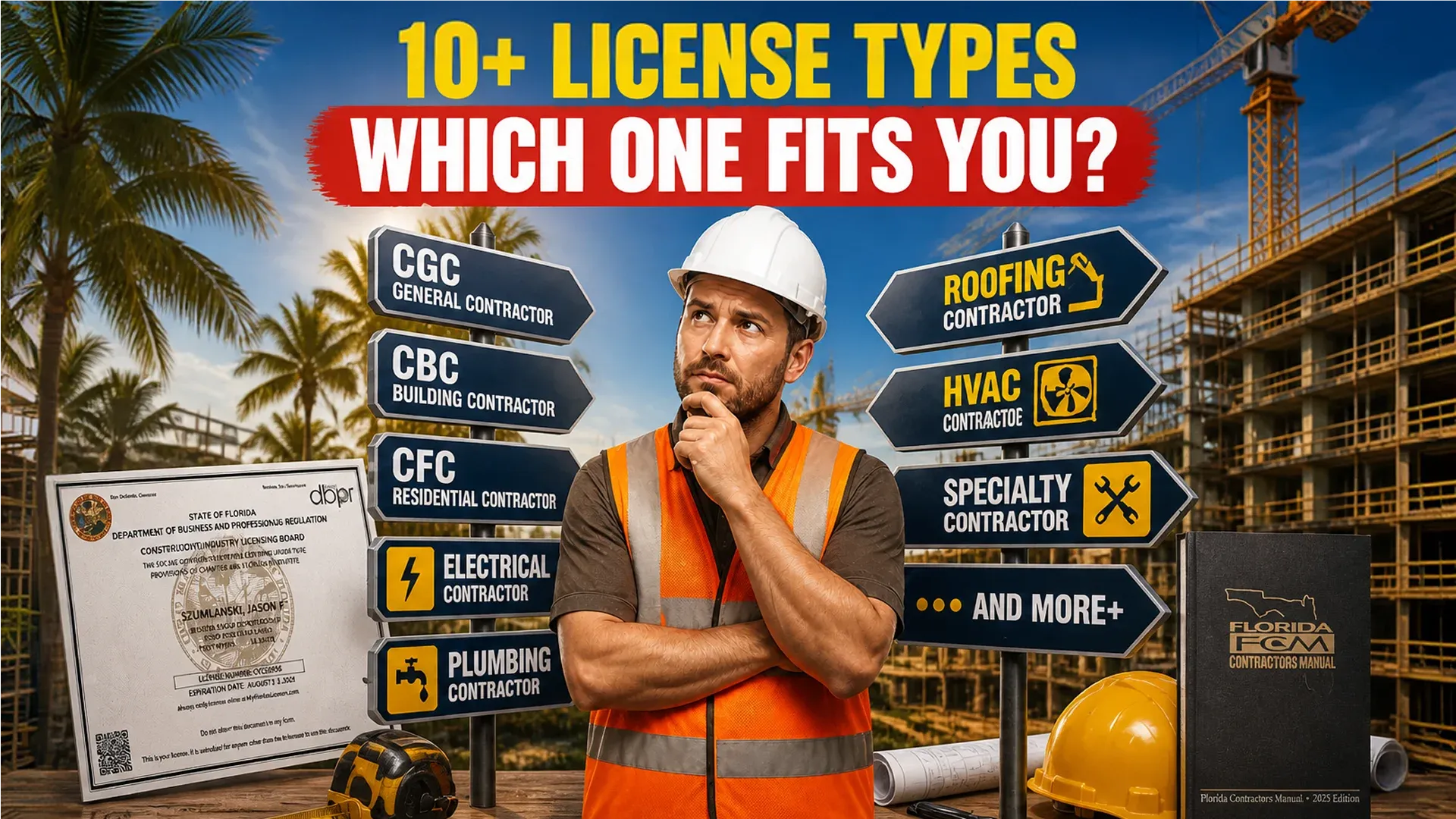
Not just CGC, CBC or CRC. Florida has 10+ contractor license types. Learn which one fits your trade with LicenseFix School!

If you've been working in construction in Florida and finally decided it's time to get licensed, there's something most courses won't tell you upfront: Florida has far more license types than just the CGC, the CBC and the CRC.
The License Fix you're looking for might not involve any of those. Depending on your trade, roofing, HVAC, electrical, plumbing, sheet metal, or mechanical, Florida has a specific license built exactly for what you do. And getting the wrong one wastes time, money, and energy.
In this guide, you'll learn about every major contractor license type regulated by the state, what each one covers, and how to figure out which path is right for you. By the end, you'll know exactly where your License Fix journey begins.
The Full Map of the Florida Contractor License
Before going into each trade, it helps to understand how the system is organized. A Florida contractor license is issued by the Department of Business and Professional Regulation (DBPR) and comes in two forms:
- Certified: Valid statewide, you can work anywhere in Florida.
- Registered: Valid only in the specific county or municipality where it was issued.
For most contractors, certified is the smarter long-term move. Florida's licensing system is managed by two main boards:
- CILB (Construction Industry Licensing Board), divided into:
- Division I: General Contractor (GC), Building Contractor (BC), Residential Contractor (RC)
- Division II: Specialty trades: roofing, HVAC, plumbing, mechanical, sheet metal, and more
- ECLB (Electrical Contractors' Licensing Board): Electrical and alarm system contractors
Knowing which board controls your trade is the first real step in your Florida contractor license journey. Let's go through each one.
Certified Roofing Contractor: One of Florida's Most In-Demand Licenses
Florida's weather makes the certified roofing contractor one of the busiest, and most profitable, licenses in the state. Hurricanes, heavy rain, and extreme UV exposure mean constant demand for qualified roofers throughout the year.
The certified roofing contractor license is issued by CILB Division II and covers:
- Installation, repair, and replacement of built-up roofs
- Shingles, shakes, tile roofing, and modified roofing systems
- Single-ply systems and architectural metal roofs
- Maintenance and inspection of existing roof systems
To become a certified roofing contractor, you need to pass two exams: one on business and financial management, and one focused on roofing trade knowledge. You'll also need to show verifiable experience and carry at minimum $100,000 in public liability insurance and $25,000 in property damage coverage.
After major storms, certified roofing contractors are among the first professionals called in, making this one of the most financially rewarding License Fix paths available in Florida.
HVAC Contractor License Florida: Three Levels, One Big Market
The HVAC contractor license Florida, officially called the Air Conditioning Contractor license, comes in three tiers, depending on the scope of work you want to perform:
- Class A: Covers installation, service, and repair of any HVAC or refrigeration system, regardless of size. This is the unrestricted license.
- Class B: Covers commercial and residential systems up to 25 tons of cooling capacity.
- Class C: Covers residential HVAC systems only, also up to 25 tons.
The higher the class, the broader your authorized work and the more competitive your business becomes. In Florida, air conditioning is not optional, which means the demand for a qualified HVAC contractor license Florida holder never slows down.
To obtain an HVAC contractor license Florida, you need to pass both the business management exam and the trade-specific exam, show proof of industry experience, and maintain the required insurance coverage. Contractors who already hold a Class C or B license can also upgrade to higher classifications with additional proven experience.
Florida Electrical Contractor License: A Separate Board, A Separate Path
The Florida electrical contractor license is not issued by the CILB. It falls under the ECLB, which operates independently. This matters because the application process, exam structure, and requirements are different.
Under the ECLB, there are several license types:
- Unlimited Electrical Contractor: Can perform any electrical installation of any size, anywhere in Florida.
- Residential Electrical Contractor: Limited to 1-4 family homes, up to 2 stories, with single-phase service up to 400 amps.
- Specialty Electrical Contractors, including: Lighting Maintenance, Sign Electrical, Limited Energy Systems.
- Alarm System Contractor: Covers installation and service of burglary, fire, robbery, and medical emergency alarm systems.
The Florida electrical contractor license at the unlimited level is one of the most versatile, and most tested, in the state. If your work involves any electrical wiring, panels, conduit, or alarm systems, you'll need to go through the ECLB and not the CILB.
Florida Plumbing Contractor License: More Responsibility Than Most Think
The Florida plumbing contractor license authorizes you to contract for plumbing work statewide, from residential water lines and drain systems to commercial gas piping and sewer connections.
What many applicants don't know is that holding a Florida plumbing contractor license also makes you legally responsible for your entire team's compliance. If any employees work on medical gas systems, for example, they are required to hold specific certifications and you, as the licensed contractor, are accountable for ensuring they do.
To obtain the Florida plumbing contractor license, you need to:
- Pass the business management and trade exams
- Demonstrate financial responsibility
- Carry at least $100,000 in public liability and $25,000 in property damage insurance
Like all Division II licenses, it can be certified (statewide) or registered (local). For contractors who want to grow beyond a single county, the certified Florida plumbing contractor license is the right path.
Florida Mechanical License: Beyond HVAC, Into Full Building Systems
The Florida mechanical license, officially the Mechanical Contractor license, covers a broader scope than HVAC alone. While HVAC focuses on air conditioning and refrigeration systems, the Florida mechanical license also includes:
- Piping systems and fuel distribution
- Heating and ventilation systems beyond residential scale
- Complex building mechanical infrastructure
- Industrial and commercial mechanical systems
This makes the Florida mechanical license especially valuable for contractors working on large commercial or industrial projects. Many professionals in the HVAC space use the mechanical license as a natural upgrade, expanding their authorized scope of work to take on bigger, higher-value contracts.
The exam for the Florida mechanical license includes both business management and trade-specific sections. As with all CILB Division II licenses, experience requirements and minimum insurance coverage also apply.
Sheet Metal Contractor License Florida: The Backbone of HVAC Projects
The sheet metal contractor license Florida is issued by CILB Division II and authorizes work on:
- Fabrication and installation of metal duct systems
- HVAC-related sheet metal components
- Architectural sheet metal for construction
- Custom metal fabrication for building applications
In practice, the sheet metal contractor license Florida frequently works alongside HVAC licenses, since ductwork is at the core of nearly every air conditioning installation. Contractors who already operate in HVAC often add the sheet metal contractor license Florida to their credentials to expand their capabilities and avoid subcontracting that portion of the work.
The exam covers both business management fundamentals and trade-specific sheet metal knowledge. Insurance minimums are the same as other Division II licenses: $100,000 in public liability and $25,000 in property damage.
Other Specialty Licenses You Should Know About
CILB Division II also regulates a few other categories that see steady demand across Florida:
- Pool/Spa Contractor: Commercial and residential pool construction, installation, and servicing
- Underground Utility and Excavation Contractor: Sewer lines, water mains, storm drainage, and utility work
- Solar Contractor: Solar panel installation and residential solar energy systems
- Pollutant Storage System Contractor: Fuel tanks, underground storage systems, and environmental containment
Each of these comes with its own exam, experience requirements, and scope of practice. If any of these trades describe your work, the License Fix process starts with identifying which exam is the right one for you.
Frequently Asked Questions
What is the difference between a certified and a registered contractor in Florida?
A certified contractor can legally work anywhere in Florida. A registered contractor can only work in the specific county or municipality where the license was issued. For most contractors who want to grow their business and take jobs statewide, certified is the right License Fix. It gives you freedom to operate across the entire state without geographic restrictions.
Can I hold more than one contractor license in Florida?
Yes. Florida allows contractors to hold multiple license types simultaneously. For example, you can hold both a Plumbing Contractor license and a Mechanical Contractor license at the same time. Each license requires its own application, exams, and qualifications, but there's no rule preventing you from obtaining more than one.
How do I start the process to get my Florida contractor license?
The first step is identifying which license category matches your actual trade. From there, you apply through the DBPR, meet the eligibility requirements, which include verifiable work experience, a background check, proof of financial responsibility, and passing the required exams. License Fix guides you through every step of the license fix process, from figuring out which license is right for you to preparing for and passing your exam.
Your License Fix Begins With the Right License
Most contractors walk into the licensing process thinking only about the GC, BC, or RC. But Florida's construction industry is broader than that and so are the opportunities.
Whether your trade is roofing, HVAC, electrical, plumbing, mechanical, or sheet metal, there's a specific Florida contractor license that matches what you do. Getting licensed in the right category is the smartest License Fix you can make for your career. Now you know every major path available. The next step is yours.
Ready to figure out which license fits your situation? Talk to the License Fix team. We help you find the right path and get through the process without wasting time or money.

About Adrian, Gold Alumni
Adrian is the CEO of Coastal Roofing, a company specializing in roof installation in Florida, recognized for its quality, reliability, and excellence in residential and commercial projects. With years of experience in the construction industry and Florida roofing, Adrian has built his reputation by delivering durable solutions that withstand the state’s extreme weather. Under his leadership, Coastal Roofing has become a leader in roof installation in Florida, offering modern systems such as TPO, PVC, metal roofing, and other efficient solutions to reduce costs and extend the lifespan of roofs.
More from Adrian, Gold Alumni