
Florida CRC Exam: What the Test Covers
If you are studying for the Florida residential contractor exam, you already know the CRC license lets you bui...
Adrian, Gold AlumniSeptember 18, 20268 min read
Topic
The certified residential contractor (CRC) license covers one-family, two-family and three-family residences. Learn the height limit in the statute, how the three CRC exams are weighted and how to prepare for them.

A Florida residential contractor practice test is the best way for Division I builders to experience how the state separates Contract Admini...
If you are studying for the Florida residential contractor exam, you already know the CRC license lets you bui...

If you build homes, remodel kitchens, or frame additions for a living, you already have the hands-on skills. W...

If you have spent time researching Florida contractor licenses, you have likely run into an alphabet soup of a...
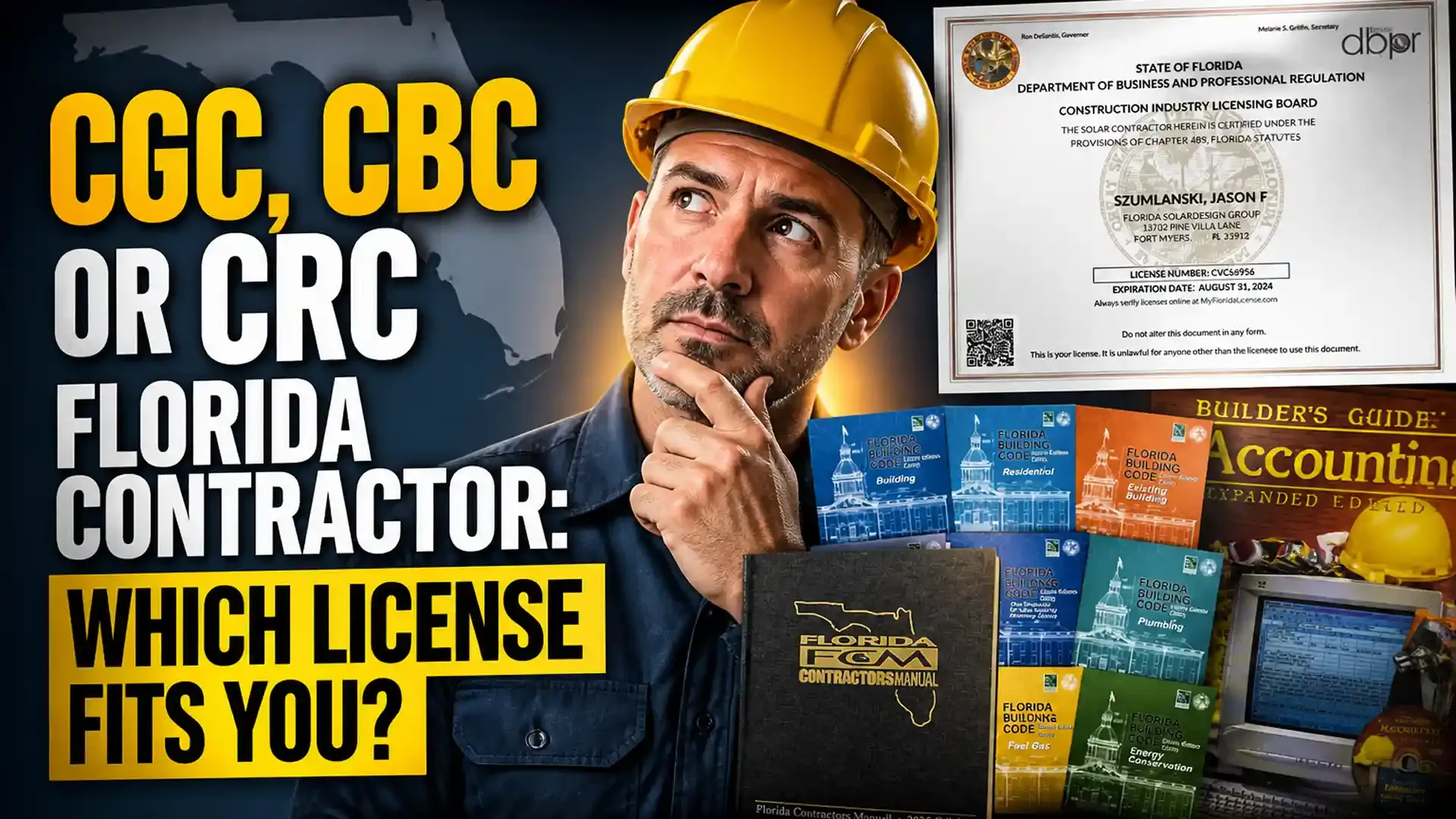
Choosing between CGC, CBC, CRC Florida contractor licenses is one of the first decisions anyone entering the c...
The certified residential contractor license, known as the CRC, is built around houses: one-family, two-family and three-family residences of limited height. These guides are for builders and remodelers who work on homes and want to know what the license covers, what its three exams ask and how to prepare.
The statute limits the license to construction, remodeling, repair or improvement of one-family, two-family or three-family residences not exceeding two habitable stories above no more than one uninhabitable story, with accessory use structures. What a CRC license covers and how it compares to CBC and CGC explains the limits in plain terms, and a comparison of the three Division I licenses by project type helps if your projects sit near the line.
Residential candidates pass three tests: Business and Finance with 120 questions in 6.5 hours, and Residential Contract Administration and Residential Project Management with 45 questions each in 4.5 hours. Contract Administration is 40% project contracts and 29% preconstruction activities. Project Management is 64% construction methods, materials, tools and equipment, with safety and reading plans and specifications at 18% each. The CRC exam content, scope and reciprocity notes map the test, and the residential study plan with a schedule and book list turns it into a calendar.
After the exams, the application asks for experience in three or more of five areas named in the experience rule: foundations, slabs and structural formwork; masonry walls; structural demolition; structural wood framing; and column erection. Insurance minimums are $100,000 public liability and $25,000 property damage, lower than for general and building contractors.
An active certified residential contractor can later move to a building license with three years of proven experience in the classification, or to a general license with four. Florida's reciprocity list, which covers Louisiana, Mississippi and North Carolina, includes residential licenses. License Fix has a residential contractor exam course, and in-person Business and Finance classes can be added to the online course.
The statute limits the license to residences not exceeding two habitable stories above no more than one uninhabitable story. The buildings themselves must be one-family, two-family or three-family residences, together with accessory use structures connected to them. Larger residential buildings fall under the building or general contractor licenses.
The Business and Finance exam runs 6.5 hours and has 120 scored questions. Residential Contract Administration and Residential Project Management each have 45 scored questions in 4.5 hours. With the pass mark at 70% and no rounding, that works out to 84 correct answers on Business and Finance and 32 on each of the other two.
Possibly, after a failed written attempt. The statute lets an eligible applicant who fails a written examination, other than the general and building contractors' examination, and who shows acceptable proof of lack of comprehension of written examinations, petition the board for a uniform oral examination. Conditions apply, including ten years of experience and written recommendations.
The board rule sets the minimums for a residential contractor at $100,000 in public liability and $25,000 in property damage coverage. The applicant attests to the coverage by signed affidavit, along with workers' compensation coverage or an exemption to be obtained within 30 days after the license is issued.