
Florida Roofing License Practice Test: Free Quiz & Answers
Test your knowledge with 7 Florida roofing license practice test questions and answers. See DBPR weights and sign up free at License Fix.

A Florida roofing license practice test is the fastest way to see how the state exams measure code lookups and field rules under a five hour clock. Candidates seeking a Certified Roofing Contractor (CCC) license must pass both the Business and Finance exam and the 80 question Roofing Trade Knowledge exam at Pearson VUE with at least 70 percent. Every figure below was checked against Florida Statutes Section 489.105 and Rule 61G4-16.001, Florida Administrative Code in October 2026. The seven original practice questions below mirror the official blueprint so you can test your speed and are study practice only, not copied from the confidential state exam.
What Does the Florida Roofing License Exam Cover?
The Florida roofing license exam is an open book, computer based test consisting of 80 equally weighted questions with a five hour time limit, requiring 56 correct answers (70 percent) to pass. Under Rule 61G4-16.001, the Construction Industry Licensing Board divides the exam across nine subject areas:
- Built up roofs: 15 percent (about 12 questions)
- Shingles and shakes: 15 percent (about 12 questions)
- Single ply systems: 15 percent (about 12 questions)
- Modified roofing systems: 15 percent (about 12 questions)
- Architectural metal roofs: 10 percent (about 8 questions)
- Concrete and tile roofs: 10 percent (about 8 questions)
- Equipment and safety: 10 percent (about 8 questions)
- Membrane waterproofing: 5 percent (about 4 questions)
- Drains and gutters: 5 percent (about 4 questions)
For a full breakdown of the books and study schedule, review our Florida roofing license exam guide and allowed roofing book list.
How Should You Use a Roofing Contractor Practice Test Florida Candidates Trust?
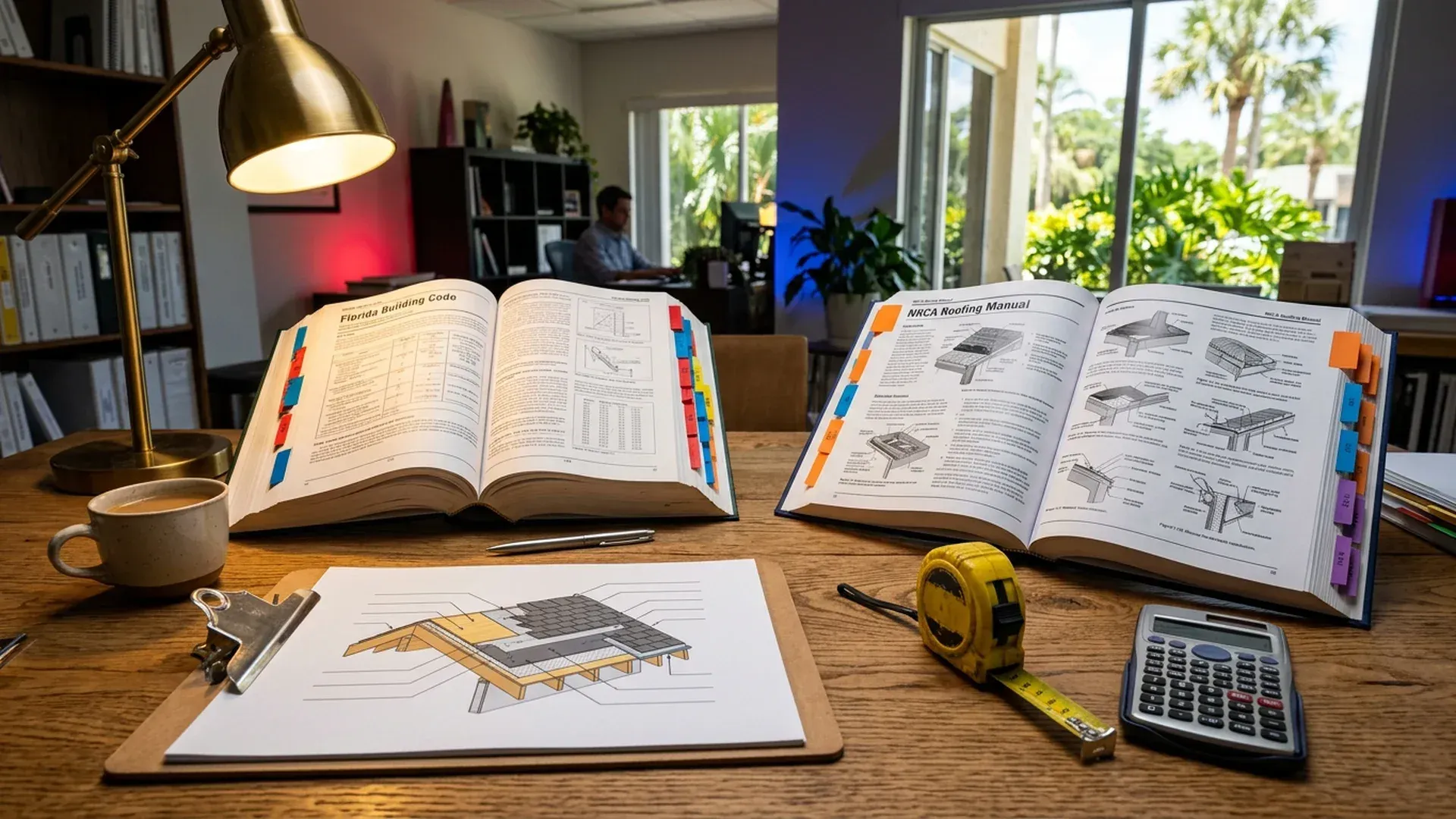
A roofing contractor practice test Florida applicants use effectively should train book navigation rather than memory alone, because every question on exam day is tied to an approved reference manual. With 80 questions in 300 minutes, you have 3.75 minutes per question to identify the keyword, open the right volume, and verify the answer.
- Time yourself at three minutes per question so you build a 60 minute review buffer for calculations and multi step code lookups.
- Write down which reference book each question comes from: the NRCA Roofing Manual volumes, the 2023 Florida Building Code (Building or High Velocity Hurricane Zone chapters), SMACNA, or OSHA 29 CFR 1926.
- Flag any topic where you take longer than four minutes to locate the index entry, then check your tab placement.
- Never rely on jobsite habit when a question asks for minimum fastener spacing, slope limits, or OSHA guardrail heights.
Florida Roofing Contractor Practice Exam: Questions 1 and 2 (Scope & Shingles)
This first set of Florida roofing contractor practice exam questions tests statutory scope under Chapter 489 and shingle slope limits.
- Question 1 (Scope of Work): Under Florida Statutes Section 489.105(3)(e), which task may a Certified Roofing Contractor legally perform during a roof replacement? A) Relocate branch circuit wiring. B) Evaluate and enhance roof to wall connections on a structure with wood roof decking. C) Replace load bearing masonry bond beams. D) Install water heater piping.
- Answer 1: B. Section 489.105(3)(e) includes evaluating and enhancing roof to wall connections on wood roof decking during a roof replacement or repair, plus skylights and wood sheathing repairs.
- Question 2 (Shingle Slope): Under FBC Building Chapter 15, what is the minimum roof slope permitted for asphalt strip shingles with double underlayment? A) 1:12. B) 2:12. C) 4:12. D) 5:12.
- Answer 2: B. Asphalt shingles are permitted on slopes of 2:12 or greater with double underlayment per FBC Section 1507.2.2.
Roofing Trade Knowledge Practice Questions: Questions 3 and 4 (Membranes & Tile)
These roofing trade knowledge practice questions test low slope membrane drainage rules and tile attachment specs (55 percent of the exam).
- Question 3 (Single Ply and Modified Bitumen): In low slope roofing design per the NRCA Manual, what is the purpose of installing tapered insulation crickets and saddles between drains? A) Increase R value over columns. B) Provide positive drainage and prevent ponding water around penetrations and between drains. C) Eliminate parapet flashing. D) Replace perimeter fasteners.
- Answer 3: B. Tapered insulation, crickets, and saddles direct water toward drains and prevent ponding water.
- Question 4 (Concrete and Clay Tile): Which manual on the Florida reference list governs high wind mortar and adhesive paddy attachment for roof tiles? A) OSHA 1926. B) FBC Chapter 15 and the FRSA/TRI High Wind Concrete and Clay Roof Tile Manual. C) SMACNA Manual. D) AIA A201.
- Answer 4: B. Tile uplift and attachment tables are tested from FBC Chapter 15 and the FRSA/TRI manual.
Florida Roofing License Practice Test: Questions 5 and 6 (Safety & Area Math)
This Florida roofing license practice test section covers OSHA fall protection rules (10 percent of the exam) and roof takeoff math.
- Question 5 (OSHA Fall Protection): Under OSHA 29 CFR 1926.501(b)(10), workers on low slope roofs with unprotected sides must be protected from falling at what height or more above lower levels? A) 4 feet. B) 6 feet. C) 10 feet. D) 15 feet.
- Answer 5: B. Fall protection in roofing work under 29 CFR 1926.501(b)(10) triggers at 6 feet or more above lower levels, using guardrails, safety nets, personal fall arrest, or a warning line and monitor.
- Question 6 (Roof Area Math): A rectangular roof measures 60 feet by 30 feet horizontally with a 5:12 slope (factor 1.083). Including 10 percent waste, how many squares must you order? A) 18.0. B) 19.5. C) 21.5. D) 24.0.
- Answer 6: C. Area is 1,800 square feet times 1.083 equals 1,949.4 square feet, times 1.10 waste equals 2,144.3 square feet (21.5 squares).
Question 7 and How to Score Your Roofing Practice Run
Drains, gutters, and membrane waterproofing account for the final 10 percent of the exam, testing metal gauge and expansion joint lookups.
- Question 7 (Gutter Sizing): Which approved reference manual on the Florida roofing exam list governs expansion joint spacing, metal gauge selection, and downspout sizing for rectangular architectural metal gutters? A) SMACNA Architectural Sheet Metal Manual. B) NRCA Steep Slope Manual. C) Builders Guide to Accounting. D) Florida Statutes Chapter 713.
- Answer 7: A. Metal gutter, flashing, and downspout sizing tables come from the SMACNA Architectural Sheet Metal Manual.
- Scoring Your Run: Passing the real 80 question exam requires 70 percent (56 correct answers), so aiming for at least 5 out of 7 (71 percent) on this quiz is a good baseline. If you missed any question or took more than 3.5 minutes to verify the code section, focus your study hours on tabbing that manual before test day.
Frequently Asked Questions (FAQ)
How many questions are on the Florida roofing license exam?
The Florida Roofing Trade Knowledge exam has 80 equally weighted multiple choice questions with a five hour time limit at Pearson VUE. You need a score of at least 70 percent (56 correct answers) to pass. Candidates must also pass the 120 question Business and Finance exam unless already exempt.
Is the Florida roofing contractor exam open book?
Yes, both the Roofing Trade Knowledge exam and the Business and Finance exam are open book tests. However, you may only bring the specific editions listed on the official DBPR reference list, with permanent chapter tabs and no handwritten notes. Review our open book exam rules guide before test day.
Can a Florida General Contractor perform roofing work without a roofing license?
Generally no. Under Florida Statutes Section 489.113(3), a general, building, or residential contractor must subcontract roofing work to a licensed roofing contractor, with a narrow exception allowing them to install wood or asphalt shingles on a new building of their own construction.
Where can I take a free Florida roofing practice test online?
You can practice with the seven worked questions on this page and then register for a free student account on our Free Course page. Your free registration unlocks the License Fix Student Portal, foundational Business and Finance lessons, and sample practice questions with no credit card required.
Start Your Free Florida Roofing License Course Today
Working through a Florida roofing license practice test is a strong first checkpoint, but passing both the 80 question Roofing Trade Knowledge exam and the 120 question Business and Finance exam on your first try takes structured repetition. At License Fix School, you can create your free student account right now at our Free Intro to Business and Finance Course page with no credit card required. Inside your free account, you get immediate access to the License Fix Student Portal on your phone or computer, video exam preparation guidance, and additional free contractor practice test questions. When you are ready for full trade preparation, enroll in our self paced Florida Roofing Trade Exam Preparation Course to drill timed exam simulators and learn exact book tabbing strategies.

About Pascual, Contractor Licensing Instructor
Contractor Licensing Instructor
Pascual is a Florida contractor licensing exam prep specialist, with a focus on the Business & Finance and General Contractor exams. He has helped numerous candidates prepare for and pass their state exams, combining technical knowledge of Florida's regulations with practical study strategies. His approach is straightforward and grounded in real experience with the exam format, helping future contractors understand not just the content, but also how to avoid the most common mistakes that trip up candidates.
More from Pascual, Contractor Licensing Instructor